

Enhancing PU coating performance with advanced Capa® polyol technology
Last update on Apr 23, 2026
An interview with Shaun Birss, Global Technical Applications Manager - Coatings, Ingevity
Ingevity’s Capa® polycaprolactone polyols add significant value to the end properties of one-component (1K) stoving enamels and two-component (2K) waterborne and solvent-borne polyurethane coatings. This makes them long-lasting and more sustainable.
From coating wind turbines to protecting electronic equipment, Ingevity’s Capa® polyols provide processing and performance advantages including:
- Low viscosity, easy application, reduced VOCs
- Behaves like a reactive coalescing agent, improving the film formation of waterborne coatings
- Impressive weather, abrasion, chemical resistance
- Ultimate combination of flexibility and toughness
- Excellent finish and appearance with high gloss, low haze
We recently interviewed Shaun Birss, Global Technical Applications Manager - Coatings, Ingevity. He shares how Capa® polyols stand out for being label-free and supporting high-solids, low-VOC formulations while delivering tougher, more durable coatings.
#1. What are some of the new developments in Capa® polyol technology?
Ingevity continues to evolve its Capa® polyol platform with innovations that directly address modern coating challenges such as durability, VOC reduction, and substrate versatility.
Recent developments include PROTX diols designed for polyurethane dispersions (PUDs), offering improved stain resistance and faster hardness development while maintaining flexibility. These materials also provide lower viscosity, enabling easier processing and reduced solvent demand.
Additionally, label-free PROTX triols are enabling formulators to develop high-solids, low-VOC systems without adding regulatory complexity. Hydrolysis-stable Capa® HS grades further enhance coating durability under humid and wet conditions, extending service life.
Another key innovation lies in advanced adhesion-enhancing architectures, which improve direct-to-metal (DTM) and direct-to-plastic performance by optimizing wetting and film mechanics that help coatings tolerate substrate variability and reduce surface preparation.
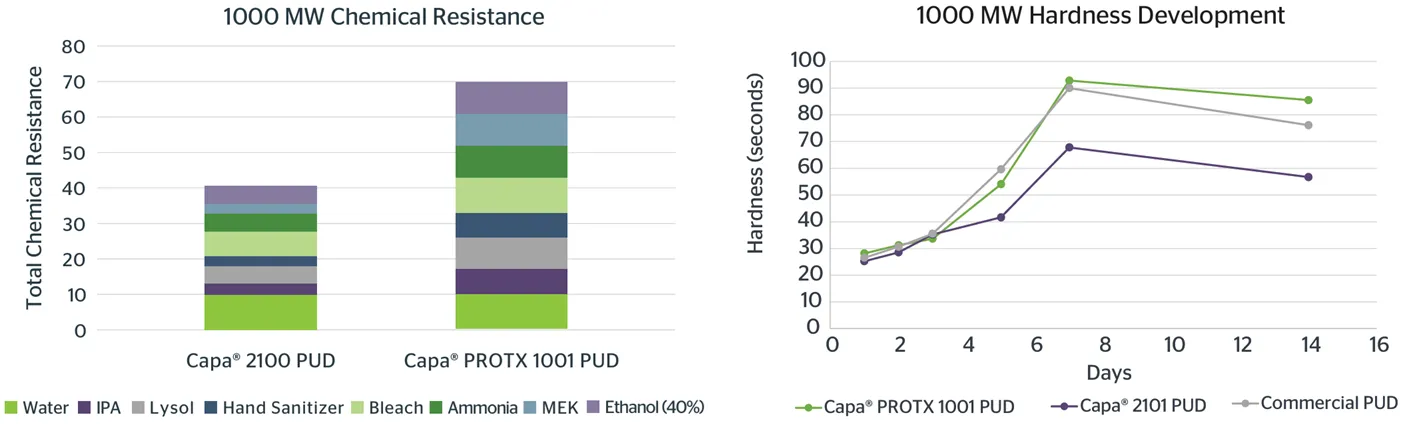
Graph 1(a) and 1(b) Capa® PROTX improves stain resistance and hardness in PUDs
Capa® PROTX polyols demonstrate enhanced chemical resistance across multiple aggressive agents, along with faster hardness development over time compared to conventional PUD systems. This combination enables improved durability, stain resistance, and faster return-to-service in waterborne polyurethane coatings.
#2. What are the advantages of Capa® PROTX triols over conventional grades?
Capa® PROTX triols provide a strong combination of formulation simplicity and enhanced performance. Being label-free, they integrate easily into existing PU systems while supporting higher solids and lower VOC formulations.
These enable the formation of tougher films with improved abrasion, scratch, and impact resistance, which helps coatings retain gloss and aesthetics over time. At the same time, these systems demonstrate faster hard-dry times while maintaining a practical pot life that supports improved application efficiency and production throughput.
From a sustainability perspective, PROTX grades can incorporate bio-based carbon content, allowing formulators to meet evolving environmental requirements without compromising coating performance.
#3. Can you explain how Capa® polyols can improve adhesion to challenging substrates?
Capa® polyols inherently support adhesion through improved interfacial wetting and controlled flexibility during film formation. This balance allows coatings to maintain strong contact with substrates while accommodating mechanical stress.
Advanced developmental grades further expand adhesion performance, particularly on low-energy substrates such as plastics. These materials improve crosshatch adhesion results and reduce reliance on costly adhesion promoters or aggressive pre-treatment processes.
Improved adhesion also contributes to better corrosion resistance. By maintaining strong interfacial bonding and cohesive film integrity, Capa®-based coatings help reduce under-film creep and extend protective performance.
#4. How is Ingevity adjusting to recent market trends?
Ingevity is actively aligning its Capa® technology platform with key industry trends such as sustainability, durability, and regulatory compliance.
To support lower VOC requirements, Capa® PROTX polyols enable high-solids formulations with reduced solvent demand. Their low viscosity also facilitates easier processing, particularly in waterborne systems. Durability remains a critical focus area. Capa®-modified coatings exhibit strong abrasion, impact, and scratch resistance, ensuring longer service life and sustained aesthetic performance.
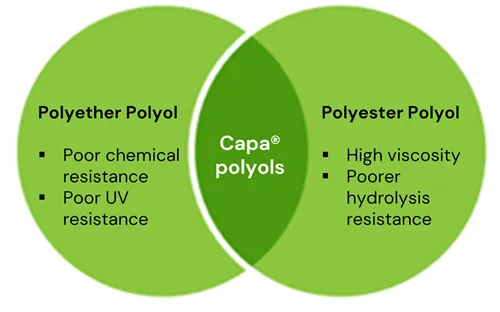
Hydrolytic stability is another important advancement. Compared to conventional polyester polyols, Capa® materials maintain performance in humid and wet environments, making them suitable for demanding applications such as protective and automotive coatings. In addition, sustainability is being addressed through bio-based content, ISCC+ pathways, and technologies that extend coating lifespan, reducing overall environmental impact.
#5. What differentiates Capa® polyols from other polycaprolactone polymers?
Capa® polyols stands out due to its focused expertise and long-standing leadership in caprolactone chemistry. Backed by decades of manufacturing experience and application knowledge, it offers consistency and reliability that formulators can depend on.
The chemistry itself is highly formulation friendly. Primary hydroxyl functionality, clean polymer backbones, and controlled molecular architecture result in predictable curing behavior, stable pot life, and consistent film properties.
Capa® polyols provide exceptional versatility. Its tunable structure allows formulators to optimize properties such as adhesion, flexibility, hardness, chemical resistance, hydrolysis stability, and VOC performance without requiring complete reformulation.
This adaptability makes Capa® a powerful toolbox for designing coatings across diverse applications, from automotive and protective systems to industrial and specialty coatings.
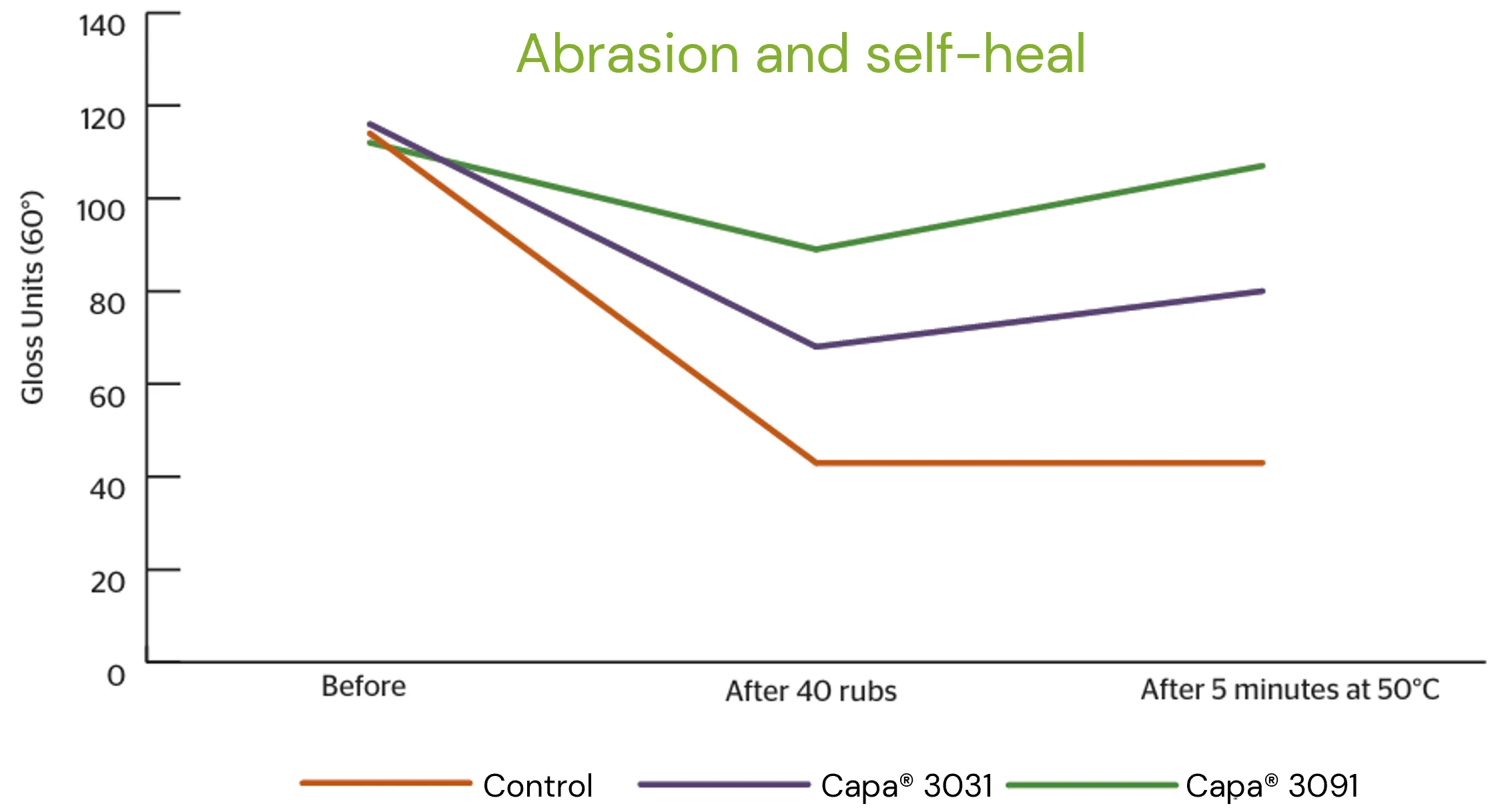
Graph 2: Comparison of 60° gloss before abrasion, after mechanical damage, and after heating, highlighting the self-healing capability of Capa® polyols
The graph highlights the self-healing capability of Capa® polyols, where coatings recover a significant portion of their gloss after thermal exposure following mechanical damage. This behavior indicates improved resistance to surface defects and enhanced long-term appearance retention.
Microscopic images illustrate the surface condition of coatings before and after thermal recovery. Compared to conventional systems, Capa®-modified coatings show a visible reduction in scratch severity, confirming the self-healing mechanism at the microstructural level.
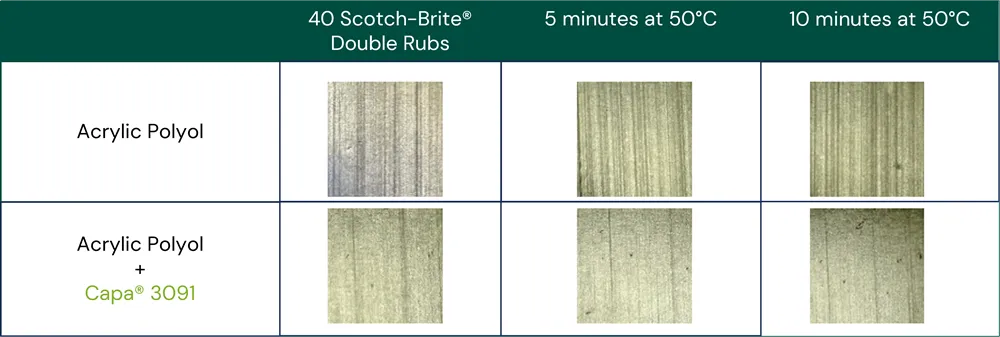
Microscopic visualization of self-healing behavior
Repeated abrasion and thermal recovery cycles demonstrate consistent gloss restoration, confirming the repeatability and durability of the self-healing effect in Capa® 3091-based coatings. This ensures sustained performance even under multiple wear events.

Graph 3: Repeatable self-healing performance of Capa® 3091 in PU coatings
Final words
With advancements in caprolactone chemistry, Capa® polyols provide a versatile platform to optimize durability, adhesion, and VOC performance, supporting the development of high-performance PU coatings across demanding applications.

Shaun Birss is Global Technical Applications Manager for Coatings at Ingevity. Over the past two years, he has advanced polyurethane and coating technologies, drawing on more than a decade of experience in formulation development, production scale up, and application engineering. He previously served as Technical Manager at IMCD South Africa and has held technical R&D and commercial roles with coatings manufacturers, spanning sales support, and the in‑field implementation of finished coating systems across diverse applications.
Shaun holds a BSc in Biochemistry and Chemistry, and a Postgraduate Diploma in Management Practice. He is a certified NACE Coatings Inspector and an ISO 17025 Internal Auditor, underscoring his commitment to technical rigor and quality compliance. His work covers flooring, automotive OEM and refinish, general industrial, and corrosion‑protection markets, with a strong focus on polyurethane chemistry, surface preparation, and sustainable, next‑generation materials. |
DISCLAIMER: All images, tables, and graphs used in this article are copyright of Ingevity.