

Essential Equipment for Inkjet Ink Manufacturing
Last update on Dec 14, 2017
Are you new to inkjet ink manufacturing and want to explore more on some of the essential / must-have pieces of equipment?
We are here to help you… Introduce yourself with a detailed knowledge on the equipment needs for solvent-borne and waterborne inks manufacturing.
Let's begin by understanding the structure of an ink formulation:
Structure of an Ink Formulation
We know that an ink formulation consists of:
- Colorant ( a dye or a pigment)
- Resin component
- Some additives, and
- Liquid component
There are essentially two ways used to combine all of these ingredients:
- We can utilize pre-dispersed pigment preparations (in solid or liquid form) and resin solutions and simply combine these with the liquid components - additives, water or solvent to make a finished ink.
- The second way is to start from scratch - grinding your own pigments, dissolving resin into a liquid carrier and then successfully combining all of these ingredients. And it is for this method that we're going to discuss the implementation of the equipment.
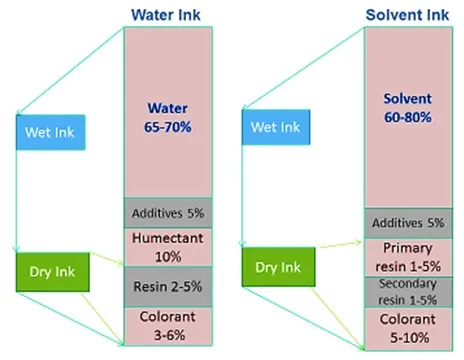
Water-based & Solvent-based Ink Formulation
For inkjet ink manufacturing, the key pieces of equipment in order of use are:
- Premixers
- Milling or grinding machines
- Filters, and
- De-aerators
Premixers for Better Milling
Historically, premixing was done using high speed dissolvers or dispersers. This is still practiced today, but a more sophisticated method of premixing is preferred for digital inks with the aid of special premixing equipment.
Pigment and other ingredients are combined together and mixed often under vacuum to ensure the best wetting of the pigments involved.
These units can offer heating and cooling, simple propeller or magnetic agitators, and even powder suction capability to reduce mess. Pre-mixing makes the work of the milling stage which follows significantly better.

Premixing Device For Inkjet Inks
Bead Mills for Making Pigment Dispersions / Finished Inks
Bead mills are required to micronize pigments and certain dyes to submicron particles, while maintaining stability of those dispersions. They are available with varying degrees of sophistication and each company has its own terminology. You will hear terms like bead mill, pin mill, microfluidizer, and micromedia mill being used.
In general each milling machine utilizes small ceramic or zirconium beads to grind the pigments to particle sizes below 100 nanometers and the size of the milling media (beads) ranges from 0.1mm – 0.8mm.
Depending on the level of efficiency being offered by the machine, some companies are choosing to mill in stages starting with larger beads and then working their way down to the smaller bead sizes. A range of different bead mills are shown below:

Variety of Bread Mill Options
The bead mill can be used to make pigment dispersions or it can even be used to make finished inks by grinding directly into the finished ink formulation.
Filtration and De-aeration
Filtration and de-aeration are essential components in the chain of inkjet ink manufacturing, and like any integral part, if this is missing, the final product suffers.
- Filtration is there to catch any oversized particles that may inadvertently find their way into the ink. Filtration units are often offered as part of some of the more sophisticated milling machines today. They consist of a canister system which contains a filter bag, usually made of nylon, polyester or polypropylene. How fine a filer system you use will depend on the nature of the ink, but we are talking about sub-micron filtration.
 |  |
| Filter Housings for Ink Production Line | NETZSCH DA / DA-VS Vacuum De-Aerator |
- De-aerators (also known as degassers) use a vacuum system to remove micronized gases from fluids and the benefit of removing air (bubbles) from the ink is threefold. This is because:
- First de-aeration minimizes instances of nozzle blockages caused when air moves from an ink cartridge into the print head.
- Secondly, we see more consistent viscosity values, as entrapped air can cause ink to exhibit higher than desirable viscosities.
- Ink stability is increased because of the reduced pigment: Air interface and by limiting how much air gets introduced into the system, you maximize the pigment wetting effect.
Conclusion
The essential equipment list for inkjet ink manufacturing highlights some of the production sophistication necessary for success. If you currently work with gravure and flexo inks, the idea of de-aeration and nanoparticle milling may be new to you. But I hope that through this brief tutorial, you'll find yourself better equipped to venture into the digital market.

Enhance your Knowledge in Inkjet Printing!
Check out the other articles from inkjet series:
- Why Inkjet Will Ultimately Replace Flexo and Gravure?
- Understanding Aqueous Inkjet Formulation
- Modern Eco-solvent Inkjet Formulation
- Challenges with UV/LED Inkjet Formulation