

Emulsion polymers selection for paints and coatings
Last update on Apr 27, 2026
Emulsion polymers are highly versatile materials with a wide range of chemistries. They offer key benefits, such as low cost, low emissions, zero VOC, good shelf-life, freeze-thaw stability, and potential sustainability in many coating formulations.
As a result, they are increasingly used in paints and coatings. They help meet the growing needs of diverse sectors and applications.
To further simplify your selection journey, this guide walks you through the fundamentals of emulsion polymers, their key features, criteria for selection, available chemistries, and the scope of application.
Emulsion polymers: Basics and production
What are emulsion polymers?
Emulsion polymers can be defined as dispersions of polymeric particles of about 100–1000 nm in size in an aqueous dispersion medium. In technical terms, they are polymer dispersions. They are often also referred to as polymer emulsions, dispersions, or polymer latex.
Physically, they fall into the category of colloidal systems.
- Colloids are the microscopic dispersion of one substance into another, in which it is not (or is only slightly) soluble.
- These systems are characterized by high internal interface areas and specific physicochemical properties derived thereof.
Due to the high surface area, all colloidal systems are metastable. The laws of physics drive them to reduce that area, which leads to coagulation. In technical systems, stabilizers are used to mitigate this natural tendency and to keep the systems in the colloidal state until usage.

No. of cubes | 1 | 8 | 1000 | .... | 1018 |
| Dimension (m) | 1 | 0.5 | 0.1 |
| 1*10-6 |
| Volume (m3) | 1 | 1 | 1 |
| 1 |
| Surface (m2) | 6 | 1.2 | 60 |
| 1*10-6 |
Dispersion and dimensions of surface/particle size
Examples of naturally formed colloids are milk, fog, mist or clouds, smoke, blood, and the natural rubber latex from the Amazonian rubber tree (Hevea brasiliensis), which stands at the origin of this industry. Since its first industrial application in the early 20th century, emulsion polymerization developed into one of the most versatile polymerization techniques in the polymer industry.
Searching for the polymer emulsions for your next project? You are at the right place! Our Master Catalog offers access to 2K+ polymer emulsions from top global suppliers. Access technical datasheets and order samples seamlessly through our platform.

How are emulsion polymers made?
Emulsion polymers are formed by free-radical polymerization of monomers emulsified in water. Emulsion polymerization has a specific mechanism and kinetics, which makes it different from many other polymerization techniques.
Organic monomers are emulsified with the aid of stabilizers in water that serves as a continuous matrix.
- The addition of radical-forming initiators to the aqueous phase starts the polymerization. This happens outside the monomer droplets (this would make suspension polymerization instead!).
- But in the aqueous phase, monomer micelles or monomer-swollen polymer particles depend on the mechanism and phase of the process.

Schematic representation of the emulsion polymerization process
(Source: ResearchGate1)
The monomer droplets serve as a reservoir from which monomer molecules are delivered. With this mechanism, very high degrees of polymerization can be achieved at high-solids content, whilst the overall viscosity of the system stays within reasonable terms for processing. This process results in a dispersion of about 50-60% solid polymer particles in the aqueous matrix.
For many applications, this dispersion is ready-to-use without further expensive separation and cleaning steps. In other cases, the polymer emulsion is precipitated or spray-dried to form a re-dispersible polymer powder (RDP).
Polymer emulsions are primary dispersions, which means that the polymer and the colloid are formed in one step. Dispersing already-made polymers into an aqueous medium forms secondary polymer dispersions (commercial examples are wax dispersions). This step requires:
- High-energy intake to create small enough particles
- High amount of stabilizers to keep the microscopic particles separated
From an application point of view, polymer emulsions are waterborne systems. Waterborne systems are based on water (not an organic solvent) as the main carrier. They found increasing interest over the past decades due to their favorable profile in terms of emission control. Therefore, polymer emulsions are amongst the fastest-growing categories of specialty chemicals in the world.
Technically important amongst the colloidal polymers are polyurethane dispersions and polymer emulsions. Here, we are focusing on the latter. The flowchart below depicts the classification of colloidal polymer materials.
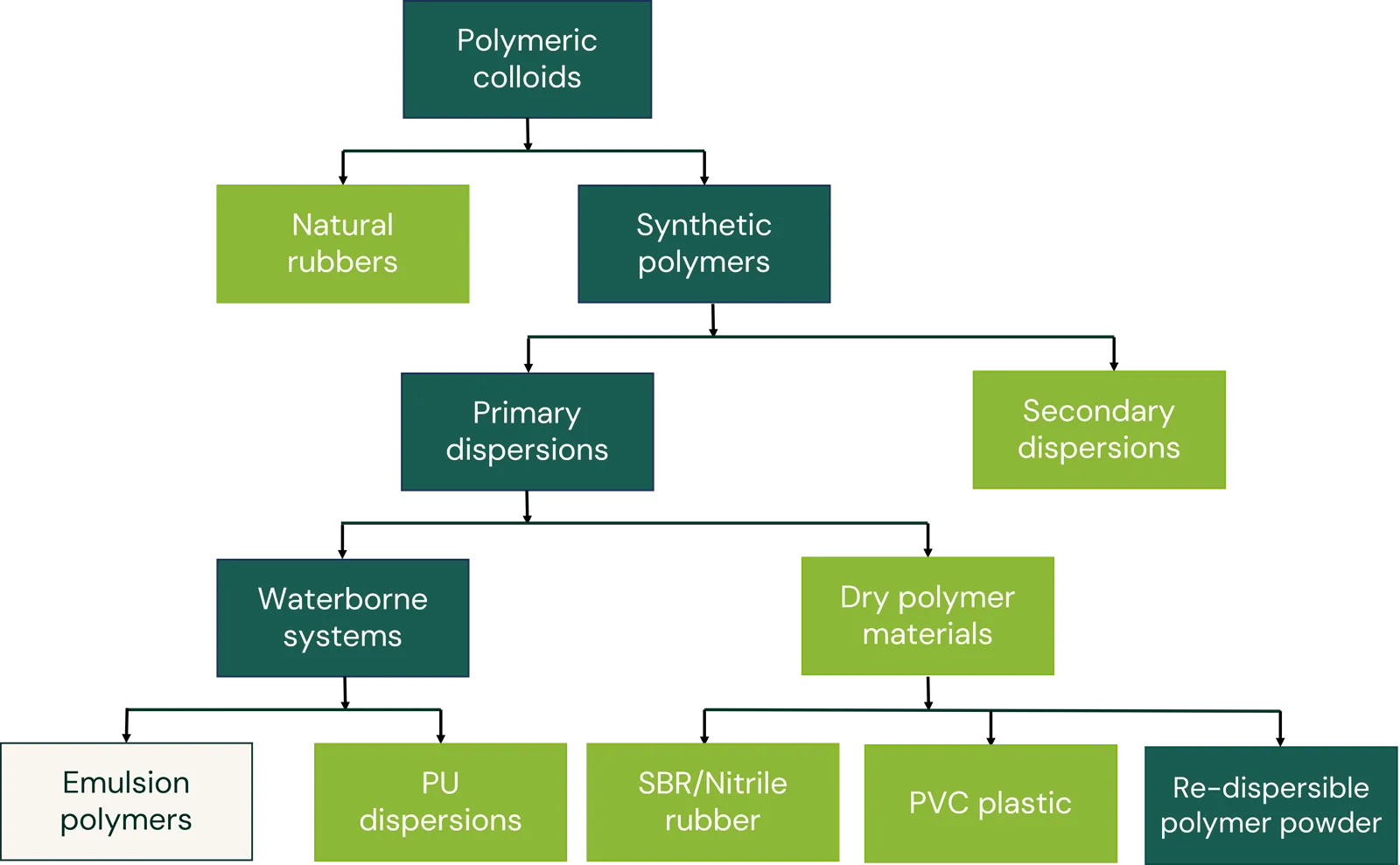
Classification of colloidal polymer material
Let's dig into the key characteristics and performance attributes of emulsion polymers to set the stage for a better selection of the right grades.
Key features and performance attributes
Properties of emulsion polymers
Emulsion polymers are very versatile products. They are commercially available as a dispersion of polymer particles in water. These milky-white liquids range from water-thin to thick, paste-like in viscosity. These two properties, together with pH, define the standard qualities of any commercial emulsion polymer.
Some key factors for characterizing polymer emulsions are:
Solid content
The solid content is defined as the dry residue of all solid material after evaporation of water, containing polymer, stabilizer, and organic or inorganic auxiliaries, divided by the total mass of the dispersion. Commercial polymer emulsions contain about 45% to 65% solids according to that method.
Particle size
The real particle size of any given polymer dispersion is often difficult to attain. The results differ from the physical method used, or the specific equipment provided. A well-defined, narrow, monodisperse particle size distribution is the exception for the products to be discussed here.
Most of the emulsion polymers exhibit broad or multi-disperse, often skewed distributions. Also, the shape of the particles that are not necessarily ideal spheres, and the particle morphology, need to be considered. Often, only a few characteristic numbers, such as the average number or average weight, are calculated from the measured values to characterize the dispersion.
The polymer particles have a more or less extended interface layer. It is composed of adsorbed or grafted stabilizers and electrolytes. Thus, the dry core diameter needs to be distinguished from a hydrodynamic diameter in the swollen, wet state.
The preparation of the dispersion before testing is often crucial. Some dispersions tend to form agglomerates, which can bias some methods towards higher average particle sizes.

Particle size consideration while formulating polymer dispersion
The frequently used particle size methods established for the characterization of emulsion polymers are:
|
|
Some of the methods fail to detect very small particles, others overweigh large particles or agglomerates.
In general, it is advised to use a combination of two or three different methods to know the true particle size distribution of a given dispersion. For quality control measures, it is often sufficient to use a robust, established, wide-range standard method, as offered by test equipment suppliers for that purpose.
Coagulum in a product
Any coagulum is an expression of insufficient stabilization. The coagulum present in a commercial product is measured by washing a measured sample of a diluted emulsion polymer product through a sieve with a defined mesh size. The coagulum is calculated as the weight of the dry residue on the sieve divided by the total amount of dispersion run through.
Rheology/viscosity
The viscosity or rheology of an emulsion polymer is a complex property that depends on:
- solid content
- particle size distribution
- pH
- particle surface charge, and
- organic content in aqueous phase
The viscosity or thickness, in practical terms, is defined as the resistance to flow. High viscosity liquids are relatively immobile when subjected to shear (a force applied to make them move), whereas low viscosity fluids flow relatively easily.
The shear rate is defined as the speed with which a material is deformed.
- High shear rate: In some processes relevant for the application of polymer emulsions, such as spraying or nozzle application for adhesives, the shear rate is high.
- Low shear rate: Other processes, for instance, during pumping or formulation leveling, the associated shear rate is low.
The viscosity remaining constant and independent from the shear rates applied defines Newtonian fluids. Shear-thinning materials exhibit decreasing viscosities when the shear rate increases. Most polymer emulsions fall into this category.
In some rare cases, emulsion polymer products can also have shear-thickening properties. Under shear stress, the components of the dispersion rearrange, and the resistance, and therefore the viscosity is increased. Therefore, the understanding of the full rheological profile of an emulsion polymer over a wide range of shear is essential.
Just relying on a single point value at one specific set of conditions is often not sufficient. It is often used as a quality check with a simple rotary viscometer, at defined rotations per minute and sample temperature.
Measurement of viscosity and other rheological properties can be made using either a capillary or a rotational rheometer. The choice of system depends on the properties of the material being tested and the data required.
Glass transition temperature
The glass transition temperature (Tg) of an emulsion polymer product is measured by differential scanning calorimetry on a dried film. It translates into mechanical properties. For example, abrasion resistance or the rigidity of a formed film. The Tg of a given product is mainly influenced by the bulk monomers it is made of.
Residual monomer/VOC
As many emulsion polymer products are used in green applications for reduced emissions and to replace solvent-borne systems, the residual monomer content as well as the account of total volatile organic components (VOC) is an important characterization. Gas chromatography is a standard method to identify the residues of organic components in emulsion polymers.
Molecular weight
There are many more dimensions to investigate and to characterize an emulsion polymer fully. Most of them are not easy to access. For instance, the molecular weight of the polymers is often not thoroughly analyzed.
The bulk polymer is often not accessible for molecular weight analysis. This is due to the emulsion polymerization's typical high molecular weights, crosslinking, or grafting reactions. Only the soluble part is investigated and separated from the insoluble one.
Depending on the specific question to be solved, properties like polymer micro-structure, particle surface charge, or content of aqueous solution (serum) are investigated.
Performance attributes of emulsion polymerization
In most cases, emulsion polymers are ready-to-use products. Expensive secondary process steps, like precipitation and cleaning of the product, are spared. Some exemptions are:
- Rubbers
- Emulsion polymerized polyvinyl chloride plastics (PVC), and
- Re-dispersible powders (RDP)
Impact of water during polymerization
Due to the specific emulsion polymerization mechanism, very high molecular weight can be achieved. Here, the polymerization happens in water as the continuous phase, without having unmanageably high process viscosities. Water also acts as a heat-transmitting fluid and helps to manage the exothermic nature of the reaction.
Low emissions and VOC
Modern emulsion polymers are relatively sustainable products. They help to reduce emissions in several applications. Many processes and applications that require solvents can be transferred into completely solvent-free, water-borne ones, based on emulsion polymers.
Therefore, the past and ongoing growth of the emulsion polymers sector is primarily driven by the increasing substitution of solvent-based systems with more environmentally-friendly water-based ones in paints & coatings, adhesives, and other construction materials.
A key role for this increasing market penetration plays regulatory support towards lower emissions. In general, there has been a reduction in volatile organic components (VOC) across various nations and regions for a wide variety of consumer products.
TIP: Your quest for commercial sustainable emulsion polymer grades is now just a click away on our platform. Click on the advanced "Sustainability claims" facet and filter out/select the required claim from the drop-down. Download the technical datasheets of the products and request samples.

Now that we are aware of the characteristics and performance properties of polymer emulsions, let's move on to learning about the parameters for their selection and a thorough overview of their chemistries.
Selection criteria and chemistries of polymer emulsions
Markets served by polymer emulsions

Emulsion polymers are products by the process - chemical composition & making process derive specific application properties
Almost one-third of all emulsion polymers produced are used in the formulation of architectural coatings

The second biggest segment for the application of emulsion polymers is the coating of paper and paperboard