

Maximizing Sustainability in SMP Sealant Formulations with Advanced Rheology Modifiers and Catalysts
Last update on Jan 18, 2021
For many sealant formulators, sustainability has become an essential part of their marketing strategy. Sustainable certifications allow formulators to differentiate themselves by proving that their products meet key environmental standards. Contractors will often select a sealant based on the extent that a product meets these standards.
The prime sealants focus in recent years has been on reducing the volatile organic compounds (VOCs) in the formulation, but there are many other pathways to sustainability as listed below.
- Reduce the content of chemicals in the formulation that:
- May be toxic to life
- Contribute to ozone depletion, greenhouse gas formation, acid rain, or water pollution, and
- Cause safety and health issues
- Reduce releases of such harmful materials in the workplace, during application, and after the sealant installation
- Use fewer non-renewable resources (e.g., petroleum-based chemicals)
- Decrease energy consumption required for manufacture, use, and disposal
- Use non-migrating additives to prolong the sealant's useful life
- Reduce maintenance or replacement costs
Here, we will review how silane modified polymer (SMP) sealant formulations can be optimized to reach sustainability goals without diminishing properties. SMP sealants are also known as 'hybrid' sealants since they have properties comparable to both polyurethane and silicone sealants. Let's see how to maximize the sustainability of these products.
Sustainability as a Sealant Value Proposition
Sustainable sealants are those that reduce harm to the environment throughout its entire life cycle. Environmental responsibility must be exerted not only during the manufacture of raw materials but also during formulation, application, end-use, service life, and disposal at end of life. The environmental concerns do not stop at the formulator or end-user of construction sealants. Once it is applied and cured, the sealant may require 'indoor' environmental properties such as low toxicity and odor.
In the building construction industry, several certification programs have been developed to show the builder's commitment to sustainability. In addition to promoting environment and health perceptions, the motivation for certification of a building as 'sustainable' is to achieve higher value for the building.
The procedure is to collect points by fulfilling "credits" for proper consideration of environmental aspects (e.g., indoor air quality, saving of energy and of resources, and more). Standards and certifications that meet sustainable building criteria have emerged globally. Some of these standards are listed in the table below.
| Country/Region | Standard |
| United States | LEED (Green Building Council's Leadership in Energy and Environmental Design) |
| United Kingdom | BREEAM (Building Research Establishment's Environmental Assessment Method) |
| France | French Démarche HQE certification |
| Germany | German DGNB (Deutsche Gesellschaft für Nachhaltiges Bauen) |
The motivation of sealant manufacturers is that they can offer products to contractors who want to maximize sustainability credits for their building. Sustainable building projects are gaining importance in the market. Low VOC and high bio-content sealants contribute to the rating of a building as "sustainable".
| DOWNLOAD THE ARTICLE HERE |
What Makes Silyl Modified Polymers (SMPs) so Popular?
Silane modified polymers, also known as silyl modified polymers (SMPs), are obtained by combining reacting polymers with a silyl group. The products are differentiated by backbone (generally polyether or polyurethane) and in number and nature of groups attached to the backbone. All of the polymer backbones are terminating with a silyl group. They have closely associated chemistry and many common features. The most common SMP polymers are known as:
- MS polymers (polyether backbone)
- SPUR polymers (polyurethane backbone)
The global SMP market was valued at USD 3.5 billion in 2019 and is expected to grow at 7.3% CAGR during the 2019-2024 period.1 The growth is driven mainly by the increasing use in the construction of modern and energy-efficient buildings.
Advances are also expected in bonding / sealing of lightweight materials in the transportation and wind power industries. A broad range of SMP polymers are available. Key players in the market include:
- Kaneka Corporation
- Risun Polymer International Co., Ltd.,
- PCC Group
- Evonik Industries
- Wacker Chemie AG, and
- Momentive
SMPs as Base Polymer in Sealant Formulations
SMP single-component sealants cure via reaction with environmental moisture. Curing entails crosslinking by the hydrolysis and generation of siloxane linkages. A catalyst is required to accelerate this process.
SMPs have become important base polymers for sealant formulations due to their:
- High-performance properties, and
- Sustainable characteristics.
Performance comparisons between SMP, polyurethane and silicone sealants are provided in the table below. SMPs offer superior properties which makes them suitable for use in numerous sealant applications.
Property | SMPs | Polyurethane | Silicone |
| Environmental friendliness | 10 | 5 | 9 |
| Non-bubbling | 10 | 6 | 10 |
| Low temperature gunnability | 10 | 8 | 10 |
| Slump resistance | 10 | 10 | 10 |
| Quick cure | 10 | 7 | 10 |
| Storage stability | 10 | 7 | 9 |
| Body (tooling capability) | 9 | 10 | 8 |
| Weather resistance | 8 | 6 | 10 |
| Adhesion to various substrates | 10 | 5 | 8 |
| Mechanical properties | 10 | 10 | 10 |
| Heat resistance, mechanical stability | 9 | 8 | 10 |
| Non-dirt pickup | 10 | 10 | 5 |
| Stain resistance | 8 | 8 | 5 |
| Paintability with water-based paint | 10 | 10 | 3 |
Performance Property Comparison of SMP, Polyurethane, and Silicone Sealants
(Based on 10 Point Rating with 10 Being the Highest Performance)
Environmental Benefits of SMPs
- Reduced application cost (less need for primers, increased storage stability, low temperature gunnability), and
- Reduced maintenance cost (improved paintability, less dirt pick up, longer life) of these higher performing sealants.
| Formulator Benefits | End-User Benefits |
|
|
Benefits of Sustainable SMP Sealant Formulations
Additives in SMPs – Roadblock in Sustainability Journey
- Rheology modifiers / fillers: Fine thixotropic fillers such as silica and titanium dioxide are suspected health hazards.
- Plasticizers: Reproductive harm and asthma are known to come from phthalate plasticizers. Plasticizers can eventually migrate out of the sealant creating environmental concerns and degraded properties.
- Catalysts: Tin-based catalysts are a suspected bioaccumulation toxin and endocrine disruptor. These catalysts are commonly used in silane crosslinking mechanisms.
New Renewable Rheology Modifiers Supporting SMP Sealants Sustainability
- Up to 50% higher efficiency than thixotropic fillers resulting in excellent slump / sag resistance
- Easy extrudability by virtue of its low yield point
- Easy compounding and much less energy, dust, and frothing compared to fumed silica
- Twenty times the density of fumed silica allowing less volume in transportation and storage space
- Free of hazardous or special labeling
- Improved sealant elongation without the need of plasticizers
| Component | Pigmented Concentration (%) | Non-pigmented Concentration (%) |
| Silylated polyurethane prepolymer (SPUR) | 23.0 | 58.0 |
| Plasticizer | 18.0 | 31.5 |
| Calcium carbonate | 54.3 | - |
| Titanium dioxide | 0.7 | - |
| Moisture scavenger | 0.3 | 1.5 |
| Rheology additive | 3.0 / various* | 7.5 / various* |
| Adhesion promoter | 0.6 | 1.0 |
| Catalyst | 0.1 | 0.5 |
| Total | 100 | 100 |
| *Concentration of fumed silica and diamide-based thixotrope varied as 1.0, 2.0, 3.0% by weight for pigmented formulation, and 5.5, 6.5, and 7.5% for non-pigmented formulation. | ||
Starting Formulations for Pigmented and Non-Pigmented SPUR-Based Sealant
Improved Rheological Performance
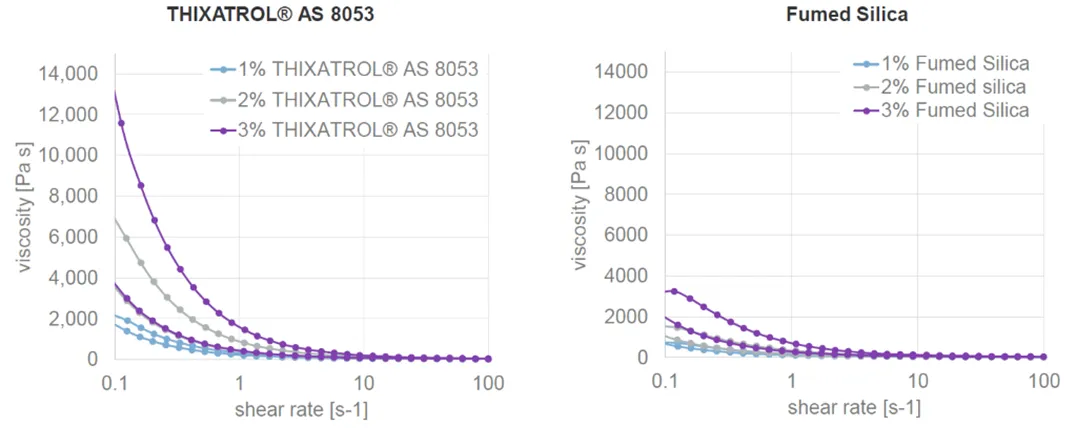
Diamide Thixotrope Provides Significantly Higher Rheological Performance in a SMP When Compared to Fumed Silica.3
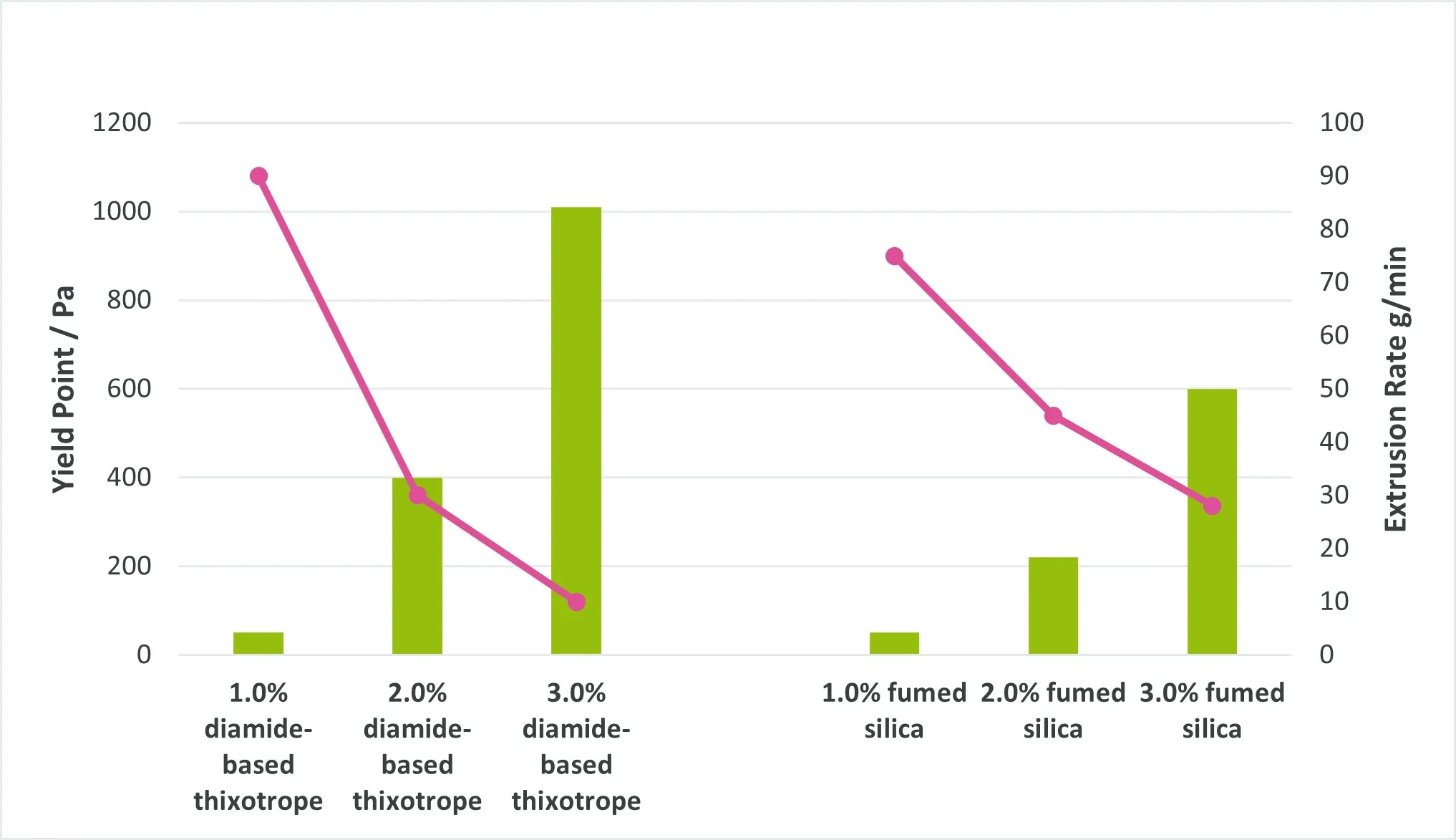
Influence of Rheology Modifiers on Yield Point and Extrusion Rate in SPUR Sealants.4
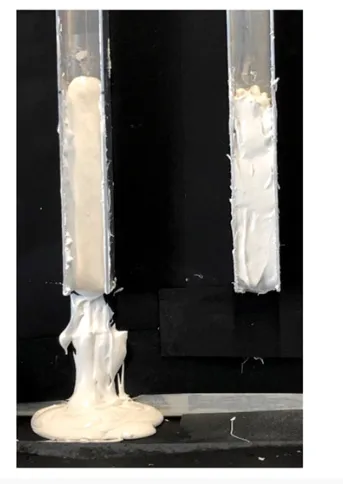
Improved Sag Properties with the Diamide-based Thixotrope (right)Compared to Fumed Silica at Equal Loading of 1.0%.4
Eliminating Plasticizers – Get Higher Elongation in SMP with THIXATROL®
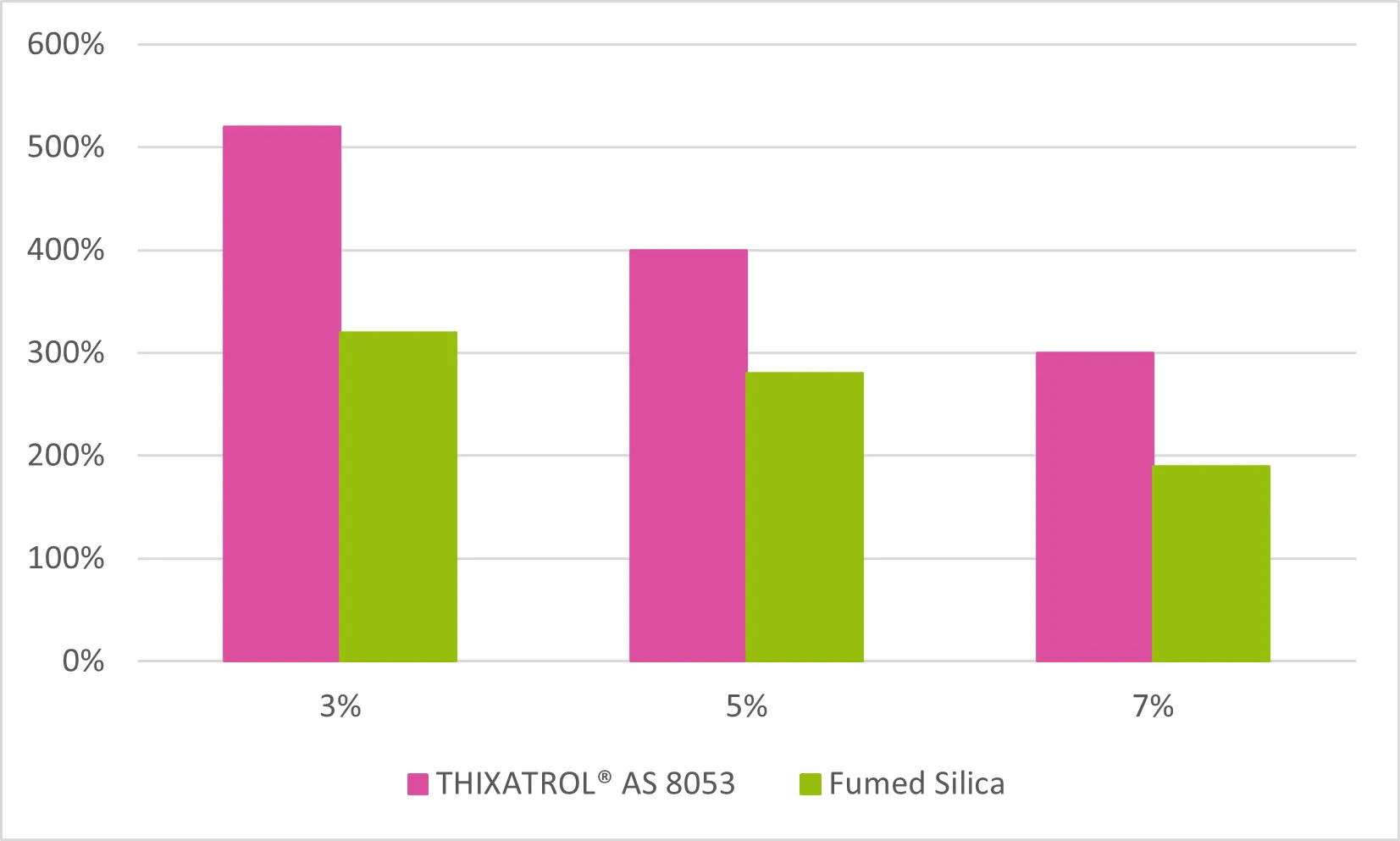
Elongation of SMP Sealant Based on THIXATROL® AS 8053are Significantly Higher vs Fumed Silica Sealants.3
Get Comparable Mechanical Properties with Tin-free Catalysts
Ethoxylated silane polymers produce ethanol on cure, a less harmful chemical than methanol which is produced in methoxy silane systems. However, catalysis of the ethoxy silane crosslinking reaction is challenging. Tin compounds have proved to be inefficient for these reactions. The K‐KAT® 670 catalyst does not contain tin and provides mechanic properties and cure rate that are comparable with tin-based catalysts for all silane systems. Typical dosage ranges from 0.4 to 2.0% on total formulation weight.
Conclusion
New raw materials are being developed that are finding their way into sustainable building sealants. These include additives that are biobased and safer to use. New SMP sealant formulations have been motivated by the green building movement. SMP polymers are already free of VOCs and solvent. New rheology modifiers and catalysts such as described in this article will even further contribute to their sustainability by eliminating potentially hazardous particulate fillers, plasticizers, and tin-based catalysts.
| DOWNLOAD THE ARTICLE HERE |

View Starting Point Formulations Based on SMP

Stay Updated with SMP Developments in the Industry
- Global Hybrid Adhesives and Sealants Market, Mordor Intelligence LLP.
- Saini, V., et. al., “Diamide-Based Organic Thixotrope: An Alternative to Fumed Silica in Adhesives and Sealants”, Adhesives & Sealants Industry, November 2019.
- Fraile, C.F., Improving the Production and Performance of Adhesives and Sealants with Innovative Rheological Additives, Special Chem Webinar, June 23, 2020.
- Saini, V., et. al., “Diamide-Based Organic Thixotrope: An Alternative to Fumed Silica in Adhesives and Sealants”, Adhesives & Sealants Industry, November 2019.
- The EU has restricted six phthalates – BBP, DBP, DEHP, DIDP,DINP, and DNOP in toys and childcare articles since 1999. Along with other phthalates, these six are regulated under REACH and several other regulations.
- The European Agency for Safety and Health at Work (EU-OSHA) directive 67/548/ EEC, and the 25th updating of this directive (98/98/EC), have defined methanol as harmful with danger of very serious irreversible effects by inhalation, skin contact and ingestion.
- Tan, C., et. al., “The Synthesis of Low-Viscosity Organotin-Free Moisture-Curable Silane-Terminated Poly(Urethane-Urea)s”, Polymers, Vol. 10, 2018, p. 781.
- Florio, J., et. al., “Non-Tin Catalysts for Alkoxy Silane Polymers”, European Coatings Journal, March 2016, pp. 48-54.
- KKAT670_flyer_US1.pdf (kingindustries.com).