

Emulsion Industry: Key Trends, Drivers & Challenges - Part 1
Last update on Mar 23, 2018

All industries are getting influenced by the global megatrends, emulsion industry is no different. Thus, it would be interesting to investigate these general trends.
Want to understand how these trends are impacting the emulsions industry?
Explore what challenges and opportunities can be derived from the general global megatrends for the emulsion Industry. And, find how an effective reaction on these external impulses could help develop potential strategies for sustainable, low emission, green polymer emulsions.
Let's begin with the leading trends shaping the emulsion Industry...
Identifying the Leading Trends Impacting Emulsions Industry
Amongst the megatrends that shape our present and ignite the change for future developments, there are a few that specifically impact the emulsions industry.
Trend #1
The first trend is the undeniable shift of the epicenter of economic growth and political influence towards Asia. The economic success of the already progressed Asian nations and their impact as a role model for the now emerging ones led (or will lead) to a new, rising middle class, with increasing needs for high-quality consumption.
This need is for instance expressed in a booming housing and construction industry. There are many differentiated applications, from the construction materials for a foundation, over insulation, sealants up to decorative paints and trendy furniture. Emulsion polymers can and does serve for all these applications.

Trend #2
Here, the new middle class starts to care more about health and environment issues. Therefore the consumption patterns become more "green". The new consumers now take up needs, e.g. for low emission applications in the housing industry, that was first developed in 'Western' societies in the 1970s, but were not accessible for the majority of the world's population until now.
The emulsions industry's promise of high durability and functionality provided by waterborne polymer binders formulated without additional solvents fulfills exactly this new customer need.
As these are trends are for emerging regions and based on the prognosis of a rising middle class; there is still a huge potential. For instance, a significant part of all globally used Paints and Coatings is still solvent-borne. Or, less than 50% of all dry mortars are polymer modified on a global base, compared to almost 100% in Central Europe.
Besides these two leading trends, emulsions industry is influenced more by the chemical industry. The specific ones include a change in raw material base towards more sustainable ones, increasing regulation, and finance investor driven restructuring of the whole industry.
Overview Emulsions Polymers
The polymer emulsion industry is very versatile. Polymer emulsions can be formed from different classes of raw materials and serve manifold, diverse applications, such as:
- Architectural Coatings
- Industrial Coatings
- Paper Coatings
- Packaging Adhesives
- Adhesives for Tapes and Labels, or
- Carpet Backing Adhesives, amongst many others
With these applications, emulsion polymers are used in diverse sectors, such as:
- Housing and construction industry
- Decoration or protective coatings
- Packaging industry
- Non-woven textiles
- Food coating, or
- Printing inks

Global Share Volume Based on Application, as Forecasted for 2021 by The Freedonia Group
Formulating Polymer Emulsion
Polymer emulsions are formed by free radical polymerization of monomers emulsified into water. This results in a dispersion of solid polymer particles in the aqueous matrix. For many applications, this dispersion is ready to use without further, expensive separation and cleaning steps. Although, in some cases; the polymer emulsion is spray dried to form a re-dispersible polymer powder (RDP).
A fast amount of both bulk and functional monomers can be used in emulsion polymerization to tailor the application properties. In addition, specific chemicals are used to aid the process and to impact the performance of the polymer emulsion. The most prominent of these chemicals are surfactants or polymeric stabilizers.But, the choice of initiator, buffer system and even the process conditions are also crucial for the final application properties.
Classification of Polymer Emulsions
Polymer emulsions are typically classified based on their main co-monomers, such as:
Besides them, there are many special, lower volume polymer emulsions types.
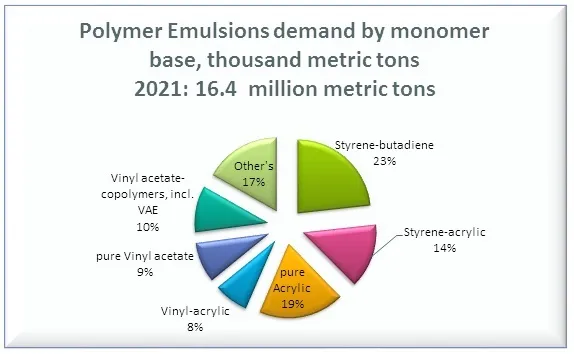
Global Share Volume Based on Monomer Base, as Forecasted for 2021 by The Freedonia Group
Acrylic Based Polymer Emulsion
The class of Acrylic-based polymer emulsions is the biggest in volume and value. Also, it is the most versatile in terms of polymer property range.There are many monomers commercially available as esters of Acrylic- or Meth-acrylic acid, ranging from low to high Tg as well as from hydrophilic to hydrophobic.They also can bear manifold functionalities.Acrylic based monomers can be copolymerized with Styrene or Vinyl acetate, forming Styrene-acrylics and Vinyl acrylics as sub-classes, respectively.
Vinyl Acetate Based Polymer Emulsions
Vinyl acetate based polymer emulsions are somewhat limited in choice of copolymers compared to acrylics based copolymers. They are often supplied as pure Vinyl acetate polymer emulsions, sometimes with some functionalization in low percent region.
Vinyl versatate (VeoVa10™) and in special cases, Vinyl chloride function as main co-polymers for Vinyl acetate based emulsions.
From these sub-segments, Ethylene-Vinyl acetate polymer emulsions (VAE) form one of the fastest growing sub-segments in whole emulsion industry.
Styrene-Butadiene Emulsions
Styrene-Butadiene is the least versatile segment in terms of copolymer composition. It is mainly differentiated whether carboxylated or not.About 60% of the total volume is delivered into the Paper Coatings application, which accounts together with Carpet Backing Adhesive applications for in total three-quarters of the whole volume produced.In reverse, Styrene-Butadiene accounts for 70% of the polymer emulsions used in Paper Coatings and for more than 90% used in Carpet Backing Adhesives. In this respect, this class of polymer emulsions stands out from the general observed high diversity and versatility.
The table below shows a list of typical monomers to synthesize polymer emulsions, with key physical data
| Monomer | Boiling point / °C | Tg / °C | ΔpolyH / MJ kg-1 |
| Ethylene | - 103 | - 100 | - 3.42 |
| 1,3-Butadiene | - 4.5 | - 85 | - 1.28 |
| n-Butyl acrylate | 148 | - 54 | - 0.60 |
| Ethylhexyl acrylate | 214 | - 50 | - 0.33 |
| VeoVa10TM | 270 - 280 | - 3 | - 0.48 |
| Vinyl acetate | 73 | 28 | - 1.02 |
| Vinyl chloride | - 13.4 | 85 | - 1.69 |
| Styrene | 145 | 100 | - 0.65 |
| Acrylic Acid | 105 | 105 | - 1.08 |
| MMA | 101 | 105 - 120 | - 0.58 |
Now, let's understand what drives the emulsion industry:
Key Driver 1: Undampered Growth, with the Focus Shift to China & Asia-Pacific
Polymer emulsions are amongst the fastest growing categories of specialty chemicals in the world. The annual growth rate is projected with 4- 6% to reach a volume of about 14-18 million metric tons, worth about 35-45 billion US$ in revenue end of 20201.

Based on its general economic growth, Asia Pacific became the leading region for polymer emulsion market over the past decade or so. This is due to the rapid growth of end-user industries, such as: Paint and Coatings, Buildings & Construction and Adhesives in the region. China alone will soon account for over one-fourth of global sales in polymer emulsions and will continue to shape global demand trends.
All segments and applications grow, but mainly Acrylics and VAE sub-segment of Vinyl acetate based polymer emulsions serving the general Housing and Construction sector as well as the Paint and Coatings industry outpace the other categories.
Emulsion polymers are also growing above GDP in the mature markets of (Western) Europe and (North) America. But, with an aging population and in general comparatively lower growth rates, this doesn't take away the focus from Asia. Consequently, all major suppliers are present in the region and invested both in new emulsion production capacity and local research centers. Some of them are- or will soon be- serious contenders of the established players. It can be expected that even more innovation will come from Asia.
Also, new trends will be set there and then adapted into the global emulsions world. There is no doubt, the 21st-century focus on polymer emulsion industry shifted east.
Key Driver 2: New Emerging Regions
Whilst China and Asia-Pacific established itself as new focus region for emulsion industry, India will provide the fastest growth rate of any country. Originally developed as markets in Western Europe and North America, it made its first major footsteps in Asia in Japan and then in China, and now spreading over the whole Asia-Pacific region. From there it is growing in India, and there are already new seeds coming to Near East Region, which is approached from both East and West now.
At this moment, there are interesting developments happening in Near East region, e.g. with the announcement of Saudi-Arabic government to invest in downstream chemistry and the establishment of a larger emulsion polymers complex in UAE2.
Dampened by still unfavorable economic conditions, Russia, parts of East Europe, and Latin America still stay behind their potential for polymer emulsions application and growth. As soon the economic conditions change there, allowing a middle class to thrive, emulsions industry will harvest also in these regions.
Key Drivers 3: Regulation

The trend towards higher environmental awareness and a need for sustainability drives the chemical industry towards higher regulation. Regulation comes not only from official governmental or even supra-governmental side (e.g. REACH in European Union), but also from consumer initiatives.
Additionally, industry ties or high impact players can 'regulate' the raw material base of emulsion industry. As an example for the latter case, there are global acting formulators or consumer solution providers who set their own, often higher than official, standards to manage environmental or health issues for their customer base.
The emulsions industry, with its diverse raw materials footprint on the one side and target markets aiming for green (e.g. in construction) or non-toxic (e.g. food packaging) application, is especially prone to regulation.
Driving Towards APEO Free version
Alkylphenol ethoxylate (APEO) derivate-based surfactants were one of the most widely used types of stabilizers in emulsion industry. They now are almost completely erased from the emulsions raw material base in major regions. And there will be increasing pressure in the future to eliminate them in the residual recipes. Quite some effort went into the development of emulsion polymers that provide similar performance in the final applications with the APEO free versions.
Especially for Europe, on the tail end of the raw material base for emulsion industry, REACH will impact on the variability of available specific surfactants and auxiliaries. So on one end, increasingly diverse regional markets and customer needs drive for diversification in the raw material base for emulsion polymers, while regulation drives the variety of choice down.
Limitations on Formaldehyde
Another big issue for regulation is Formaldehyde. Formaldehyde is released from components used in emulsion polymerization, such as initiator system, biocides or specific cross-linkers. Formaldehyde is labeled as carcinogenic or suspected to be so in many regions of the globe. The use of Formaldehyde releasing components was limited over the past in many applications and it will be under increasing pressure for further elimination.
The main monomers used in emulsion polymerization itself bear some potential for regulation. As these monomers are transformed into polymers they lose their hazardous potential over the course of polymerization. Hence, increasing regulation targets the residual monomers left in the ready to use emulsion.
This drives the emulsion producers to take additional steps for removing them, adding to investment and operations cost
There is a sort of contradiction as quite toxic monomers are transformed into a product that is designed to serve green, sustainable applications. Even when risks can be managed technically, both customer perception and governmental regulation might drive the emulsions industry towards narrowing down its potential raw material base.
Every challenge also bears an opportunity. Every threat also can drive towards
an innovative solution allowing for further diversification from competition
But, there are two real challenges that impact the emulsions industry in the present. Let's have a look:
Key Challenge 1: Commoditization
As the big chemical conglomerates were disaggregated into their pieces in the beginning of 1990s, roughly 4 sectors were created beside pharmaceuticals, these were:
- Base chemicals
- Fine chemicals
- Agrochemicals, and
- Specialties
Emulsions were originally in the specialty sector, which made sense with its batch operations, manifold raw materials, a wide range of products offered, and high level of customer service provided. But time has changed!
Today, the vast majority of emulsion polymer products are exposed to a trend towards commoditization.
- For almost any application in almost every market, the buyers have 'technically' the choice of a number of substitutes. The substitutes can be within the same emulsion class, such as more than one. For example: Styrene-acrylic is available from different suppliers for the same application. Or, there are even different solutions provided out of more than one class of emulsion polymer: the same application property can be achieved for example formulating with a Styrene-Acrylic or a Vinyl-acrylic or a VAE.
- Raw material cost is still the most important factor for pricing an emulsion. Only in a few niche applications, true value-based price models can be executed. Therefore, global trends in raw material and energy pricing have a significant influence on the profitability of the different emulsion chemistry segments.
- There is an increasing spread of information about formulations, recipes, and technologies. Many inventions made in a phase of highly active emulsions research, run out of patent protection. This is not yet 'perfect' information, as many details e.g. on specific essential small fraction ingredients or process conditions kept secret. Still, the more emulsions technology spreads over the globe; the learning curve keeps up, also for latecomers.
- There are low entry barriers to set up emulsion production. This is especially true for simple technologies, which already can be used to make 'standard' emulsions for the respective application. For higher specialized emulsions, there are some barriers are still kept.
Also, there was only marginal product innovation happened in the past 20 years or so in emulsion industry. 'New' products are in their fast majority incremental improvements over previous applications. Much of R&D effort went into adaptions to regulations (APEO, Formaldehyde) or adjustments of recipes to slightly different customer demands to enable regional expansion.
At the customer end, more and more emulsion industry customers learned how to use emulsions to formulate for specific applications. Therefore, the gain from increased service offers- aka extensive technical service– also became marginal. It cannot be used as differentiator anymore.
Hence, the competition is not yet perfect. The fact that shipping emulsions inherently means shipping up to 50% water makes, real global distribution (and therefore, competition) difficult from an economic point of view. Also, emulsion polymerization still needs certain know-how and deep understanding of the complex interactions and processes to tailor the products to the applications needs.
But in general, it can behold true that emulsion industry is on the slope towards commoditization and therefore, under an increasing pressure on the cost side. The reaction of the industry, in general, is restructuring and partly concentration.
Key Challenge 2: Value Chain Position
The second big challenge for the emulsion industry is its position in the value chain and the question how to create value at this position.

Emulsion industry uses intermediates as raw materials and supplies to formulators or solution providers who themselves- direct or over additional players in the supply chain to an end market.
Challenges at Raw Materials' End
On the raw material side, emulsion producers are partly back integrated into their main raw materials. Or to put it into another conception: the monomer producers integrate forward by entertaining an emulsions business. If not back integrated, emulsion producers suffer from having low pricing power. Their main raw materials, the monomers, go up and down with the crude oil price, global economy, and many other factors.
The emulsion producers can just pass on to their customers when prices increase and must hope to keep them up for a while when raw material cost cycles down. Both choices are limited by competition.
Challenges at Consumer's End
On the emulsions customer end, there are often big, global operating solution providers, example:
- Big paint companies
- Big adhesives producers, or
- Big consumer good companies
These companies are the real face to the end customers. They often guard the formulation recipes and applications know how. Also, they have the 'new oil' - all data on customer and market trends. Therefore, the pricing power is on their side, considering that in almost every case they have a choice between multiple suppliers providing to the same application.
Some emulsion producers are heavily integrated into their main customer applications. For instance, emulsion producers supplying into the Paper Coating market have invested into pilot coaters to model their customer's processes. This investment, together with a strong network, close ties to their customers, and built up experience gives them a competitive advantage against potential new entrants into these specific segments. But in general, emulsion industry is 'squeezed' between raw material supply that is not in their control and powerful customers.
Conclusion
Overall, there is a positive outlook for the emulsions industry. The trends and drivers, as much they can be predicted in a volatile and fast pace changing the world, set the scene for an increasing application of polymer emulsions as sustainable, low emission, green binders in many applications around the globe.
The question is how the emulsion industry is able to develop innovative answers towards their challenges and how they take advantage of the drivers.
Stay-tuned to evaluate some approaches towards these questions in the second part!
- Consolidated results, from Zion Research, The Freedonia Group and other’s
- https://www.khaleejtimes.com/business/local/-51-million-visen-polymer-plant-opens-at-hamriyah