

VAE Emulsions - Current Status and Future Innovations
Last update on Jan 30, 2018
Vinyl-acetate ethylene co-polymer emulsions (VAE) are one of the youngest children in the family of emulsion polymers.
Initial experiments to introduce ethylene as monomer into the emulsion polymerization were done in 1950s and VAE was made commercial available in the late 1960s1. This new type of co-polymer emulsions took a while to become successful outside of niche markets and on global scale.
Starting in the 1990s their growth rate got an onset and now VAE emulsions are amongst the fastest growing sub-segments in the emulsions world.
The business is currently driven by the shift to Asia and other emerging regions with an ongoing boom in construction. Adding to that is the increasing environmental awareness of the local customers.
Housing and construction is going green! Therefore waterborne systems continue to replace solventborne ones.
VAE is prone to gain increasing share when it comes to the application of low emission or even zero volatile organic component (VOC) formulations.
Have a look on the graph below showing historical and prognostic growth rates for specific sub-segments of polymer emulsions.

Historical and prognostic growth rates for specific sub-segments of polymer emulsions based ondata for polymer emulsions global demand 2000 – 2021
Source: 'D. Urban and K. Takamura (Ed.),Polymer Dispersions and Their Industrial Applications, Wiley-VCH, 2002', Grand View Research, and Freedonia, Inc.
Much different from most of the other sub-segments of emulsion technologies with a high diversification of suppliers; only about ten producers in total, supply to the VAE segment. Amongst this already very little group, only three corporations dominate the market:
Together they account for about 80% of the global available capacity. All three producers are fully or partly back-integrated into Vinyl acetate monomer (VAM).

Estimated share of VAE producers on global VAE capacity
Source: Freedonia, Inc. and corporate publications
Half a Century of VAE Emulsions
Over the years, some of them sold the technology or disinvested from it. Between 1995 and 2010 several mergers and acquisition led to the formation of the two global leaders.
In 2008 Wacker took over the emulsions business from Air Products, after already 10 years of shared responsibilities in two joint ventures. Celanese took over the Hoechst legacy VAE emulsions business from Clariant. And then, they merged it in 2005 with the emulsion business legacy from ICI.
Development in VAE Around the World
The recent development of the VAE emulsions segment was characterized by fast expansion of manufacturing capabilities in Asia.
Since 2005 the leading VAE producers built up about 700,000 metric tons annual capacity for VAE emulsions in China and South-East Asia. And another 100,000 metric tons are already announced to go on-stream in the next two years. Less than 100,000 metric ton capacity expansion were announced both in Europe and USA for the same time frame, whilst in parallel VAE manufacturing sites were closed or consolidated.
VAE Technology Challenges
There are also challenges for VAE technology. Most serious one is the stable supply with ethylene. If the VAE manufacturing site is not directly connected to ethylene supply, there are additional challenges when ethylene needs to get brought in with rail or road car, compared to liquid monomers. This adds to raw material cost.
In general, raw material cost is still the largest cost driver for VAE emulsions. There are regional differences in price for the main monomers VAM and ethylene that also impact the sales price. Also, cost for supply of the final product can have significant contribution to the total cost.This is true for all emulsion products, where up to 50% water is carried around on the way to the customer.
In the recent years VAE emulsions found its limits in growth in existing applications, such as:
- Engineered fabrics or
- Paper and packaging adhesives
The reasons are in general low growth rates of the applications ornon-in-kind replacement.
In general, VAE emulsions face strong competition in most of its markets. In all major regions there are three or more suppliers active for VAE emulsions, beside the competition from other emulsion chemistries or other technologies solving the same customer need in the application. With this comes, that there are only a few segments left, where VAE emulsions hold a real specialty position. Most of the large volume products became commodities and therefore margins are challenged.
VAE Chemistry with VAM
VAE emulsions form a special class within the space of Vinyl acetate based co-polymer emulsions. VAM and Ethylene exhibit almostideal co-polymerization behavior. Therefore, they can form ideal random co-polymers under the right process conditions.
Ethylene adds softness, flexibility, chemical resistance, hydrophobicity and adhesion to non-polar surfaces to the VAM based emulsions space, which stands for:
- Rigid polymers
- Hardness, and
- Already high adhesion on polar surfaces, such as: Cellulose fiber in paper, wood, or similar materials
The table below lists some typical monomers to synthesize polymer emulsions, with key physical data:
| Monomer | Boiling point / °C | Tg / °C | ΔpolyH / MJ kg-1 |
| Ethylene | - 103 | - 100 | - 3,42 |
| 1,3-Butadiene | - 4.5 | - 85 | - 1,28 |
| n-Butyl acrylate | 148 | - 54 | - 0,60 |
| VeoVa10™ | 270 - 280 | - 3 | - 0,48 |
| Vinyl acetate | 73 | 28 | - 1,02 |
| Vinyl chloride | - 13.4 | 85 | - 1,69 |
| Styrene | 145 | 100 | - 0,65 |
Copolymerization parameters for selected monomer combinations used in commercial emulsion polymerization are mentioned below:
| Monomer | r1/r2 |
| 1,3-Butadiene / Styrene | 0.75 / 0.58 |
| Styrene / n-Butyl acrylate | 0.19 / 0.80 |
| n-Butyl acrylate / Vinyl acetate | 6.40 / 0.03 |
| Vinyl acetate / Ethylene | 1.40 / 0.79 |
Major Application Sectors
Based on this favorable material property profile, VAE found its larger commercial success in form of re-dispersible powders for:
- Construction applications, such as tile adhesives and mortars
- Paper and packaging adhesives (in liquid form)
- Binders for non-woven fabrics, and more recently, as
- Binders for indoor decorative paints
These four application segments account for an estimated 70-80% of the globally produced VAE emulsions.
VAE - A Solution to Low Polarity, Specific Rheology & Contactless Packaging
- In waterborne adhesives for paper and packaging applications the introduction of VAE allowed for formulations without the addition of low molecular plasticizers that came under pressure due to their migration risk and toxicological profile. Formulated with VAE, the adhesives can comply with regulations for indirect or even direct food contact.
- Adhesives VAE are provided with co-polymer Tg at about 0 °C and usually do not contain any further functional monomers.
- The stabilization system consists mainly of partly hydrolyzed poly-Vinyl alcohols (PVOH), which also contribute to the rheology profile of the formulated adhesive.
In a few cases, the VAE are co-stabilized with anionic or non-ionic surfactants. It is crucial to manage the process in a way to ensure high enough molecular weight of the polymer. Also, with the incorporation of ethylene moieties it is crucial to keep the right balance between adhesion to low surface energy / low polar surfaces and sufficient cohesion strength of the adhesive.
 | With ongoing innovation in the packaging sector, the VAE suppliers have to solve the need for adhesives managing surface2 with:
|
VAE for RDP in Construction Application

The material property profile of VAE is also advantageous in the application of polymer modified construction adhesives, such as:
- Tile adhesives
- Mortars
- Putty's, etc.
The idea to transfer polymer dispersions to RDP originates from Dr. Max Ivanovits in the 1950s.3
High adhesion, high flexibility, and high saponification resistance characterize the RDP based on VAE emulsions. VAE for RDP in construction application are mainly stabilized with PVOH and have no functionalization for standard application.
For higher quality applications, VAE based ter-polymers with Acrylates4 or Vinyl esters of long chain carboxylic acids5, such as Versatic acid (VeoVa10™) can be provided beside functionalized VAE. As for adhesives, the stabilization system contains mainly partially hydrolyzed PVOH.
VAE Application in Non-Woven Textiles
 | Also, in so called non-woven textiles VAE found its application as adhesive binder providing favorable application profile based on its specific material properties. VAE offers:
|
VAE binders for non-woven application usually contain a certain amount of N-methylol acrylamide (NMA) monomer6. NMA acts as heat and catalyst activatingcross-linkers amongst other functional co-monomers such as Acrylic acid7.
Anionic surfactants in combination with non-ionic surfactants are used as stabilization system. And with specific recipes and carefully controlled process conditions, rather small and narrow particle size distributions can be achieved.
VAE Gaining Shares in Paints as well...
Emissions from paints and other chemicals used for housing and construction became a concern over the past 40 years. With raising awareness of the customers on this issue and upcoming regulations for indoor emissions such as EMICODE, VAE gained larger shares in the segment of decorative paints mainly in the indoor application.
The advantage VAE emulsions bring to the paint and coating sector is an effect calledhydroplastification. In VAE, which combines hydrophilic VAM with hydrophobic Ethylene, water functions as acoalescing aid. Based on this, low emission paints with high wet scrub resistance can be formulated without the addition of an organic solvent as coalescing agent. These paints have a minimum film form temperature below 5°C, which makes them workable also at lower ambient temperature.
The recipes vary both in usage of functional co-monomers and stabilization systems, depending on region and specific application. For instance, Vinyl alkyloxy silanes or Glycidyl methacrylate (GMA) are used as functional co-monomers for VAE emulsions to enhance cross-linking to inorganic surfaces.8
The VAE box
With all that advantageous properties, what could limit an even wider application of VAE emulsions? Unfortunately, also some disadvantages are entrained in their physico-chemical or material properties.
For instance, a certain tackiness Acrylic polymer emulsions can exhibit cannot be reached with VAE emulsions. Not even by adjusting the copolymer composition toward high amounts of ethylene and therefore the Tg to low values. Contrary to the segment of Acrylic based emulsions; there is only a limited number and diversity of commercially available monomers that can be easily incorporated in the polymer backbone.
The most common commercially available candidates for ter-polymerization with VAE are:
- VeoVa10™ and
- Vinyl chloride monomer (VCM)
The first one found its (niche) application in hydrophobic and alkali-resistant VAE used in paint and construction application9. Unfortunately its further growth and expansion in other applications is limited by the availability of Versatic Acid and the price of the monomer.Ter-polymer emulsions in the space between VAM, VCM and Ethylene have a very interesting profile from a material property point of view, such as:
- Flame retardancy
- Mechanical resistance combined with flexibility, or
- Hydrophobic-hydrophilic balance amongst others
Limitations to VAE
After a short period of manifold developments and commercials applications, this extension of VAE emulsions came under pressure. This was due to the toxicological profile of VCM and in general concerns about the environmental impact of chlorine containing materials in the applications VAE is targeted to grow. Consequently the main VAE producers limited or even abandoned their activities on this field of development.

Furthermore, also the commercial available functional monomers are often based on Acrylic or Methacrylic moieties that do not exhibit ideal co-polymerization behavior with VAM and Ethylene. Hence, co-monomers based on Allyl moieties are often even worse in their practical application in commercial processes. On a commercial scale only a few functional co-monomers account for the larger volume applications: Acrylic acid, NMA (often in combination with Acrylamide), Vinyl alkyloxy silanes and GMA.
What could be done?
- VAE technology requires to manage the save handling of Ethylene and the operation of pressure equipment. The pressure rating of the equipment defines the amounts of Ethylene that can be incorporated in VAE within a reaction time that is economically viable in batch operation.
- Also, already VAM itself, but even more Ethylene, exhibit higher heat of polymerization ΔRH than for instance Acrylate monomers or Styrene. Therefore more effective cooling capabilities need to be engineered both for safety and production efficiency. These all together add to the capital cost for new investments and make VAE technology initially less profitable.
- The polymerization process itself, including the choice of initiator and its dosing into the reactor impacts the maximum molecular weight achievable, but also the fraction of grafted polymer, which can have an effect in the desired applications.
The above mentioned factors altogether define a 'box' of co-polymer composition, emulsion and polymer material properties and therefore applications, within VAE emulsion became commercially successful. The Tg stretches from about− 20 °C to 20 °C, and there is a certain range forhydrophilic / hydrophobic balance as it is for adhesion / cohesion properties.
Over time, this box got more or less fully explored. There are many patents from explorative phase of VAE commercialization, where many combinations of potential further monomers for ter-polymerization of functionalization, different stabilization systems as well as many process variations tried out.
Besides adapting the polymers to new markets during the geographical expansion, one main driver for recent innovation in the VAE segment was regulation. For example, Alkyl phenol ethoxylates (APEO) were widely used as very effective stabilizers in the past. But now they are almost completely eliminated from the formulas.
As Formaldehyde came under pressure in diverse regulatory initiatives in many regions, alternative VAE processes were developed with formaldehyde free initiator systems . Also for VAE containing NMA based cross-linkers variants with lower Formaldehyde release were developed already many years ago11. Even though, the ideal, non-releasing cross-linker for VAE is still no yet found.
Generally, it is only fair to state, that the VAE box is widely explored within the current boundaries. New products are often just adaptions of existing ones to changed applications or new markets or at best evolutionary improvements in some performance criteria. To further innovate, one has to think outside the walls!
VAE Innovation – Outside the Box
After more than 50 years of continuing success - where does the journey for VAE emulsions go if it comes to innovation?
At first, the scope of defining innovation has to be broader than seeking disruptive changes in polymer or material and therefore application properties. This is one (important) type of innovation. But there are many more potential fields of innovation12:
|  |
Often, the innovation happens when two or more elements are applied together. For example, a process innovation might enable a new channel to the customers and with this a new business model.
Approaching the Target Customer
Wacker provides a customer experience around its brand VAE brand, that goes far beyond the usually technical service and sales support in a B2B business. They not only provide qualified technical centers in all of their focus markets, but also use the 'Wacker Academy', 'Wacker on Wheels' and 'MyLab' to promote their brand and VAE technology.
The target group is not only the direct customers, but also the local construction industry and even the wider public interested in modern housing in general.
The underlying assumption is, that less than 30% of all dry mix mortars used globally are already polymer modified. With their innovative approach to their potential new customers they create a strong market pull calling for RDP to be used in construction industry.
Process Innovation
Initial trials were made around 1980 to transfer the VAE process from batch to continuous operation13. Very recently new approaches were made to optimize these processes or to provide new solutions.
- One approach is to use a cascade of Continuous Stirred Tank Reactors (CSTR) to ensure efficient conversion and good product performance14.
- Another approach was made using a so-called loop reactor15.
These processes do not aim for VAE emulsion products with new material properties at first place, but provide processes with higher efficiency and potentially less capital investment needed for new capacity.
Process innovations ware also provided within the frame of classical batch processes. As a surprise it was found, that applying much higher polymerization temperatures than the usual 60 - 80 °C doesn't lead to a drop in molecular weight and therefore mechanical properties of the polymer but to VAE fulfilling the performance requirements in their target application16.
New Application Fields
In the recent years, VAE managed to expand its applications into the field of paper coatings and carpet backings. These applications are traditionally covered by competitive chemistries, such as Styrene-Butadiene (SB) or Styrene-Acrylic (SA) emulsions.
A strategic shift in raw material cost base and new manufacturing technologies made these applications attractive for VAE. Between 2010 and 2014 there was a phase of rather high cost base for oil / naphtha based intermediates compared to natural gas / ethylene based intermediates, such as VAM and Ethylene itself. The oil / naptha based intermediates included:
- Butadiene
- Styrene or
- Acrylic Acid…
This effect, together with the above mentioned process innovation, allowed the VAE producers to enter application fields that were economically not available for this technology traditionally.
But once these new applications were accessible for VAE emulsions, also innovative new solutions, such as a higher flame retardancy17or improved mechanical strength18, could be provided on the material property end.
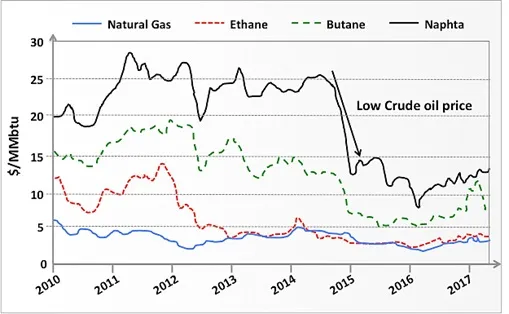
US NGLs vs. Naphta pricing developments, data from ICIS consulting & ICIS pricing
New Materials - Expanding the VAE Box
It is inevitable that only pushing the boundaries of the VAE-Box will lead to new innovations on the product or material side. Within the classical VAE space, the material property profile is widely explored.
A very recent attempt was made to introduce new Vinyl based co-monomers into the VAE space19. It is claimed, that the VAE polymers containing Vinyl benzoate units exhibit improved mechanical resistance based on the introduction of high Tg monomer.
VAE-Acrylics
Whilst non-VAE Vinyl acrylates are widely used for instance in paint and adhesives applications, Acrylate containing VAE ter-polymer emulsions only found limited commercial applications. This even though this space was explored already in the late 1970ies and led to very interesting material properties that led to higher value applications of the polymer emulsions20.
Commercially, there are VAE-Acrylics available for special adhesives application and exterior Paint application.
The ter-polymerization of VAM with Ethylene and Acrylates is not easy from a mechanistic point of view. The co-polymerization parameters are very unfortunate. This makes it difficult to ensure an even distribution of Acrylate units into the VAE polymer backbone. Therefore, specific process control measures have to be applied to overcome this issue. This makes the manufacturing more difficult and costly.
Recently, new attempts were made to incorporate Acrylate monomers into VAE polymerization. In this case, the polymerization is staged, with the formation of VAE first, followed by polymerization of Acrylate monomers into the VAE, forming domains of different material properties in the VAE matrix21.The formation of domains within the VAE matrix was also approached without using additional monomers. By a staged polymerization, Ethylene rich domains could be produced within the VAE matrix22.
Heat Sealable Coatings Based on VAE Technology
Commercially available VAE emulsions contain between 5 and 25 wt-% Ethylene. This translates to a molar fraction of about 50 %. Increasing the Ethylene content in VAE further doesn't lead to more softness as could be concluded just based on co-polymer Tg. The resulting polymers contain domains of poly-ethylene within a VAE matrix, and exhibit a clear melting point in the DSC diagram23.
New applications, such as heat sealable coatings were explored based on this technology, but didn't find yet broader commercial success. With classical VAE technology, it seems to be difficult to further explore and develop this technology.
Incorporating higher amounts of ethylene into VAE under the usual pressure ratings for commercial available reactors becomes increasingly difficult. Due to the moderating effect of Ethylene higher amounts of initiators are needed. That limits the molecular weight of the resulting polymers, with consequences for the material and application properties of the VAE emulsion.
Incorporating higher amounts of ethylene into VAE under the usual pressure ratings for commercial available reactors becomes increasingly difficult. Due to the moderating effect of Ethylene higher amounts of initiators are needed. That limits the molecular weight of the resulting polymers, with consequences for the material and application properties of the VAE emulsion. But there is (in theory) no limitation to the pressure rating of emulsion reactors. Polyethylene and also Ethylene-Vinyl acetate (EVA) polymers are made in reactors rated up to 1000 bar.
Initially, processes for making poly-ethylene emulsions were explored on the way leading toVAE24. So, when innovation on polymerization technology side could enable commercial viable processes for EVA or even polyethylene (PE) emulsions, new application fields might open.
New Cross-linkers for VAE Technology
Another interesting field for expansion of the VAE-box could be a combination with non-emulsion aqueous chemistry, such as Urethanes. Also, the investigation of new cross-linkers to further enforce the VAE polymer backbone could be a viable route to new material properties.
There are attempts made in the emulsions world, but mainly in the segment of Acrylate based emulsions25.
Conclusion and Outlook
In conclusion, it can be expected that VAE emulsions have a bright future. Several external drivers are advantageous for VAE emulsions like:
- Increasing environmental awareness of a raising middle class
- Globally stronger regulations towards solvents and other VOC in housing and construction applications
This can - of course - only hold to be true, if not a serious political or economical crisis alter the general global growth and development scenario.
It will only be a question of time until India's paint and construction market ripened for either a domestic player developing into VAE technology or one of the global leaders set up local manufacturing capacity.
At the time being, India market is supplied from South East Asia production facilities, but at least for liquid emulsions the cost for shipping up to 45% of water challenge this model from an economical point of view. The developing economies in the Near East are also set to establish local VAE technology. There is a raw material cost advantage and in general the raw material based industry is in the moment investing heavily into chemistry downstream of refinery and production of intermediates.
There are two more regions that still have a quite low coverage by VAE technology:
- Russia and
- South America
Either regions host local emulsion producers or global players with differed emulsion chemistry base and are supplied from outside, either from Europe or North America, with VAE emulsions and RDP.
As long the economical development is uncertain and there is no strong growth of a middle-class, it will take more time until VAE technology enters these two regions with local production.
At the moment VAE grows into these new markets by geographical expansion within the scope of already existing applications:
- RDP, and
- Paints and coatings

The producers will have to further adapt their recipes approaching new regions with local formulations, regulations, test regimes and customer preferences. But this process will only initiate further evolutionary, incremental innovation within the existing VAE-Box.
As soon the growth by market extension finds its saturation, the question will become more evident: How can VAE grow into new applications?
It seems to be un-evitable that only more out-of-the box innovation will be needed on the material property side for this case.
Compared to other polymer emulsion types, VAE is quite under researched from an academia point of view. Sure, other systems follow more close ideal kinetic schemes and are therefore easier to model.
On the experimental side, the complexity of VAE pressure polymerization exceeds the one for simple glass pot synthesis. But also it is not rocket science anymore to operate an autoclave. And wouldn't be a more in-deep investigation of particle formation and polymerization kinetics of the VAE emulsion system be a great scientific challenge?
But once done, there are probably many chances for new material properties in this yet unknown territory
- US 2,703,794 (DuPont), US 3,145,194 (Wacker), US 3,355,322 (Monsanto), US 3,404,113 (Air Reduction), US 3,483,171 (Hoechst)
- US 2008/0039572 A1 (Celanese)
- https://cdn.ihs.com/Connect/Content/ChemWeek/pdf/Wacker.pdf
- EP 1,110,978 B1 (Wacker)
- US 2005/0250899 A1 (Wacker)
- US 3,345,318 (Air Reduction)
- DE 2,512,589 A1 (Wacker)
- US 3,440,199 (Air Reduction), EP 1,153,979 B1 (Wacker), US 2013/0338253 A1 (Celanese)
- EP 1,069,169 B1 (Wacker), US 2015/0152291 A1 (Celanese)
- US2014/0171574 A1 (Celanese)
- US 4,449,978 (Air Products), EP 1,777,241 (Wacker), US 7,582,699 (Celanese)
- L. Keeley : Ten types of innovation, John Wiley & Sons, Inc., 2013
- US 4,035,329 (Wacker), US 4,164,489 (Air Products)
- EP 1,352,915 B1 (Wacker), US 8,822,572 (Wacker)
- WO 2013/171584 A1 (Celanese)
- US2009/0203832 A1 (Celanese), US 8,039,563 (Wacker)
- US2013/0156997 A1 (Celanese)
- US2012/0021237 A1 (Celanese)
- US2015/152291 A1 and EP 2,204,390 A2 (Celanese)
- EP 0,185,356 B1, EP 0,216,210 B1 (Wacker)
- US 2009/0043035 A1 and US 2014/350172 A1 (Celanese)
- EP 1,133,527 B1 (Elotex), US 2014/0350172 A1 (Celanese)
- US 7,189,461 (Air Products)
- US 2,592,526 (ICI), US 3,226,352 (Gulf Oil), US 3,296,170 (Union Carbide). US 3,380945 (Monsanto), US 3,400,089 (Hoechst)
- Okamoto et al., Progress in Organic Coatings, 29, 1996, 175-182 or Athawale and Nimbalkar, Pigment & Resin Technology 40(3), 2011, 181-190