

Conductive fillers: How to select the right grade for adhesives & sealants?
Last update on May 13, 2026
Electrical and thermal conductivity are critical performance requirements in modern adhesives and sealants. This is driven by the rapid evolution of electronics, energy storage, and power management technologies.
Achieving meaningful conductivity in adhesive systems is not easy, as the resin matrix is inherently insulating in nature. It demands careful decisions around filler chemistry, particle geometry, resin compatibility, and long-term stability under real-world conditions.
Let's find out how filler selection and resin design will help in achieving the desired electrical and thermal conductivity in adhesive formulations.
Why formulators choose conductive adhesives?
Certain applications require adhesives or sealants to have a degree of electrical and/or thermal conductivity. These include electrical and electronics, batteries, solar modules, and more. Technological advancements also require adhesives that combine strength, conductivity, and compatibility.
Most adhesives are inherently very low in electrical and thermal conductivity due to their organic nature. There are only two ways of producing polymers that have moderate degrees of conductivity:
- Synthesizing conductive molecules with intrinsic conductive behavior.
- Adding specific fillers to more common polymeric adhesive formulations.
The first method is extremely difficult. The filler route is a more direct and commercial approach to produce highly conductive adhesives. The type of filler used and its loading level can significantly impact conductivity, cost, formulation characteristics, and the final mechanical properties.
For a specific filler, there can be several variances, such as size (mean and distribution), aspect ratio, surface area, and surface chemistry. Thus, among various fillers, finding the right one with precision is important. This helps in developing a suitable electrical or thermal conductive adhesive that matches end-user requirements.

Advantages and disadvantages
The table below summarizes the advantages and disadvantages of conductive adhesives you should weigh at the formulation stage.
| Advantages | Disadvantages |
|
|
Most of the disadvantages are the result of the high filler loadings necessary to reach conductivity levels similar to solder. Filler selection and morphology are your primary levers for managing the trade-offs.
The following section explores how conductive adhesives achieve electrical and thermal conductivity and how these mechanisms influence formulation design.
Understanding conductivity mechanisms
The choice of conductive filler is largely guided by the intended conductivity profile of the adhesive. Depending on the end-use application, formulations may be optimized for electrical conductivity, thermal conductivity, or a combination of both. Each requirement influences filler type, loading level, and overall formulation balance. Thus, it is important to evaluate conductivity mechanisms separately.
Electrical conductivity
Electrical conductivity is important in adhesives that make an electrical interconnection between energized components and those that provide electromagnetic interference (EMI) or electrostatic dissipation (ESD).
Electrical conductivity that results from an applied adhesive varies according to the direction in which the conductivity is measured. Often, applied thin films show isotropic characteristics. It is due to the shearing forces that occur during the application process. This tends to align the filler particles and create greater conductivity in the direction of the applied stress.
However, certain adhesives require directional conductivity. For example, conductive pressure-sensitive adhesive tapes in certain applications may require conductivity in the z-axis, perpendicular to the substrates. Bulk interconnection and EMI/ESD applications generally require the same degree of conductivity in all directions.
There are two main types of electrically conductive adhesives. Each one is formulated to provide specific benefits depending on the required direction of conductivity. These are explained below:
- Isotropic adhesives: Will conduct electricity along all axes. Examples of applications include an alternative to solder, ground paths, etc., on a thermally sensitive substrate.
- Anisotropic adhesives: Allow electrical current to flow only along a single axis. They provide structural strength without an electrical connection in all areas of the device. Thus, they provide electrical interconnection without a sacrifice in bond strength or other adhesive properties. Examples of applications include LCD assembly, smart cards, flip chips, etc.
Common configurations are illustrated in the figure below.

Isotropic and anisotropic electrically conductive adhesives
Fillers, such as silver, gold, nickel, aluminum, and carbon of differing sizes and shapes, are used to produce adhesives. They offer varying degrees of electrical conductivity, adhesion, mechanical strength, and durability. Nickel, antimony oxide-coated fibers are used in low-conductivity applications. Aluminum oxide cannot be used due to its low conductivity.
Thermal conductivity
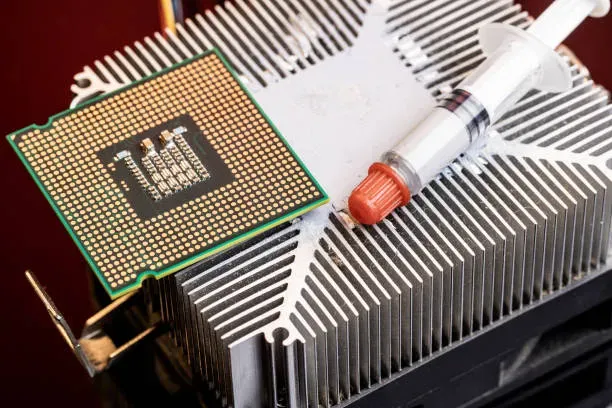
Thermal conductivity is important in highly integrated electronic applications. Here, the heat generated by components must be transferred outside of the electronic package. Many of today's electronic products feature miniaturization. In these applications, higher thermal conductivity is required from adhesive systems.
Thermal management of electronic devices has become a significant area of development. Thermally conductive adhesives provide a way to transfer heat away from sensitive electronic components. Thermal conductivity also helps to reduce heat evolution during cure. This reduces exothermic temperatures and extends pot life, particularly at high filler loadings.
Stresses related to shrinkage during cure and mismatch in thermal expansion coefficients are also reduced because of the thermal conductivity of the adhesive. Most unmodified polymeric resins have a very low thermal conductivity.
There are certain applications where high levels of thermal conductivity are required. For example, power electronic devices and other heat-generating components are bonded to heat sinks and other metal sources. Metal powder-filled adhesives, such as those described above for electrically conductive adhesives, can conduct both heat and electricity.
Some fillers are either electrically conductive or thermally conductive. Conventional thermally conductive adhesives are prepared by filling the resins with one or more fillers. Examples include graphite powders, carbon black, aluminum oxide, aluminum nitride, zinc oxide, and boron nitride. Metal powders, such as copper, nickel, aluminum, and silver, are also often used. They are used in thermally conductive adhesives, especially when electrical conductivity is also needed.
The principles leading to high electrically conductive adhesive formulations also apply to high thermally conductive adhesives. Thermal fillers show a percolation-type behavior. Thermal energy must traverse across the material thickness by hopping from one conductive particle to another.
The binder matrix coats each filler particle. This allows the thermal energy to go through a high-resistance layer before finding another conductive particle. Most commercial thermally conductive adhesives/sealants have thermal conductivities in the range of 0.4 to 10 W/m-K. A true vacuum (thermal conductivity = 0) and a diamond (thermal conductivity = 2300) are considered the limits of the thermal conductivity spectrum.
Knowing what conductivity type your application demands is only half the equation. So we will further look at the resin matrix and its design that holds the conductive particles together and plays an important role in conductivity.
How does the resin matrix affect your formulation?
The resin provides a mechanical bond between the two substrates and the conducting particles. The desired electrical or thermally conductive path itself comes from the conductive fillers. However, your resin choice directly affects the conductivity and long-term reliability of the cured system.

Conductivity is dependent on close contact between fillers within the adhesive
The particles must come in close physical contact with one another. Conductivity increases abruptly when a threshold level of well-dispersed conductive filler is achieved (shown in the figure below). This threshold level is termed the percolation level.
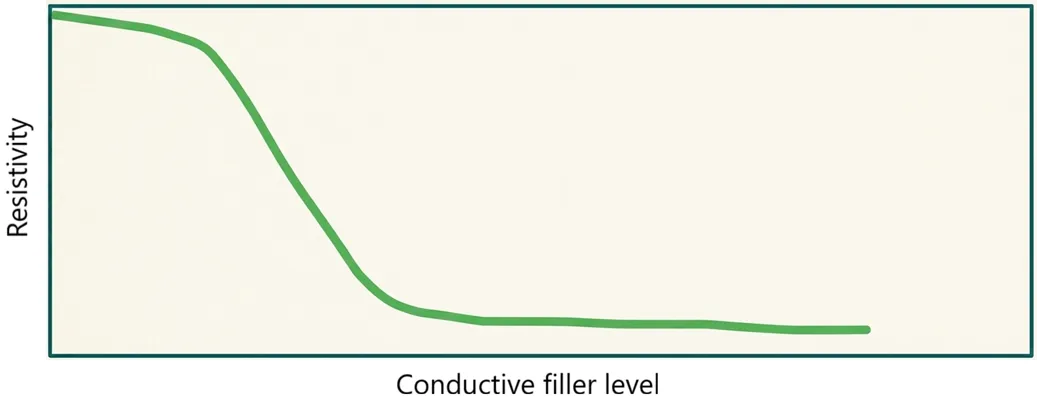
Conductivity increases & resistivity decreases when a threshold level of filler is used
Alternatively, the resistivity increases abruptly when the conductive path is broken. There can be several reasons for the interruption of the conductive path, such as:
- Loss of adhesion to the substrate
- Loss of adhesion to the particulate filler
- Oxide growth on the substrate or the filler (before or after the bond is made)
- Separation of particles due to thermal expansion differences between the resin matrix and filler
- Mechanical or environmental stress causes the fracture of the resin matrix
The oxide layers formed on metal particles rule out most metals for use in electrically conductive adhesives. For example, the aluminum powder cannot be used because of its insulating oxide film. Only noble metals form both thin and relatively conductive oxides.
Resin matrix properties influencing conductivity
The base resins used in conductive adhesives are among the most popular. Epoxy resin is the most common, but urethane, silicone, acrylic, and polyimide resins are also employed for specific end properties.
In addition to its adhesion and binding properties, the nature of the resin matrix also influences conductivity. Let's analyze each property of the resin in detail:
Resin resistivity: The resistance of the cured adhesive varies according to the resistance of the resin used. However, when compared to the metal fillers, the binders have relatively similar high resistivity.
Cure shrinkage: Each resin matrix shrinks at a different rate and to a different degree while curing. High shrinkage results in poor conductive paths. Thus, while formulating for high conductivity, resins with low cure shrinkage are chosen.
Filler wetting: Each resin will provide different wetting characteristics for the filler. This affects the ultimate concentration of filler that can be used at a practical viscosity in an adhesive formulation. A resin that wets the filler poorly limits how densely you can pack particles, which reduces achievable conductivity.
Permeability to oxygen and moisture: The barrier properties of the resin will vary by type. Resins that have high permeability to oxygen or moisture will cause changes on the encapsulated filler's surface. This can reduce conductivity over time. If your application involves elevated temperature or humidity, resin barrier properties are a critical selection criterion.
- Mechanical flexibility: Rigid resins are prone to cracking due to fatigue stress or thermal cycling. Microcracks reduce the conductivity of the cured adhesive. Thus, more flexible resin systems are considered to maintain long-term conductive path integrity.
With a clearer picture of how the resin matrix shapes conductivity, the focus now shifts to the fillers themselves. Let's see the distinct performance profiles, trade-offs, and ideal use cases that set each type of filler apart.
Selecting the right filler: Evaluating by types
Particle morphology & surface chemistry of fillers
The final selection checklist
- Licari, Swanson. (2011). Adhesives Technology for Electronic Applications. Elsevier Publishing Co.
- Liu (Ed.). (1999). Conductive Adhesives for Electronics Packaging, Electrochemical Publications Ltd.
- Klason et al. (1996). 'Electrical Properties of Filled Polymers and Some Examples of Their Applications'.