
New product concept
Open Innovation: Searching non-biocidal additives to be implemented in plastics or in coatings for plastics, that inhibit growth of microbes (bacteria, fungi, viruses)
Interested in this new product concept?
Description of Desired Solution
A SpecialChem client is seeking an additive to be implemented in plastics (including TPE, ABS, PC or PA) or in a coating for plastics, that inhibits microbial growth without being classified as a Biocides (as determined by the Biocide Product Regulations, regulation (EU) 528/2012) or the use of Pesticides (as determined by the EPA).
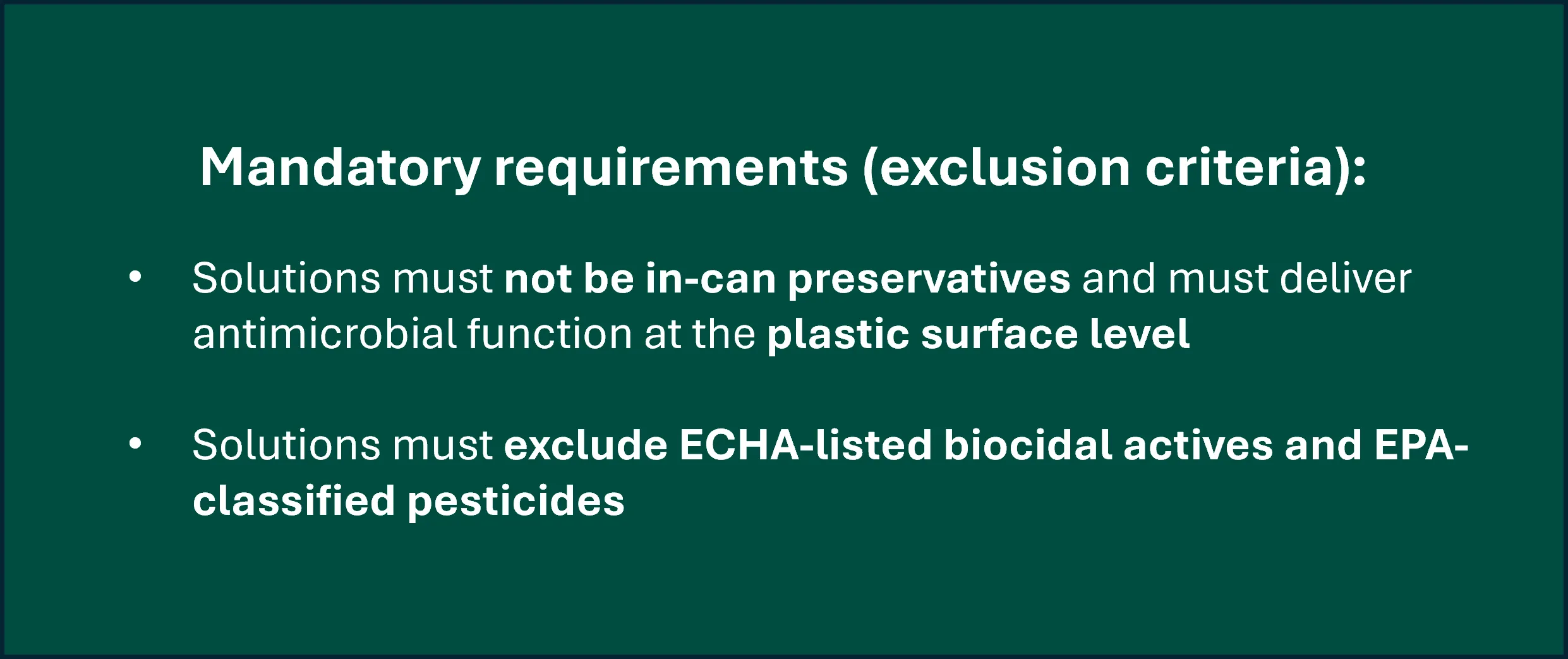
The solution should have proven efficacy & allow for direct implementation i.e. a Turn Key/ off the shelf solution. Supplier should have proof available that the solution is non-biocidal and has limited/to no effect on mechanical properties of carrier. Client not interested in preservatives, since the surface of the plastic end-product itself needs to obtain the anti-microbial function.
Detailed Solution Description

Ideal solutions are:
- Additives to be used in plastics or in coating for plastics (for TPE, ABS, PC or PA plastics) that inhibit the growth of microorganisms as measurable with ISO 22196.
- Solutions should focus on inhibiting microbial growth instead of killing.
- Additive is not part of the Biocidal Active Substance list (Information on biocides – ECHA) or classified as Pesticide as determined by EPA.
- Supplier should have proof solution is non-biocidal.
- Additives that have shown to have no/limited effect on other macroscopic properties of the base material like:
- Strength and other mechanical properties
- Friction during glide
- Color
- Additives should not impact recyclability
- Solutions are applied via injection molding process or by applying a coating.
- Additives that do not significantly alter the production method of the part.
- Solution should be scalable to enable large scale & worldwide implementation.
Possible routes to investigate (not limited to)
Additives that prevent the attachment of microorganism to the plastic surface of the end product, limiting growth of the organism. Solution should not kill bacteria via chemical means.
The SpecialChem Client is open to materials/strategies preventing the adhesion, proliferation, or survival of microorganisms to the plastic surface of the end product without releasing any toxic active substance (including innovative passive physical, topographical, or other solutions) as soon as they are durable solutions i.e. the effect doesn’t wear off during product lifetime, and they do not impact negatively other aspects of the product use.
Mandatory requirement
Solution should not contain chemicals listed on the Biocidal Active Substance list (Information on biocides – ECHA) or classified as Pesticide as determined by EPA. Solution should not be a preservative e.g. antimicrobial solutions for paint in cans.
Anticipated next steps with respondents
The proposal should clarify the potential field of application & contain proof of principle and documentation on the working mechanism. Depending on the maturity of the solution first samples will be produced and tested on microbial inhibiting properties, mechanical properties & recyclability as soon as possible.
Expected outcomes
Technology Readiness Level (TRL#): TRL 6 or above
The Special Chem Client is primarily seeking proven off-the-shelf solutions.
However, if as “by-catch” solutions with a lower Technical Readiness Level (TRL) are identified, the client is also interested in them for the longer term.
TRL# | Technology Readiness Level | Description |
1 | Basic principles | Lowest level of technology readiness. Scientific research begins to be translated into applied research and development (R&D). Examples might include paper studies of a technology’s basic properties. |
2 | Technology concept | Basic principles are observed. Applications are speculative, and there may be no proof or detailed analysis to support the assumptions. Examples are limited to analytic studies. |
3 | Proof of concept | Active R&D is initiated. This includes analytical studies and laboratory studies to physically validate the analytical predictions of separate elements of the technology. Examples include components that are not yet integrated or representative. |
4 | Validation in laboratory environment | Basic technological components are integrated to establish that they will work together. Examples include integration of “ad hoc” hardware in the laboratory. |
5 | Validation in relevant environment | The basic technological components are integrated with reasonably realistic supporting elements so they can be tested in a simulated environment. Examples include laboratory integration of components. |
6 | Prototype demonstration in a relevant environment | Representative model or prototype system, which is well beyond that of TRL 5, is tested in a relevant environment. Represents a major step up in a technology’s demonstrated readiness. Examples include testing a prototype in a laboratory environment or in a simulated operational environment. |
7 | System prototype demonstration in an operational environment | Prototype near or at planned operational system. Represents a major step up from TRL 6 by requiring demonstration of an actual system prototype in an operational environment. |
8 | Actual system completed and qualified through test and demonstration | Technology has been proven to work in its final form and under expected conditions. In almost all cases, this TRL represents the end of true system development. Examples include developmental test and evaluation (DT&E) of the system in its intended system to determine if it meets design specifications. |
9 | Actual system proven through successful usage | Actual application of the technology in its final form and conditions. Technology is commercially available. |
Company demographics
- Industry: Consumer goods
- Annual Revenue: >€10 Billion
- Years in Business: 100+ years
- Headquarters: Europe
Business considered
- Licensing
- Contractual partnership
- Buying
Want to share your solution with the seeker?
Option 1: Email submission
- Download the template to fill in with your solution here
- Once completed, please email it to: open-innovation@specialchem.com
Option 2: Online submission

Get in touch