
New product concept
Searching for a sustainable Spandex alternative
 Closed
Inquiries no longer accepted
Type of Solution sought
- A material
- A technology
- A partner
Description of Desired Solution
A global leader in the eco-designed performance clothing, is seeking an alternative to spandex.
The ideal solution:
- is from non-fossil fuel derived sources
- is recyclable in standard PET or NYL6 chemical recycling streams like glycolysis or methanolysis, at concentrations greater than 10%
- can be spun (dry spun, melt spun, etc.) into a fiber
- can be used to make compression clothing (high stretch, quick rebound).
Ideally, this would be a drop in material that can replace spandex entirely. If such a solution exists, there is no interest in tying up exclusivity for a long time and the SpecialChem client would love to build a partnership with multiple brands to bring this technology to market.
Currently the SpecialChem client uses about 200,000-250,000 pounds of spandex per year.
Background
The SpecialChem client is trying to move entirely out of fossil fuel materials, and into those that are biobased, or waste based, as well as ensure that all of the future products can be recycled efficiently.
Moreover, spandex tends to break down after time, uses isocyanates, and is generally challenging to filter out in a chemical recycling system.
Detailed Solution Description
- This polymer would need to be waste based or biobased, enable a high performance product, and be recyclable at the end of the product life.
- The material has to be spun into a fine fiber for use in apparel.
- Any solvents used should not be classified under GHS as carcinogenic, mutagenic, or toxic to reproduction (CMR) - this includes categories 1A, 1B, and 2.
- It would be functional for use in products like leggings and swimsuits, meaning the compression capability and recovery are critical performance attributes.
- Chlorine resistance and UV resistance are also important.
General Specifications (current grade, tolerances listed where applicable)
| Parameter | Current Range | Tolerance |
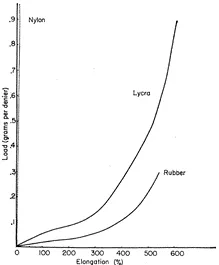
| Elastic Modulus @ 200% (gf/den) | 0.04-0.12 | 0.03-0.12 |
| Tenacity (g/den) | 0.9 | 0.5-1.2 |
| Load | 0.1 gf/d @ 200% 0.15 gf/d @ 300% 0.2 gf/d @ 350% 0.3 gf/d @ 400% |
See elastic modulus |
| Elongation | 200-700% | within range |
| Recovery @ 200% | 95%+ | 90%+ |
| Water Absorption | 0.3-1.2% | Lower than 2% |
| Chemical Resistivity | grade dependent | Resistant to hydrolysis, chlorine and UV degradation |
| Limited Permanent Set @ Elongation |
100-200% | 100-150% |
 |
 |

Possible Routes To Investigate
- TPEs are a possible solution, but hysteresis would need to be accounted for initially, and recyclability needs to be evaluated.
- Crimped PET fibers provide a material that is lightweight, stretches and recovers well, but does not provide elongation amount or compression that spandex provides.
Solution that are not of interest
- Materials still containing isocyanates as crosslinkers (TPUs, unless using a non-isocyanate polyurethane chemistry).
- PTT, PBT as they are challenging to separate in recycling systems.
- Materials using GMO outputs (US corn, soy) or derived from resources that may cause deforestation (Palm Oil, Soybean Oil, sugar cane).
- Xlance has a crosslinked olefin-based polymer that achieves close to what we are looking for, but is lacking in performance recovery, and is petroleum based. However, it does enable easier separation in chemical recycling.
- Polyether Block Amide does not have enough stretch and absorbs too much water as well as hindering recyclability.
Anticipated Next Steps with Respondents
- If a material is in polymer state, next steps would be to conduct spinning trials (minimum 50 kg), and then utilize materials at a manufacturing facility to determine commercial scale viability.
- If a material is in the fiber state, next steps would be to send this material to a manufacturing facility and determine commercial scale viability.
Type of Outcome expected
| Technology Readiness Level (TRL#) | 3 or above |
| Explain | Willing to do some testing and trials, but will need an initial proof of concept to ensure funding for further development |
|
TRL# |
Technology Readiness Level |
Description |
|
1 |
Basic principles |
Lowest level of technology readiness. Scientific research begins to be translated into applied research and development (R&D). Examples might include paper studies of a technology’s basic properties. |
|
2 |
Technology concept |
Basic principles are observed. Applications are speculative, and there may be no proof or detailed analysis to support the assumptions. Examples are limited to analytic studies. |
|
3 |
Proof of concept |
Active R&D is initiated. This includes analytical studies and laboratory studies to physically validate the analytical predictions of separate elements of the technology. Examples include components that are not yet integrated or representative. |
|
4 |
Validation in laboratory environment |
Basic technological components are integrated to establish that they will work together. Examples include integration of “ad hoc” hardware in the laboratory. |
|
5 |
Validation in relevant environment |
The basic technological components are integrated with reasonably realistic supporting elements so they can be tested in a simulated environment. Examples include laboratory integration of components. |
|
6 |
Prototype demonstration in a relevant environment |
Representative model or prototype system, which is well beyond that of TRL 5, is tested in a relevant environment. Represents a major step up in a technology’s demonstrated readiness. Examples include testing a prototype in a laboratory environment or in a simulated operational environment. |
|
7 |
System prototype demonstration in an operational environment |
Prototype near or at planned operational system. Represents a major step up from TRL 6 by requiring demonstration of an actual system prototype in an operational environment. |
|
8 |
Actual system completed and qualified through test and demonstration |
Technology has been proven to work in its final form and under expected conditions. In almost all cases, this TRL represents the end of true system development. Examples include developmental test and evaluation (DT&E) of the system in its intended system to determine if it meets design specifications. |
|
9 |
Actual system proven through successful usage |
Actual application of the technology in its final form and conditions. Technology is commercially available. |
Company Demographics
- Industry our client is in: Consumer Goods
- Annual Revenue: 1.15B
- Years in Business: 48
- Headquarters Area: USA
Business considered
- Contractual partnership
- Statement of work
- Master service agreement
- Joint development agreement
- Buying
- Funding