
New product concept
Seeking A Blue Light Absorber Technology
 Closed
Inquiries no longer accepted
Type of Solution sought
- A material or an ingredient
- A product or a technology
Description of Desired Solution
A SpecialChem Client is looking for a technology absorbing or blocking blue light transmission at 450 nm and below, with minimal visual impact.
This technology will be embedded within flexible, transparent, plastic substrates (such as polypropylene).
Background
The SpecialChem Client is a worldwide leader in consumer goods with massive outputs in optically clear, flexible, plastic substrates. The Client is seeking a technology that would allow its substrate to filter out high intensity, harmful light at 450nm.
Current market is 100 million units per year with potential of expanding to more product lines.
Detailed Solution Description
- The technology must:
- Achieve 20% transmission reduction at 450nm wavelength.
- If an additive, then require less than 1 wt% incorporation into substrates
- Maximize transmission of light from higher wavelengths in the visible spectrum so that the plastic substrate remains transparent
- Have minimal visual impact – not noticeably tinted to the naked eye
- Plastic substrate is 300 micron thick
- It is preferred if lower wavelengths of light are blocked
- Technology should be:
- Stable and should not migrate outside from the substrate
- Substrate will be exposed to mild polar solvents and/or water during post processing
- Be safe and nontoxic to human tissue contact once incorporated into substrates
- Shelf life > 5 years at ambient conditions in opaque packaging
- Heat stable at 130°C (265°F) for 30 minutes for post-manufacturing treatment
Example of desired transmission spectrum:
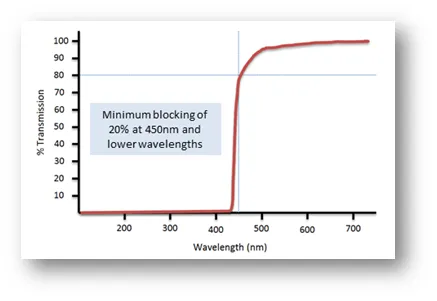
Possible Routes To Investigate
The solution can be coated on, or incorporated within, transparent plastic substrates.
- Organic dyes (soluble in polar organic solvents)
- Grafted within plastic
- Functionalized monomers to be polymerized
- Inorganic or organic pigments
- Hydrogels
- Incorporation could be by free radical polymerization
Solution that are not of interest
- Dye, as it can be washed away.
- The resultant substrate should not be brightly colored such as bright yellow or orange; while slightly amber or gray colors may be acceptable.
Anticipated Next Steps with Respondents
Technology trials could be conducted short term. Ideally, the solution can be commercialized within next 2-5 years.
Type of Outcome expected
- Ready-to-use solutions.
- Proven concepts
Company Demographics
- Industry: Consumer Goods
- Annual Revenue: >1 Billion US Dollars
- Years in Business: >10 years
- Headquarters Area: United States
Business considered
- Buying a technology or a product
- Licensing a technology
- Setting an agreement for co-development