
New product concept
Seeking A Biocompatible Gap Filling Adhesive Impermeable To Fluids
 Closed
Inquiries no longer accepted
Type of Solution sought
- A manufacturing process
- A material
- A technology
Description of Desired Solution
A SpecialChem Client is seeking a solution of filling porous substrate and small gaps to make it watertight. The solution should be waterproof with long-term stability. Due to the application, it is critical that this technology is safe for human contacts (biocompatible).
Background
The SpecialChem Client is looking for an adhesive sealant material, able to fill small gaps and to adapt to a porous substrate, ‘creating a three-dimensional plug’.
The adhesive property ensuring that a tight seal is formed avoiding fluids permeability.
Targeted volume is 40 to 70 millions of units per year.
Detailed Solution Description
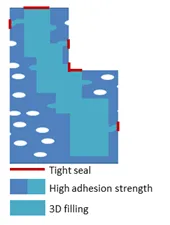
Required properties:
- Biocompatibility
- No known biocompatibility issues
- No known mutagenic and/or non-carcinogenic properties
- Desired - conforms to ISO 10993
- Desired - does not encourage bacterial growth
- Fill a complex shape
- Seal the gaps and the pores of the material
- The dimension of the gap to be filled is on the order of 1-2 mm x 1-2 mm x 10-20 mm
- The pores have diameter between 5 and 50 µm
- Temperature of application: 10-80°C
- Should harden in moist condition (up to 1% leachable)
- Possibility to have light UV and/or chemical and/or heat and/or moisture triggers for curing, avoid heavy instruments
- Tight seal
- Expansion of less than 1% and shrinkage of less than 0.3%
- High adhesion to porous substrate is desirable (bonding strength > 2.0 MPa) but nor critical as long as the material provides sealing. The sealing system should seal those pores to prevent aqueous fluid flow into the sealed gap, and could also utilize them to increase the adhesion via the mechanism interlocking mechanism. The surface of the gap can be described as a moist inorganic surface with fraction of organic substrates.
- Easily applicable
- Curing time of 15 min to 24 hours
- Low odor
- For flowable materials, the viscosity should be low enough to be able to penetrate into a 5 µm diameter pore. Alternatively, a practical application method that ensures that the small pores are sealed.
- Durable
- Resistant to liquids, pH ranging from 3 to 10
- Minimum shelf life of 24 months
- Color stable
- No diffusion in substrate
- Temperature of usage: 10-80°C
- Hardness no more than 50 VHN (material could also be elastic)
Possible Routes To Investigate
The technology solution can be a single or multi- component formulation.
- Functionalized polymers acting as a filler and adhesive agent
- Non-functionalized polymer with the adhesive agent dispersed in the polymer, requiring local activation
- Elastomeric material such as polybutadiene, polyisoprene, SBR, etc.
Solution that are not of interest
- Coating on the elastomeric filler, as it won’t have high adhesion strength with the porous substrate
Anticipated Next Steps with Respondents
Immediate if a ready of the shelf solution is applicable.
Type of Outcome expected
In decreasing order of priority
- Ready-to-use solutions
- Proven Concepts
- Concepts
- Partners
- Ideas
Company Demographics
- Industry: Various
- Annual Revenue: 10+ billion dollars
- Years in Business: 20+
- Headquarters Area: NAFTA
Business considered
- Licensing
- Buying
- Contractual partnership (R&D, marketing…)
- Joint-venture