


How to improve dimensional stability?
Last update on Jan 15, 2026
Dimensional stability measures a plastic's ability to maintain its shape, size, and functional properties over time. Engineering plastics often face extreme conditions, including machining processes and harsh operating environments, which can affect the material's performance and the part's overall functionality throughout its lifecycle.
What factors affect dimensional stability?
The three biggest factors are:
- Moisture & humidity: Different plastics absorb varying amounts of moisture at different rates. Over time, this moisture can influence the plastic’s mechanical strength, electrical properties (such as the dielectric loss factor), and physical dimensions.
- Temperature: Plastics generally have higher thermal expansion coefficients compared to metals, causing them to change size more significantly in response to heat. For complex or tightly-packed configurations operating in extreme temperatures, it's crucial to choose plastics with low thermal expansion coefficients.
- Mechanical stress: Compression, wear, and other stresses can cause plastics to distort over time. This distortion can occur both during the application of pressure and persist afterward, preventing the plastic from returning to its original shape.
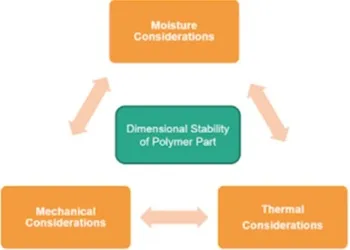
Image credits: https://www.findoutaboutplastics.com/1
| Resistant to moisture & humidity | Resistant to temperature | Resistant to mechanical stress | |
| PEEK | ✓ | ✓ | ✓ |
| PEI | ✓ | ✓ | |
| PPS | ✓ | ✓ | |
| PTFE | ✓ | ||
| PAI | ✓ | ✓ |
Formulation strategies
Visible After Login Visible After Login Visible After Login Visible After Login Visible After Login Visible After Login Visible After Login
Visible After Login Visible After Login Visible After Login Visible After Login Visible After Login Visible After Login Visible After Login Visible After Login
Visible After Login Visible After Login Visible After Login Visible After Login Visible After Login Visible After Login Visible After LoginVisible After Login