

What DMA can do for your product development needs?
Last update on Aug 6, 2019
 Dynamic mechanical analysis, or DMA, continues to find new applications in the development of novel and unique materials.
Hence, it is a very useful and powerful technique for both the resin formulator as well as the resin processor.
This article will help you understand how this technique can be used to satisfy the requirements of new product developments.
Let's start with understanding the basics of this technique.
Introduction and Basics of DMA
Dynamic mechanical analysis is an experimental technique that is often used to study and characterize the viscoelastic behavior of polymers. During the technique, a sinusoidal stress is applied to the material that is being tested. The strain in the material is then measured, allowing for a determination of the complex modulus. The temperature of the sample and the frequency of the stress are often varied, leading to variations in the complex modulus values.
The complex modulus that is measured in DMA experiments can be separated into two parts. E', or the storage modulus, measures the stored energy in the sample. E', or the loss modulus, measures the energy that is dissipated as heat. Finally a commonly quoted parameter is tan delta, the ratio of E' to E', or loss modulus to storage modulus.
Plotting Tan Delta v/s Temperature plot of DMA
In a typical DMA plot, both E' and tan delta as a function of temperature are displayed for a particular polymeric material. In such a graph, E' starts at a relatively high value, representative of a glassy material and starting at a temperature that is related to the material Tg it begins to decrease.
At some elevated temperature, E' is essentially zero and the polymer is in the rubbery state. At approximately the same temperature that E' begins to decrease, tan delta begins to increase and eventually it passes through a peak. The temperature at which the peak occurs in the tan delta values is one of the most common methods for defining transition temperatures. Also, in this particular case, the peak corresponds to the Tg of the material.
An Example of a typical tan delta plot is shown in the figure below.

Here, the peak at about 25°C is the Tg for this particular polymer.
Common Uses of DMA
DMA can generally be used to relate the performance of a product to its molecular structure and its processing conditions. Due to that fact, it is often used in structure/property/processing studies. Some of the most common uses for DMA are: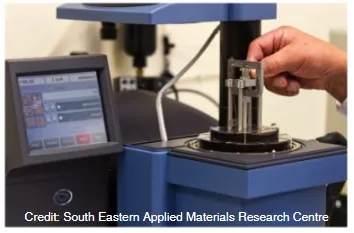
- Definition of Tg in new formulations
- Studying the effect of plasticizers
- Understanding the phase structure and behavior in multi-component material systems and
- Examining cure reactions in thermosetting materials
The general approach to using DMA to optimize formulations is to first define the property of interest, such as HDT or stiffness. Then, using established relations between DMA and the property of interest, the needed formulation is estimated. DMA testing is further done to verify that the predicted results are correct. Further formulation modifications are then done to obtain the desired DMA result.
Advantages of DMA over DSC Technique
DMA has certain advantages compared to other characterization techniques such as DSC, such as:
- First, DMA is very sensitive to small stiffness differences, thus allowing for clear definition of transitions such as Tg. This can be particularly important for thermosetting materials for which the definition of Tg can often be difficult.
- Second, unlike DSC, DMA is able to detect secondary transitions in polymers. The presence of these transitions is often related to hardness and other mechanical properties. Thus, DMA can provide insight into the molecular nature of the performance of polymers. Further examples of properties that DMA can help explain are HDT and stiffness.
- Finally, DMA testing can be done quickly, often in about 30 minutes. The actual time that is involved of course depends on the heating rate that is utilized in the testing. For multi-frequency experiments, it is necessary to use a slower heating rate to guarantee that transition temperatures can be accurately determined.
New Applications of DMA
- DMA is a very convincing technique for defining transition temperatures as a function of different processing conditions. Thus, for example Tg in a starch/cellulose acetate formulation can be discussed as a function of various processing situation, including both residence time in the extruder and the extrusion temperature. The effect of changes in both the screw speed and the extrusion temperature on both the glass transition temperature and the tan delta peak intensity has been investigated.
The implications of these results are that:
The extrusion conditions can affect the material performance and the performance can be characterized by use of the DMA techniqueThis is just one example of the use of DMA to characterize materials in the general developing field of bio-polymers and their applications.
- The other area in which DMA has been making significant contributions recently is in the evaluation of different rubber formulations. This can involve both mixtures of different rubbers as well as the use and incorporation of unique monomers into the basic rubber chemical structure. The focus of much of this work is the definition of the appropriate formulation to obtain a desired property, such as a specific Tg value. In these type of studies, DMA can be effectively used as a quick screening tool to help evaluate a number of possible formulations.
One example in which that approach has been successfully utilized is some work that has been done on mixtures of nitrile butadiene rubber with a polyimide polymer. The purpose of that study was to determine how the addition of various concentrations of the polyimide to the rubber affects the Tg value. A significant increase in the rubber Tg was observed and the work suggests that different Tg values can be obtained with different amounts of the polyimide in the rubber. This further implies that:
The performance characteristics of the rubber formulation can be optimized through the use of DMA technique

Conclusion
Overall, then, one of the emerging applications for DMA is in the definition of new formulations and the most efficient processing scenarios for those formulations. It can be used to both effectively and quickly screen new materials for unique uses or to define the best processing conditions for a particular formulation.
Thus, it is a potential technique for both the resin formulator as well as the resin processor. Compared to other characterization techniques, one of the primary advantages that DMA offers is the level of sensitivity to small material parameter differences. This sensitivity allows it to be a very effective way to discern small and subtle differences between various samples. As such, it is a very useful way to assist in the definition of the right material for a particular specific end-use application.