

Carbon black: How to select the right grade for plastics?
Last update on Apr 22, 2026
Carbon black is a highly engineered form of carbon, mostly used in plastics and rubbers. This black pigment helps you create a range of shades, from light gray to deep black.
You can change the properties of carbon black pigment to get the final product of your choice. Some features to keep in mind while selecting carbon blacks include:
- Tinting strength, level of jetness or blue undertone, and conductivity
- Particle size, structure, and surface chemistry
In this guide, we will showcase the process involved in producing carbon black pigments in various applications. Also, get to know the properties to consider while selecting the right carbon black for your formulations.
Role of carbon black in various industries
Carbon black is used in many products and articles we use and see around us daily, such as:
- Plastics, rubbers & tires
- Coatings & inks
Each product has a specific property that can be modified and enhanced by carbon black additives. The most important role of a carbon black is:
- Reinforcement of elastomers to enhance their mechanical properties (modulus, tensile and tear strengths, abrasion resistance…)
- Light protection
- Coloring
- Conductivity enhancement
- To reduce cost
- By decreasing the rubber weight (and its cost) used to obtain the same mechanical performances
- By increasing the functional performances as abrasion resistance
Thus, the requirements for the carbon black are different for each application and influence the specific properties in the final application. For the plastics and rubbers, there is a wide range of carbon black grades available in our Master Catalog. This can make it difficult to choose the most suitable carbon black for your final application.

For example, when aiming for 'piano blacks' for rich, luxurious finishes in automotive interiors, the carbon black pigment is often a material of choice. However, normally these types of carbon black grades are the most difficult to disperse correctly into the desired particle size.
The carbon black producers are addressing these issues by developing specialty carbon black grades that have been surface-modified and/or are pre-treated to overcome these difficulties.

Carbon black applications
You should consider important parameters while selecting the suitable carbon black grade. It is also essential to study how these parameters influence the other properties. Let's begin by discussing the processes used in the production of carbon black pigments.
How carbon black is produced?
The properties of the carbon black are influenced by the method of preparation. The different processes used for carbon black production are discussed below.
Furnace black process
Furnace black process is the most common method which uses (aromatic) hydrocarbon oil as the raw material. Due to its high yield and possibility to control the particle size and structure, it is most suitable for mass production of carbon black.
In the reactor, the conditions (e.g. pressure and temperature) are controlled to provide a number of reactions. The most important reactions include:
- Particle nucleation
- Particle growth
- Aggregate formation
Water injection rapidly reduces the temperature and ends the reaction. The primary particle size and structure of the carbon black are controlled in two ways. The first is by tuning the conditions in the reactor. The second is by adjusting the time allowed before the reaction is quenched.
Thermal black process
It is the most common method used for carbon black production after the furnace black process. It is a discontinuous or cyclical process. This process uses natural methane gas as raw material. When the natural gas is injected into the furnace in an inert atmosphere, the gas decomposes into carbon black and hydrogen.
The carbon black produced using this method has:
- Largest particle size and
- Lowest degree of aggregates or structure
Due to the nature of the raw material, this carbon black is the purest form available on the industrial scale.
Channel process
This process uses partially combusted fuel which is brought into contact with H-shaped channel steel. It is not the most used method anymore because of its:
- Environmental issues
- Increased natural gas price
- Low yield
The benefit of this process is that it provides carbon black with a lot of functional groups.
Acetylene black process
This process uses acetylene gas as raw material. It produces mainly high structure and higher crystallinity. This makes this type of carbon black suitable for electric conductive applications.
Lampblack process
It is the oldest industrial process for making carbon black. It uses mineral/vegetable oils as its raw material.
Recovered carbon black from end-of-life tires
Recovered carbon black or (r)CB is a fast-expanding market. Recovered carbon black is obtained through the pyrolysis process of end-of-life tires. The importance of companies in the production and use of recovered carbon black is three-fold:
- The growing global problems arising with end-of-life tires (ELT)
- Companies shifting strategy to fulfill the targets ensuring a green economy
- Price changes of regular carbon black due to fluctuations in oil pricing
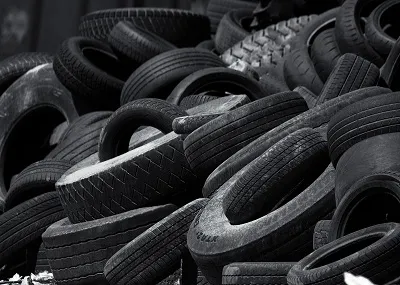
Recovered carbon black obtained from ELT
Depending on the composition, the content of carbon black in tires can be up to 30%. Next to carbon black, the tires consists:
- Rubber
- Rubber processing additives
- Metal
- Textile
- Fillers such as silica
The amount of silica depends on the type of tire, for example winter or summer tire, racing tire, or tire for agricultural vehicles, and will not be separated from the carbon black during the pyrolysis process, which will result in higher ash content.
In a typical car tire, up to 15 different types of carbon blacks can be used, each attributing to the different properties required. This blend of carbon blacks will then also be the make-up of the final (r)CB composition. Besides tires, other sources that can be used are rubber conveyor belts or other technical rubber products.
The presence of inert conditions in the pyrolysis process is important so that no additional carbon black is being produced.
The main differences in the properties of recovered carbon black are:
- The ash content is higher for (r)CB caused by the fillers being used in tire production.
- A blend of carbon black properties as a result of the carbon black used in the tire.
- Residual hydrocarbons on the carbon black surface, depending on the quality of the pyrolysis process.
To understand how the properties of (r)CB influence the final applications and to know which carbon black is used in which category, you need to understand the fundamental differences between the available carbon blacks in our Master Catalog.
Key properties of carbon black
Primary particle size
The first parameter to consider is the primary particle size of the carbon black. The primary particle size can vary from 15 nm up to 300 nm. Some furnace blacks have a particle size of even as small as 8 nm.

Primary particle size of carbon black
Carbon black with smaller particle size
Small particles result in higher jetness caused by a high surface area. They also provide:
- Better weatherability
- UV-fastness
- Better conductivity
On the downside, the smaller particle sizes lead to higher viscosity and require more energy for dispersing. These types generally have a blueish undertone and are used in the automotive industry where high jetness is required.
Carbon black with high particle size
The higher particle size improves the viscosity and dispersibility properties within the application. They have a more brownish undertone. They are generally more suitable for rubber and tire applications.
Structure
Physically, the carbon blacks are organized in three structural levels:
- Primary particles characterized by sizes ranging from 10 to 500 nm.
- Aggregates of particles characterized by size ranging from 40 to 600 nm.
- Agglomerates of aggregates.
Chemically, carbon blacks are more or less pure carbon as shown in table below.
| Chemicals | Channel | Furnace | Thermal |
| Carbon, % | 96 | 98 | 99 |
| Oxygen, % | 3 | <1 | Negligible |
| Hydrogen, % | 0.5 | <0.4 | 0.4 |
| Sulphur, % | <0.1 | 0.5 to 1.8 | <0.05 |
Carbon blacks: Chemical analysis examples
Already during the production process, aggregates are being formed from the primary particles. The structure of the carbon black is determined by:
- How the aggregates are shaped, and
- The level of branches in the aggregates.
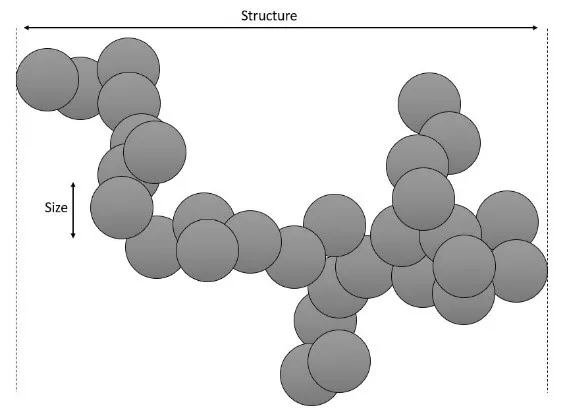
Structure of carbon black
High-structured aggregates give improved dispersibility and increased viscosity. On the other hand, they will affect the blackness with several important in-rubber properties.
Select from 80+ carbon black grades with improved dispersibility on our platform.
| Influence on Properties | Particle Size | Structure |
| Viscosity | ↑ | ↑ |
| Hardness | ↑ | ↑ |
| Modulus | - | ↑ |
| Elongation at Break | ↓ | ↓ |
| Swelling after Extrusion | - | ↓ |
| Dispersibility | ↓ | ↑ |
| Impact Resilience | ↓ | - |
| Tensile Strength | ↑ | - |
Influence on properties for particle size and structure
Surface chemistry
Another important aspect of carbon black is surface chemistry. Depending on the production process, the functional groups on the surface of the carbon black will be different. The type and number of functional groups will play a big role in the affinity within the application it is being used.
In general, when talking about surface chemistry, it is meant the level of oxygen-containing groups on the surface. For certain applications, the carbon black is further oxidized to increase the number of oxygen-containing groups on the surface.
Note: During the surface oxidation of carbon black, carboxyl groups are formed on the surface. This leads to a low pH of the carbon black. This could even cause incompatibility in certain coating systems.
Analysis methods
A number of tests are normally done to further specify the properties and analyze the carbon black used. The table below shows an overview of the most important test properties for carbon black and their corresponding ASTM methods.
| Property | Unit | Test Method |
| BET Surface Area | m2/g | ASTM D6556 |
| Statistical Thickness Surface Area, STSA | m2/g | ASTM D6556 |
| Oil Absorption Number | cm3/100g | ASTM D2414 |
| Pellets Hardness (average) | g | ASTM D5230 |
| Pour Density | kg/m3 | ASTM D1513 |
| Sieve Residue, 325 mesh | % | ASTM D1514 |
| pH | - | ASTM D1512 |
| Moisture Content | % | ASTM D1509 |
| Ash Content | % | ASTM D1506 |
| Sulfur Content | % | ASTM D1619 |
Properties of carbon black and their corresponding ASTM methods
So, what should be considered when selecting carbon black for plastics?
Factors to consider when selecting carbon black for plastics
Carbon black in rubbers and tires
Finding the right carbon black for your application
- (2017). Standard Classification System for Carbon Blacks Used in Rubber Products. ASTM International.
- (2009). Rubber compounding ingredients — Carbon black — Determination of solvent-extractable material. ISO 6209:2009.
- Balentine Enterprises Inc. (n.d.). Standard Reference Carbon Black (ASTM D-24). Carbon Standard.