

Omya Smartfill™ enhances the ductility, sustainability, and cost of engineering polymers
Last update on May 14, 2024
This is a sponsored article by Omya.
Polyamide and polycarbonate are high-performance polymers that are usually modified to meet the requirements of the application. Engineering polymer compounds usually contain materials such as glass fibers, minerals, impact modifiers and pigments, which bring their specific advantages but also disadvantages, such as increasing stiffness while reducing elongation and impact.
Omya Smartfill™ offers new properties not previously known from calcium carbonate and opens up new possibilities for engineering polymer compounds.
The benefits of calcium carbonate are well known in the plastics industry, and calcium carbonate is an important raw material in the industry. With Omya Smartfill™, these benefits can now be transferred to engineering polymers. Omya Smartfill™ provides the following benefits to engineering polymers:
- Increased productivity,
- Enhanced functionality, and
- Improved sustainability
In this article, you will learn about the new possibilities opened up by Omya Smartfill™ calcium carbonate. The way it improves the properties of polyamide and polycarbonate. We will also take a look at the area where innovation and sustainability meet in polymer applications.
The importance of calcium carbonate in the polymer industry
Calcium carbonate, which is ubiquitous in nature, can be found everywhere in daily life. It is used widely as a:
- Coating agent for paper and carton board
- Filler in paints
- Additive in food, pharma, and cosmetics
- Soil fertilizer in agriculture for water remineralization, flue gas desulfurization, etc.
In plastics, the first applications date back to the 1950s when Omya first introduced surface-coated calcium carbonate for PVC applications. Since then, the mineral is playing an integral part in many PVC formulations for wire and cables, pipes, conduits, and profiles. Today calcium carbonate is an important raw material for the whole plastic industry when producing products from polymers such as PS, UP, PUR, PE, PP, ABS, PET, PA, and PC.
Adding customized value to the plastics and rubber industry
Calcium carbonate is often mistakenly seen as just a filler, but it offers much more than that. By using Omya calcium carbonate, functionalities can be achieved that a pure polymer does not meet. Omya products enhance performance and profitability by:
- Improving polymer properties
- Lowering material and production costs
- Reducing the carbon footprint
- Increasing the recycled content
Omya provides natural calcium carbonate grades having a lower carbon footprint than polymers and pigments, as well as specific grades being made of recycled calcium carbonate.

Key features of Omya calcium carbonate
Omya meets the essential needs of current and future generations with technically advanced, responsibly sourced raw materials.
Performance of Omya Smartfill™ differs from known calcium carbonates
Omya Smartfill™ is a natural calcium carbonate powder with an innovative surface modification for compatibility with engineering polymers like polyamides and polycarbonate providing enhanced mechanical properties.
Polyamide (PA) with improved ductility at lower cost and lower carbon footprint
Minerals fulfill a wide variety of roles in polyamides and their performance differs according to whether they have low or high aspect ratio.
- Low aspect ratio — They have the advantage of better processing and good dimensional stability with improved stiffness.
- High aspect ratio — They have a positive effect on tensile strength and stiffness at the expense of dimensional stability.
A general major disadvantage of the minerals used to date is the reduction in elongation and lower impact strength in polyamide glass fiber compounds.
The use of calcium carbonate, which has an aspect ratio of 1, has so far provided an overall performance that is inferior to other minerals, but the development of the innovative surface modification of Omya Smartfill™ has opened new possibilities of improvement of the performance of polyamide products.
Omya Smartfill™ improves the elongation and impact strength of polyamides due to enhanced isotropy and provides processing benefits such as reduced warpage and better surface finish of glass fiber compounds. Compared to other minerals such as wollastonite and talc, Omya Smartfill™ offers higher impact strength and excellent whiteness.
| Materials | Modulus [MPa] | Elongation at Break [%] | Charpy Notched Impact [kJ/m2] | HDT (120°C/1.80 MPa) [°C] |
| Daunyl DPN 27 AV (Natural PA6) | 3190 | 8 | 2.4 | 60 |
| PA6 + 30% Omya Smartfill™ 55 - AV | 3930 | 19 | 4.1 | 65 |
Omya Smartfill™ improves performance of PA6
Replacing 5% glass fibers with 10-20% Omya Smartfill™ in a PA6GF30 compound increases stiffness while maintaining impact strength, and enhanced isotropy provides better dimensional stability of complex injection-molded parts.
| Properties | Polyamide Grades | Omya Smartfill™ | ||
| 0% | 10% | 20% | ||
| E-Modulus [N/mm2] | PA6GF30 | 8070 | 9010 | 10600 |
| Charpy Notched Impact [kJ/m2] | 10.8 | 11.1 | 10.0 | |
| Yield Strength [N/mm2] | 142 | 135 | 130 | |
| E-Modulus [N/mm2] | PA6GF25 | - | 8060 | 10400 |
| Charpy Notched Impact [kJ/m2] | - | 10.4 | 9.8 | |
| Yield Strength [N/mm2] | - | 122 | 133 | |
| E-Modulus [N/mm2] | PA6GF20 | - | 6740 | 7370 |
| Charpy Notched Impact [kJ/m2] | - | 8.1 | 8.6 | |
| Yield Strength [N/mm2] | - | 106 | 106 | |
10-20% Omya Smartfill™ improves overall performance of PA6GF30 compound
Polyamides and glass fiber are significantly more expensive and have a higher carbon footprint than Omya Smartfill™. Using Omya Smartfill™ in polyamides and polyamide-glass fiber compounds improves both cost and carbon footprint. Omya Smartfill™ 55 - AV is made from 100% recycled calcium carbonate and supports the industry in achieving its targets for the use of more recycled raw materials.

Presence of Omya Smartfill™ offers benefits to PA
White polycarbonate with improved stiffness, excellent opacity, and lower cost
Minerals and pigments usually degrade polycarbonate and reduce its mechanical properties. Thanks to an innovative surface modification, Omya Smartfill™ offers improved properties compared to conventional calcium carbonate and titanium dioxide, which increases both the modulus and impact resistance. Omya Smartfill™ can partially replace titanium dioxide without affecting the color values, thus improving the environmental impact and lowering overall costs.
| Materials | Modulus [MPa] | Yield Strength [MPa] | Elongation at Break [%] | Charpy Notched Impact [kJ/m2] | Opacity [%] | Color Value | ||
| L | a | b | ||||||
| 94% PC + 6% TiO2 | 2459 | 63 | 43 | 9 | 100 | 93 | 0 | 3 |
| 90% PC + 3% TiO2 + 7% Omya Smartfill™ | 2546 | 60 | 23 | 12 | 100 | 92 | -1 | 3 |
Omya Smartfill™ Improves Performance of PC as Compared to Conventional Fillers

Presence of Omya Smartfill™ Offers Benefits to PC
Supporting customers in reaching their sustainability goals
In all our markets, customers are increasingly focused on improving sustainability, reducing carbon footprint, and meeting their own ESG (Environmental, Social and Governance) targets. We work closely with customers to support their sustainability initiatives, primarily through the supply of natural calcium carbonate as raw material.
Our technical teams, backed by our investment in laboratories and pilot facilities, support the development of products solving specific customer challenges.
Calcium carbonate — A sustainable resource with a low carbon footprint
Calcium carbonates, such as limestone, marble, and chalk, are natural and renewable as defined by ISO 14021. Nearly 4% of the earth's crust is composed of forms of calcium carbonate, one of the most common raw materials in nature. It is continuously replenished by natural cycles in rivers, lakes, and oceans or formed as minerals, for example, from shells or skeletons.
Because of this, renewing calcium carbonate does not involve any energy-consuming chemical reaction, leaving the carbon footprint substantially lower than that of many of the raw materials it replaces. As a bio-mineralized or naturally produced resource, calcium carbonate is constantly renewed by natural processes, ensuring that reserves are available for many future generations. The replenishment rate exceeds the consumption rate, hence meeting the criteria for a renewable material.
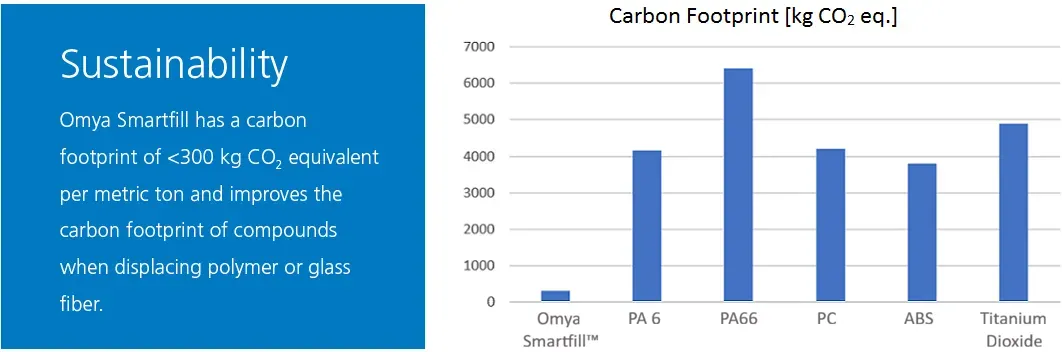
Omya Smartfill™ improves the carbon footprint of compounds when displacing polymer or glass fiber
Some grades, such as Omya Smartfill™ 55-AV, are made from 100% recycled calcium carbonate and are certified by Bureau Veritas, hence supporting e.g., the automotive industry in reaching their targets of using more recycled material.
The recycled status of this material does not affect its suitability for use in contact-sensitive applications (like food contact/food packaging).
Conclusion
Omya has introduced a new innovative grade of calcium carbonate that provides engineering polymers such as polyamide (PA) and polycarbonate (PC) with unique properties and meets the market demand for more sustainable and cost-effective solutions.
