

Nucleating and clarifying agents: How to select the right grade for polypropylene polymer?
Last update on Apr 21, 2026
Understand how to use nucleating agents and clarifying agents as well as get selection tips to effectively increase production rate, modify structure and morphology, and reduce haze in your polypropylene formulations.
Understanding nucleation in polypropylene
Role of nucleating clarifying agents
Crystallinity of semi-crystalline polymers is responsible for many of the characteristics, such as dimensional stability, clarity, and toughness.
For a defined part and process, the crystallinity is controlled by the polymer structure, the formulation, and the processing conditions that result in a specific balance of heat build-up and cooling. Consequently, crystallinity is often heterogeneous, the heat history being different for the skin and the core of the parts or goods.
Nucleating agents and clarifiers speed up and tune the crystallization allowing to adjust the end properties of semi-crystalline polymers to the functional requirements.
In polypropylene formulations, adding nucleating agents (also called nucleators) result in improved performance & processing properties, such as:
- Improved clarity and reduced haze
- Improved strength and stiffness
- Improved Heat Deflection Temperature (HDT)
- Reduced cycle time
- Reduced warpage and more uniform shrinkage
- Reduced pigment sensitivity regarding property changes with different colors
- Improved processability in certain applications
Thus, nucleation is a powerful way to improve the physical, mechanical, and optical properties of polypropylene. Clarity, dimensional stability, warpage, shrinkage, CLTE, HDT, mechanical properties and barrier effect can be improved by the careful choice of nucleators or clarifiers.

Let's discover the crystallinity of polypropylene (PP) in detail, along with its nucleation process, and types of nucleators & clarifiers available to make the right selection.
Polypropylene and its crystallinity
Polypropylene is a widely used crystalline, commodity polymer made from the polymerization of propene monomer. Upon polymerization, PP can form three basic chain structures (atactic, isotactic, syndiotactic) depending on the position of the methyl groups. The crystallinity of the polymer is characterized by:
- The shapes and sizes of the crystallites
- The crystallinity ratios, and eventually
- The orientation of crystallites
Isotactic polypropylene (iPP) is a semi-crystalline polymer. It is characterized by an excellent cost to performance ratio, making it very attractive in a wide range of applications like automotive, appliances, piping, packaging, etc.
Isotacticity index of iPP is directly linked to the degree of crystallinity which has a major impact on polymer performance. Isotacticity increases crystallization kinetics, flexural modulus, hardness & transparency, and decreases impact resistance & permeability.
Table below compares properties of two polypropylene homopolymers having a different isotacticity index.
| Properties | Standard | PP1 | PP2 | Unit |
| Density | ISO R 1183 | 0.904 | 0.915 | g/cm3 |
| Isotacticity Index | NMR C 13 | 95 | 98 | % |
| Flexural Modulus | ISO 178 | 1700 | 2300 | MPa |
| Deformation Temperature | ISO 75 | 102 | 131 | °C |
| Permeability | ASTM D 1434 | 40000 | 30000 | cm3-µm/m2-d-atm |
Effect of isotacticity index on iPP properties
DID YOU KNOW?
|
Crystallization of Polypropylene
Depending on the conditions, Isotactic Polypropylene can crystallize into four different phases denoted α, β, γ and mesomorphic smectic. The α and β phases are the most important.
 α Phase |
 β Phase |
 γ Phase |
Nucleation process in PP
It is well-recognized that the start-up point of crystallization of polymers is small germs (little particles) naturally included in the melt-like catalyst residues, impurities, dust, etc. It is then possible to modify and control crystalline morphology by the addition of "artificial" germs introduced in the polymer melt. This operation is called Nucleation.
- Nucleators or nucleating agents are employed that provide sites for the initiation of crystals.
- Clarifiers are a subfamily of nucleators that provide smaller crystallites that scatter less light and, as a result, enhance the clarity for the same wall thickness of a part.
The role of these nucleating agents is to improve the physical and mechanical properties of finished parts.
How do PP nucleating agents work?
A nucleating agent is typically characterized as an insoluble particulate that increases the rate of crystallization.
When semi-crystalline polymers crystallize from the melt (typically during the cooling phase of a process), the lamellae organize from a primary nucleus to form complex macro-structures called spherulites. These spherulites continue to grow until they impinge on an adjacent spherulite at which point the growth ceases.
Properties of the polymers, including optical and physical characteristics depend on:
- The end size of the spherulite structures
- The crystalline orientation in the matrix
In nucleated polypropylene, crystallization occurs earlier in the cooling process and happens at a faster rate. This allows decreased cooling time of the polymer. Also, nucleation density is much higher and crystal spherulite size is much smaller.
Figure below shows an illustration of the heterogeneous nucleation process versus a non-nucleated resin for comparison:

Illustration of the crystallization process in non-nucleated or nucleated matrix
Polypropylene is recognized as a relatively easy material to nucleate. This is because the rate of crystallization is low enough to allow the nucleating agent to have a direct impact on the nucleation density. Further, the effect of a nucleating agent depends on numerous parameters like:
- The nature of the polypropylene (homopolymer, random copolymer, block copolymer)
- The melt index
- The polydispersity index
- The processing conditions, and even
- The polymerization process
Nucleated PP molding formulations are often used for the production of thin-walled injection molded parts (< 0.4 mm) where stiffness is required. In some cases, cycle-time can be shortened by 30%. Nucleating agents are also used as a clarifier for films, sheets and molded parts, particularly for random PP copolymers.
Types of nucleating agents and clarifiers
Particulate nucleating agents
Particulate nucleating agents/nucleants are typically high melting compounds which are dispersed in the polymer melt via compounding. These particles act as distinct 'point nuclei' on which polymer crystal growth can commence.
- The high concentration of nuclei leads to more rapid crystallization (shorter cycle times), and higher levels of crystallinity, which improves the strength, stiffness, and HDT of the PP.
- The small size of the crystal aggregates (spherulites) leads to reduced light scattering and improved clarity.
The commonly used particulate nucleating agents include salts and minerals, such as talc, sodium benzoate, phosphate esters and other organic salts.
- Talc and sodium benzoate are considered to be low performance, low-cost nucleants, and provide a modest improvement in strength, stiffness, HDT, and cycle time. Select talc grades available in our Master Catalog!
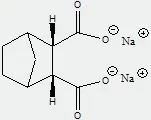
- The high performance, high-cost nucleants, such as the phosphate esters and the bicycloheptane salts give better physical properties and some improvement in clarity.
| Nucleating Agent & Chemical Structure | Description |

| Strengths:
Weakness:
Cost & Loading:
|

| Strengths:
Weakness:
Cost & Loading:
|
Bicycloheptane Salts | Strengths:
Weakness:
Cost & Loading:
|
Commonly used particulate nucleating agents

Soluble nucleating agents
- As the polymer melt cools in the mold, these nucleants crystallize out first forming a finely distributed network with extremely high surface area.
- As the temperature continues to drop the fibrils comprising this network function as nuclei to initiate the polymer crystallization.
- The extremely high concentration of nuclei leads to very small PP crystal aggregates, which give the lowest level of light scattering and the best clarity.
| Nucleating Agent & Chemical Structure | Description |
Strengths:
Weakness:
Cost & Loading:
| |
Strengths:
Weakness:
Cost & Loading:
| |
Strengths:
Weakness:
Cost & Loading:
|


Commonly used soluble clarifying agents
Other classification aspects
Inorganic and organic nucleating agents
Classification according to the favored crystal types: α, β, γ...
Benefit from a full range of nucleating and clarifying agents used to manufacture polypropylene products. Check their tech profile, ask for samples or discuss your case with producer's tech staff, and download technical data!
Nucleating agents for Polypropylene (PP) Clarifying agents for Polypropylene (PP)
Factors impacting performance of nucleants and clarifiers
Key applications

Nucleated/clarified polypropylene are used in consumer products such as furniture, lawn and garden furniture

Used in medical applications such as syringes, labware, sharps containers, and other medical equipment and devices

Nucleating & Clarifying agents are used in household applications such as coffee pots