

Millad® NX® 8000 Clarifier: How to Achieve Glass-like Clarity in Polypropylene Packaging?
Last update on Jan 16, 2025
This is a sponsored article by Milliken.
Glass has long been revered across various industries for its clarity, chemical inertness, and aesthetic appeal, especially in food and beverage packaging. Its non-reactive nature ensures that contents remain uncontaminated, preserving their quality and flavor. Its recyclability seemingly aligns with global sustainability efforts, making it popular among consumers.
However, despite these advantages, a noticeable shift towards plastics is driven by practical challenges associated with glass. Advancements in additive technologies are creating plastic resins that can match glass performance. The practicality of plastic gives it an edge over glass, including its weight and fragility.
The rise of plastics, particularly polypropylene (PP), challenges glass's dominance in clear packaging. Innovations like the clarifier further improve PP's transparency. Thus, it can achieve glass-like clarity while maintaining the practical advantages of plastics.
In this article, discover why polypropylene is a preferred choice over glass and how to achieve glass-like clarity in plastics with Millad® NX® 8000 clarifying agent.
Clear Packaging Materials for Consumer-packaged Goods (CPGs)
Clear packaging is favored for CPGs, as it enables customers to see the product, enhancing appeal. Brand owners typically use materials like glass or plastic to create clear CPG packaging.
Known for its transparency and sustainable image, glass is a seeming front-runner for clear packaging. Yet, it is heavy and expensive to convey, contributing to higher transportation costs and emissions. If a brand is considering a plastic material, polyethylene terephthalate (PET) or polystyrene (PS) are usually in the mix, but each has its shortcomings:
- PET offers clarity and strength but lacks heat resistance, making it unsuitable for microwave or high-temperature applications.
- PS leads in natural clarity and is very rigid, but the material is also brittle, dense, and non-recyclable under key guidelines.
With the latest additive solutions, polypropylene (PP) has become a viable alternative for CPG packaging. It is lightweight, highly heat-resistant, and can achieve parity with PS and even glass clarity when enhanced with a clarifying agent. Innovation surrounding PP has advanced so much that brands are considering it alongside the perceived sustainable choice of glass, and the comparison is different from what you may think.
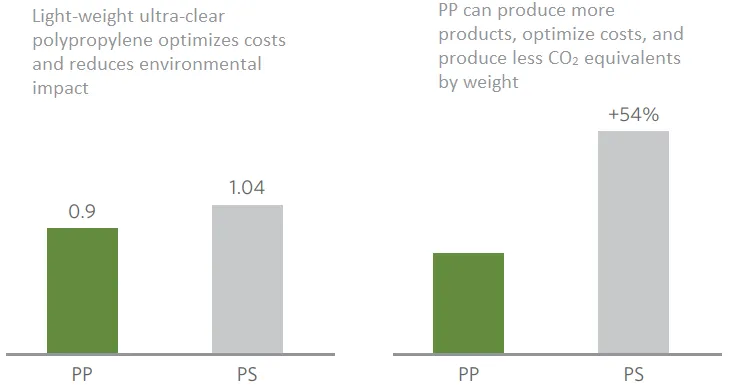
Ultra-clear PP: A Cost Competitive Material Option with a Low Impact on the Environment
A balanced perspective on plastics - An analysis from McKinsey report
Plastics, including PP, are widely used across industries but often face criticism for their end-of-life and recyclability challenges. However, plastics also offer significant efficiency benefits, such as reducing food spoilage and greenhouse gas (GHG) emissions. A report from McKinsey evaluates the total GHG impact of plastics versus alternative materials by examining their entire life cycle — from production to disposal — and their effects in use.
Based on U.S. data from 2020, the study includes projections to assess plastic usage impacts in other regions and forecasts changes as we advance toward a decarbonized future by 2050. It highlights five sectors with the highest plastic consumption — packaging, construction, consumer goods, automotive, and textiles — representing nearly 90% of global plastic use. Applications analyzed include large-scale, feasible alternatives to plastics, omitting niche solutions to ensure relevance to current market conditions.
Key findings indicate that, in 13 out of 14 cases where viable non-plastic alternatives are used at scale, plastics showed a lower overall GHG footprint, providing emissions savings between 10% and 90%. Particularly in food packaging, where few alternatives exist, plastics play a crucial role in reducing GHG emissions by preventing food spoilage and enhancing energy efficiency.
This analysis underscores that, although the circularity challenges of plastics are significant, they also offer critical benefits in emissions reduction and resource efficiency in major sectors. A balanced, science-based perspective is essential for understanding the complex implications of plastics versus alternative materials as we pursue sustainable solutions in a decarbonizing world.
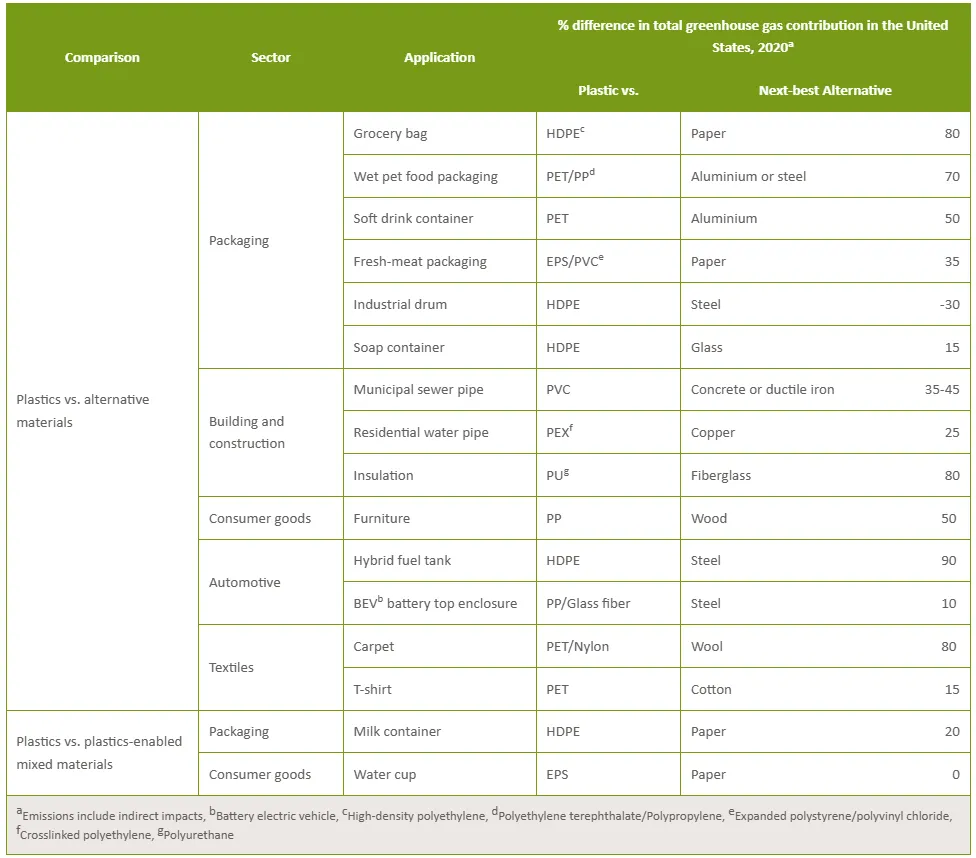
Plastics Have a Lower Greenhouse Gas Impact in 13 of the 14 Non-plastic Alternative Applications Analyzed, Including Both Direct and Indirect Value-chain Emissions1
PP Highlights: Demonstrating its Superiority
With a shift in mindset surrounding plastics, PP and glass can be compared on performance in packaging application to arrive at the clear winner.
Weight, secondary packaging, and breakage
PP offers significant advantages over glass in the weight and density category. Compared to glass, PP is lighter, translating to lighter packaging weight and reducing total product weight as less PP by volume is needed to create a similar glass receptacle. Using PP can reduce the need for secondary packaging that might be required with glass containers. Lighter-weight packaging also helps lower greenhouse gas (GHG) emissions associated with transportation. For example, studies comparing plastic soap containers to their glass counterparts show that plastic options provide an estimated 15% reduction in GHG emissions.
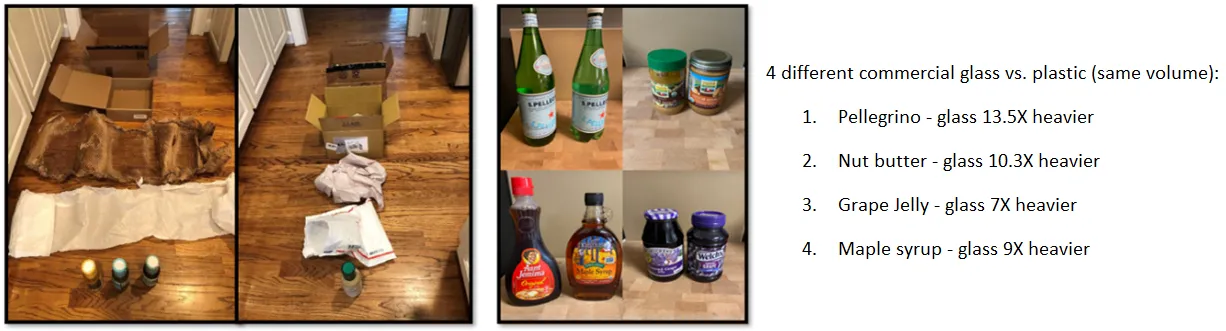
Polypropylene (PP) Provides Lower Shipping Costs than Glass
Additionally, PP's durability significantly reduces breakage, which decreases waste. PP is inherently more resilient, with a density of roughly one-third that of glass, minimizing the need for thicker construction and lowering the chances of breakage. On average, glass packaging is 12 to 14 times heavier than plastic packaging due to both density differences and the requirement for thicker walls to prevent shattering. This reduction in breakage is especially beneficial in e-commerce, where brands often bear the cost of damaged goods, and it also minimizes potential safety risks and liability claims associated with broken glass.
Recycling compatibility and environmental impact
While glass is known as one of the most recyclable materials, with the potential for nearly endless recycling without loss of quality, it comes with additional challenges that increase its carbon footprint. Recycling glass incurs high costs due to the weight and bulkiness of the material, making transportation from collection centers to processing facilities both logistically complex and expensive. This weight also contributes to higher fuel consumption and GHG emissions during transport, undermining some of the environmental benefits of glass recycling.
Additionally, broken glass presents processing challenges, as it can be difficult to sort and may damage recycling equipment. The variability in glass types and colors further complicates sorting, often requiring manual or advanced automated systems that add to processing costs. These factors collectively increase the carbon emission of glass recycling, despite its recyclability.
In contrast, PP has emerged as one of the most recycled polymers and offers distinct advantages in terms of environmental impact. PP is lightweight, reducing transportation costs and emissions associated with recycling logistics. Moreover, PP can be recycled more efficiently, with established processes that allow it to be collected, sorted, and processed at a scale. Although plastic recycling still faces hurdles, the infrastructure and technology for PP recycling continue to advance, making it increasingly viable as a circular material.
While glass remains an excellent option for long-term recyclability, the advantages of PP—particularly in reducing transport-related emissions and simplifying recycling processes—make it a compelling choice for industries focused on sustainable material management using existing recycling methodologies.
Mono-material packaging solutions
PP offers a unique advantage in creating mono-material solutions, where an entire product is made from a single material. In packaging applications, this approach—developing a packaging system, including labels, films, and caps, that is fully one material—significantly simplifies the recycling process, as the entire item can be processed together without the need for labor-intensive separation.
Mono-material solutions eliminate the complexity often associated with multi-material packaging, where components made from different materials (e.g., plastic caps, paper labels, and glass or metal containers) must be sorted and processed individually, often leading to contamination and reduced recycling efficiency.
By using PP as a mono-material solution for all parts of a product, companies can enhance the recyclability of their products, as recycling facilities can handle these items with fewer processing steps. This compatibility boosts recycling yields and reduces waste from contaminated or improperly sorted items, making the recycling process more efficient and less costly.
A viable alternative
PP stands out among plastics for its lightweight, durability, and cost-effectiveness, and with the right clarifying agent, it can even stand up to the sustainability characteristics of glass. PP has emerged as a popular alternative to glass due to its ability to achieve the same level of transparency while maintaining the practicality of plastic, opening new possibilities for industries seeking to replace glass with a safer, more efficient option without compromising aesthetics or functionality.
Millad® NX® 8000 Clarifier: Enhance PP to Produce Ultra-Clear Materials
Clear packaging developed with clarified PP needs the right
Using Millad® NX® 8000
- Superior clarity: Achieves glass-like transparency in polypropylene, enabling its use in applications previously limited to clear plastics.
- Energy savings: Offers energy savings from faster processing due to lower temperature requirements.
- Cost efficiency: PP with Millad® NX® 8000 provides a cost-competitive alternative to PS, with improved balance in properties like scratch resistance and flexibility.
- Balanced properties: Combines high transparency with good stiffness, impact resistance, chemical resistance, and thermal stability.
- Applications: Suitable for products needing clarity, durability, and sustainability, with capabilities for hot filling and retort processes.
To discuss practical applications of Millad® NX® 8000 clarifiers - Connect with experts from Milliken


Milliken – View Supplier Offerings Here
DISCLAIMER: All images, tables, and graphs used in this article are copyright of Milliken.