

Factors for Effective Reinforcement in Polymer Composites
Last update on Sep 12, 2011
Examples of high strength fibers which are commonly used in polymer composites are fiberglass, carbon or aramid. It is estimated that in about 90 percent of composites, fiberglass is used for the reinforcement. Fiberglass is used primarily because it allows for the attainment of differentiated high stiffness products and offers a high strength/price relation. It is available from several suppliers, including PPG, Owens Corning and 3B, for use in polymer composites.
Having defined the resin/fiber system which will be used in the composite, it is necessary to specify the length of the reinforcing fiber which is to be used for the most effective reinforcement. High aspect ratio fibers added to a polymer matrix increase both the Young's modulus and strength of the composite due to the fact that at a given composite strain, the fiber carries more stress than the matrix since it is stiffer. The use of long fibers in polymers can create composites with a strength and stiffness comparable to metals at a fraction of the weight. However, long fibers are often easily broken up during composite manufacturing. The use of short fibers makes the processing of the material easier but makes the reinforcement carry less load. Straining of a composite with short fibers will generally cause failure away from the fiber itself, possibly within the matrix or at the fiber-matrix boundary. A longer fiber may be of sufficient length to just cause failure in the fiber, with this length often referred to as the critical length, lc. The reinforcing fibers must have at least this length to strengthen a material to their maximum potential.
The critical fiber length can also be used as an indication of the level of adhesion between the fiber and the surrounding polymer matrix in a composite material. A weak interfacial strength results in large lc values, whereas very strong fiber-matrix interfaces results in relatively small lc values. The following relationship between the critical fiber length lc, the fiber diameter d, the interfacial strength τc and the fracture stress of the fiber σf, has been determined experimentally(1)):
|
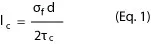
From this relationship, it can be seen that there is a correlation between the critical fiber length and the interfacial adhesion. The ideal situation occurs when the fibers in the composite are longer than the critical fiber length and when the adhesion between the fibers and the matrix polymer is high.
One approach for increasing the interfacial strength between the fiber and polymer matrix is through chemical modifications of the fiber using coupling agents. The coupling agent which is used contains chemical groups which can react with the fiber and the polymer. The bonds formed are either covalent bonds or hydrogen bonds which improve the interfacial adhesion.
The use of coupling agents in reinforced composites results in greater composite strength and longer service life. Organofunctional silanes, with the chemical structure, Y–Si(OR)3 are the best known coupling agents. In composites, as much as a 40 percent increase in flexural strength is obtained with the use of the proper silane coupling agent as well as the correct amount. Selection of the correct silane agent to use depends on the chemical nature of the matrix material, since a bond is desired between a chemical group on the coupling agent and the matrix polymer.
Another primary requirement for obtaining a high-performance composite is good dispersion of the fibers in the polymer matrix. Lack of fiber dispersion can result in clumping and agglomeration of fibers, which lead to the composite properties falling short of their true reinforcing potential. Hence, it is important to examine the fiber dispersion throughout a composite sample.
Processing can substantially influence fiber dispersion and, thus, quality of the composite performance. For example, in an extrusion process involving a composite, higher extruder screw speed is expected to increase the fiber dispersion due to an increase in the shear energy. However, at the same time, this increase in shear energy may also cause fiber breakage, affecting the attainment of the critical fiber length for maximum reinforcement. Thus, there is an interplay between the achievement of the optimum dispersion and the ideal fiber length. This effect can be minimized through the use of reinforcing fibers which are not altered during the composite processing.
Now that factors that affect the reinforcing ability in composites have been discussed, it is necessary to define a way in which the actual reinforcing ability can be quantified. The reinforcing ability of the fibers in a polymer matrix can be quantitatively described using simple analytical models. One of the most commonly used models is the Cox-Krenchel(2). In that treatment, the axial Young's modulus of the composite, Ec is written using the well-known rule of mixtures:
Ec = νf Ef + (1 - νf) Em (Eq. 2)
where Em and Ef are the Young's modulus of the matrix and the fiber, respectively and νf is the volume fraction of the fiber. This equation shows the importance of having a high modulus fiber for the production of a composite material with a high Young's modulus value.
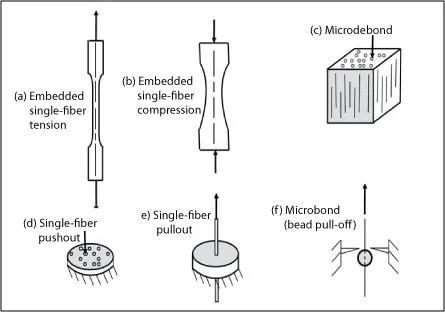
Among techniques which have been developed to quantify the interfacial adhesion in composites, one of the most often quoted approaches is based on the microbond test(3)). A pictorial representation of that test is shown in Figure 1. In the microbond test, a droplet of matrix polymer is sheared from a fiber, and the stress to cause fiber/matrix debonding is measured. The measured stress is, then, interpreted in terms of interfacial properties taking into account specimen geometry, residual thermal stresses, and interfacial friction effects.
|
The final parameter that needs to be quantified is the dispersion of the reinforcing fiber in the polymer matrix. This is typically accomplished through the use of some variety of microscopic technique. Using such techniques, it is possible to determine the size of agglomerates of the reinforcing fiber. It should be noted that there are materials available which can aid in the effective dispersion of the reinforcement material.
Summarizing, then, four important factors have been discussed for the optimization of the reinforcement and, hence, the performance in composite materials. The chemical composition of both the matrix polymer and reinforcing fiber needs to be specified as a starting point. Having done that, within the realm of the reinforcing fiber itself, fiber length, adhesion with the polymer matrix and ability to be dispersed within the base polymer are key features. This article has shown that these parameters are interconnected as well. Through an understanding of them and their relations, the maximum reinforcement in composites can be achieved.References
- A. Kelly and W.R. Tyson, 1965, "Tensile Properties of Fiber-Reinforced Metals, Copper/Tungsten and Copper/Molybdenum", Mech. Phys. Solids 13, 329-338.
- D. Hull and T. Clyne, 1981, "An inroduction to composite materials", Cambridge, UK: Cambridge University Press.
- B. Miller, P. Muri and L. Rebenfeld, Comp. Sci & Tech., 1987, 28, 17-32.