

Dispersing agents: How to select the right grade for plastics?
Last update on May 27, 2026
For effective dispersion of filler, first, it is important to understand about dispersing and coupling agents. Find out how these additives operate at filler/polymer surface and what are the several benefits offered to formulations for improved performance and cost.
Why dispersing & coupling agents are required?
For decades, the incorporation of inorganic and organic fillers into a polymer matrix has been of significant industrial importance. These additives are added to develop new composites with desirable properties adapted to specific applications. Pigments, fillers and other fine-particle solids can be incorporated more easily into plastics compositions via addition of dispersing agents and coupling agents.
On one hand, dispersants are used to wet, stabilize and increase the loading of pigments and other fillers. While on the other hand, coupling agents are used to provide a stable bond between two otherwise nonbonding and incompatible surfaces. Addition of these additives lead to:
- Proper dispersion: The energy needed for dispersion is reduced
- Enhancing the level of interaction between the filler used and polymer matrix
- Homogeneity and storage stability of the final products are improved
- The color strength of pigments increases as a result of the fine dispersion, and their productivity therefore rises
- Greater composite strength and longer service life
- At any concentration, the dispersing and coupling agents can effectively enhance processability, mechanical and aesthetic properties of plastics
- Lower viscosity/improve polymer flow for improved productivity i.e. better mold filling, thinner walled parts (Graph 1)
- Increase in impact strength
- High yield strength & elongation to break
- Higher tinting strength
- Enhance aesthetics such as gloss and surface finish
- Blocked filler surface and cannot absorb other additives from the polymer
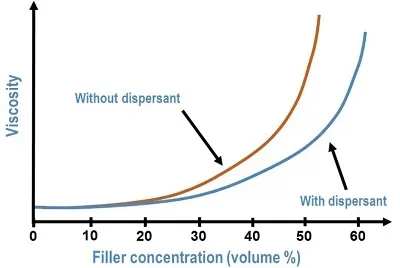
These enhanced properties make plastics material suitable for several applications like:
- Packaging
- Consumer Appliances
- Electronics components
- Automotive
- Aerospace
 |
Now that we know why these agents are essential, let's take a closer look at how they actually work at the molecular level.
Mechanism of action
Types of dispersants and couplants
- Rueda. (2017). Rheology and processing of highly filled materials. HAL Open Science.
- Katz, Milewski. (1987). Handbook of Fillers for Plastics. Van Nostrand Reinhold.
- Monte. (2002). Neoalkoxy Titanate and Zirconate Coupling Agent Additives in Thermoplastics. Polymers & Polymer Composites.
- DeArmitt. (n.d.). Dispersants and Coupling Agents Training. Phantom Plastics.
- Arkles. (2014). Silane Coupling Agents: Connecting Across Boundaries (3rd ed.). Gelest.
- (n.d.). Silane Coupling Agents. Shin-Etsu Silicone.
- Dyson. (n.d.). Engineering Polymers.