
Xenia's 20% CF Reinforced Polycarbonate Used in Production of Competitive Aircraft
Last update on Jan 16, 2025
TAGS:
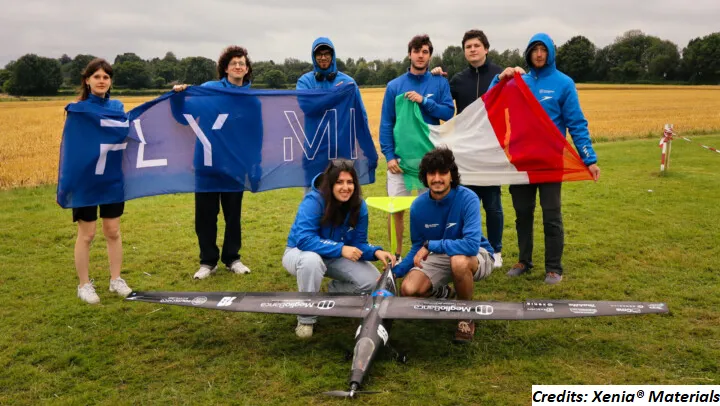 highlights its contribution to the success of Nyx, an innovative aircraft. It was designed by Fly Mi – EUROAVIA Milano, the student association of engineers and designers from the Politecnico di Milano.
This project represents a significant achievement for both the Politecnico di Milano and Xenia Materials, highlighting how collaborations between industry and academic institutions can lead to groundbreaking advancements in innovation.
highlights its contribution to the success of Nyx, an innovative aircraft. It was designed by Fly Mi – EUROAVIA Milano, the student association of engineers and designers from the Politecnico di Milano.This project represents a significant achievement for both the Politecnico di Milano and Xenia Materials, highlighting how collaborations between industry and academic institutions can lead to groundbreaking advancements in innovation.
Low CTE Reduces Thermal Shrinkage
For the academic year 2023/2024, Fly Mi decided to participate in its first international competition: the Air Cargo Challenge, held in Germany last July. Faced with the rules and restrictions imposed by the competition, the team developed and built Nyx, an ambitious drone crafted from composite materials. With a length of 1.5 meters and a wingspan of 3 meters, Nyx represents a remarkable achievement in engineering and design.
To meet the high demands of the Nyx project, Xenia Materials stepped in, supplying XECARB® 40-C20-3DP, a 20% carbon fiber reinforced polycarbonate specifically designed for Additive Manufacturing market. This material was essential in the creation of the molds used for laminating the wings and control surfaces, which are crucial for the drone's flight capabilities.
'With its low CTE values, the material provided by Xenia significantly reduced issues related to thermal shrinkage during the design phase, enabling us to produce higher-quality parts. Furthermore, the absence of permanent deformations in the molds after use, along with the resistance of internal surfaces to release agents, allowed us to repeatedly laminate the movable surfaces and test various internal configurations to find the best solution,' said the students who took part in the project.
The feedback of the engineers reflects how Xenia's advanced material ensured the reliability and superior performance needed for the ambitious goal of the project. 'At Fly Mi EUROAVIA, we partnered with Xenia Materials to meet the demanding performance standards of our project. The lightness, recyclability and ease of handling of the molds were key advantages, complemented by the increased sustainability of the process, adding significant value to our work. Thanks to this collaboration, the Nyx project successfully achieved its ambitious goals, integrating advanced material science with pioneering aerospace engineering,' said M.H., serving as president of the Fly Mi Euroavia association at the time.
Source: Xenia® Materials


Source
Xenia® Materials