
Asahi Kasei Engineering Launches Cloud-based CAE Platform to Predict Polymer Behavior
Last update on Sep 12, 2024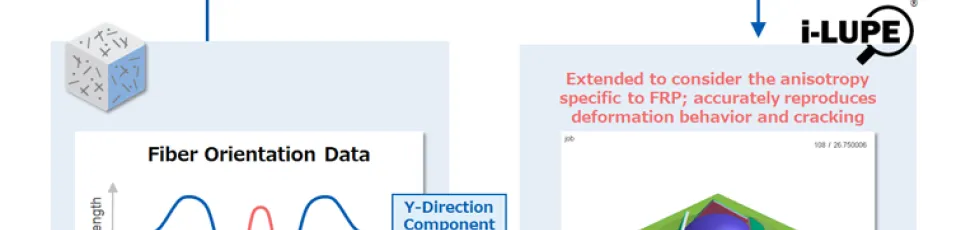
TAGS:
 Asahi Kasei Engineering Corp. (AEC) has launched a cloud-based CAE solution platform. It offers highly precise apps to predict the crash and impact behavior of polymers.
Asahi Kasei Engineering Corp. (AEC) has launched a cloud-based CAE solution platform. It offers highly precise apps to predict the crash and impact behavior of polymers.High-precision Support for Product Design and Development
With the growing use of polymer materials in automobiles and other products, accurate simulations of material behavior are becoming essential. These simulations improve product design and reduce costs and development time for materials and applications.
In recent years, cloud-based high-performance computing (HPC) is being increasingly used throughout various industries. As a result, the on-demand use of computer aided engineering (CAE) software installed in cloud HPC as software as a service is also becoming more common in the material development process.
As a technical polymer manufacturer, Asahi Kasei has provided high-precision support for customers' product design and development through CAE technical services focused on engineering plastics. Building on this expertise, AEC, a subsidiary of Asahi Kasei, has expanded its CAE services by launching the cloud-based "CAE Solution Platform." This platform offers various apps that can be easily downloaded and used by customers worldwide.
On-demand Mapping Tool for Fiber-reinforced Resins
The apps offered on the platform include the downloadable and highly accurate polymer material fracture prediction model 'i-LUPE.' Amorphous polymer materials have a complex structure, with molecular chains intricately entangled. When a force causes significant deformation, the molecular chains stretch, creating voids and fibrils (bundles of molecular chains). As these crazes grow, the polymer material eventually fractures.
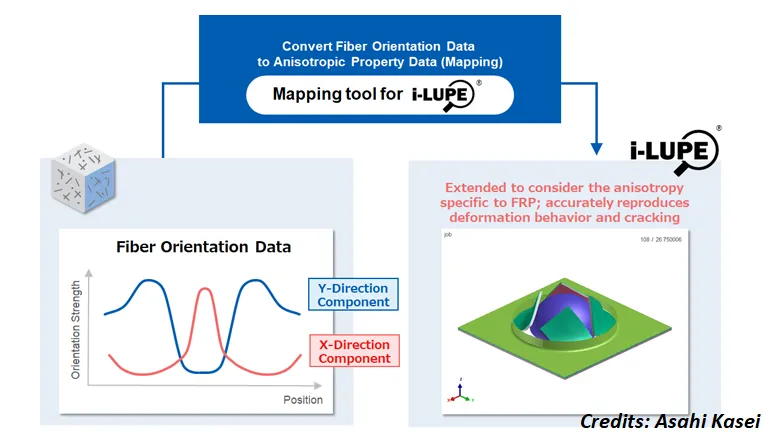
As a complement to "i-LUPE," the platform includes an on-demand mapping tool. This tool is specifically designed for anisotropic materials, such as fiber-reinforced resins. It converts fiber orientation data into material property lists for "i-LUPE." These lists help users select the best materials for specific applications and provide an accurate visual representation of deformation behavior in fiber-reinforced resins.


Source
Asahi Kasei