
Top 5 Innovations in Smart Polymers
Last update on Jun 25, 2024
 have properties that can be altered by temperature, moisture, electric or magnetic fields, pH, and stress. They can change shape and color, become stronger, or produce voltage due to external stimuli.
By using smart polymers, engineers can endow products/structures with built-in responses in a myriad of contingencies instead of adding components and mass.
In their various forms, these materials can perform as actuators. The actuators can adapt to their environments by changing characteristics such as shape and stiffness or as sensors. These provide actuators with information about environmental or structural changes.
Let's talk about the progression of innovative printing technology over the last half millennium. Gutenberg's 15th-century printing press revolutionized the way the written word was replicated. It brought 2D printing into the world, increasing the accessibility of information.

2D Printed Gutenberg Picture (Upper L), 3D Printed Face (L), 4D Stimuli Printed Face (R)
(Source: Additive Integrity)
Fast forward to the present day, the late 1980s, and we are adding a third dimension to printing capabilities. Inventions like stereolithography (SLA) and fused deposition modeling (FDM), introduced 3D printing.
to create a full physical object, effectively printing something into being. Additional means of 3D printing include:
- Directed energy deposition
- Powder bed fusion
- Material jetting
- Binder jetting
- Sheet lamination
21st century 4D printing builds on 3D printing processes. This involves a new smart polymer materials dimension (2nd row below), defined as follows:
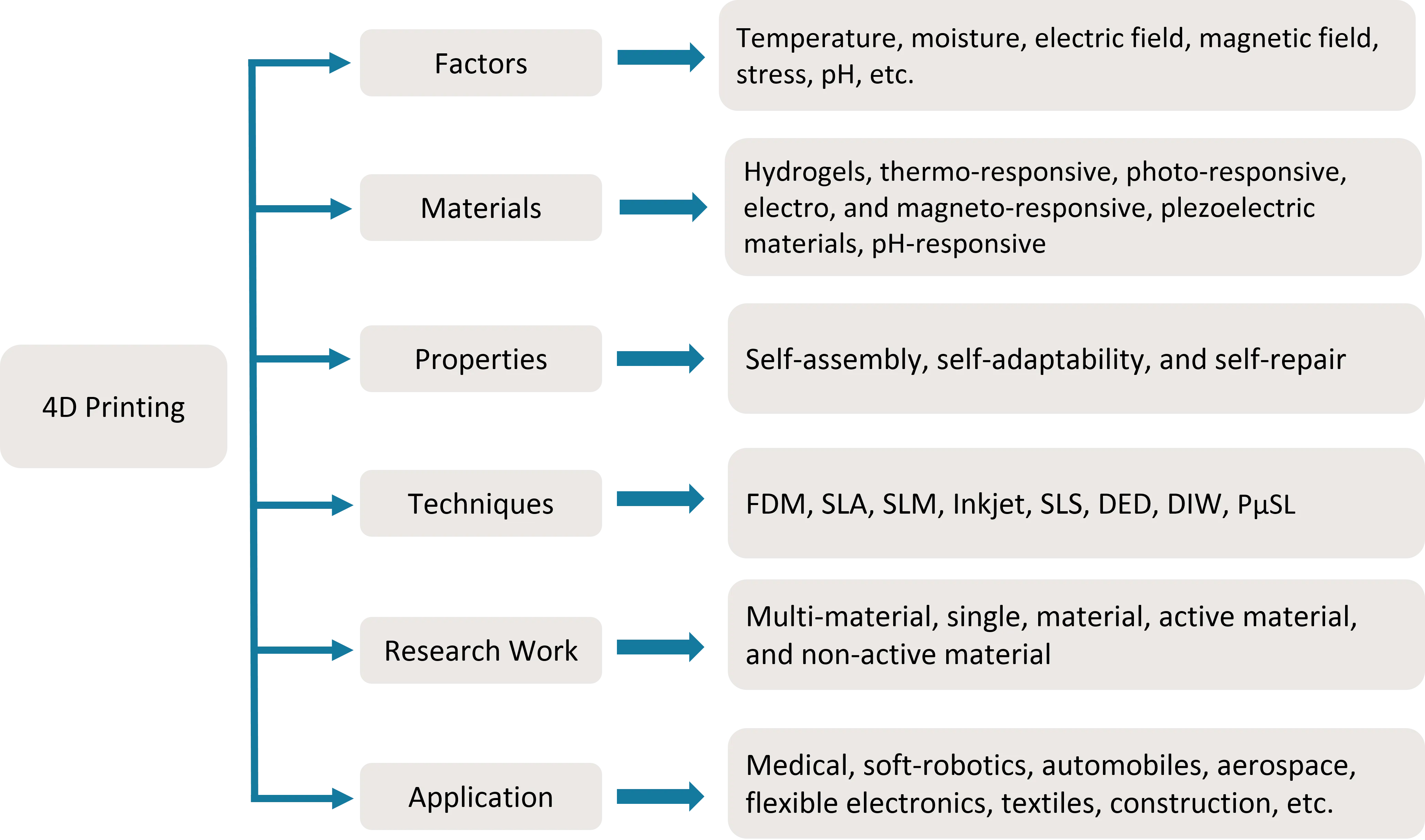
4D Printing Requirements and Applications
(Source: Additive Integrity)
A 4D-printed part utilizes smart polymers to change shape, by adjusting to various stimuli (i.e., moisture, temperature, and electric or magnetic field...) in a controlled manner.

4D Printed Flat Part (L), Water Stimuli Exposed (C), 8-sided Polyhedron (R)
(Source: Additive Integrity)
Let's now turn our attention to reviewing three smart polymer materials, followed by two applications.
CRG's SMP & PA66 Combined to Provide Lightweight Structures
Cornerstone Research Group's (CRG) Veriflex™ shape memory composites combine the structural properties of carbon fiber reinforced PolyAmide 66 (PA 66, or Nylon 66) with the characteristics of their Veriflex™ Shape Memory Polymers (SMP).
These polymer composites are like other high-performance composites. However, they use SMP technology in the PA66 resin matrix. Components and structures fabricated with SMP composites can:
- provide lightweight structures that are strong and stiff,
- allow easy manipulation of the composite above its activation temperature, and high strength/stiffness at lower temperatures

Shape Memory Industrial PA 66 Composite Parts
(Source: CRG)
SMPs can be folded, rolled, or packaged into different shapes for storage. They can be later returned to their original as-manufactured shape, without loss of performance. These structures can be temporarily manipulated for storage and/or transportation, or their configurations can be changed in real time to fulfill varying applications.

Traditional Mechanical Structures (L), SMP Structures (R)
(Source: CRG)
CRG's Veriflex™ shape memory composite produced with Veriflex™ SMP can be fabricated with almost any fiber type. Creative reinforcements allow dramatic shape changes in functional structures. These composites are also machinable. Some possible applications include:
- Substitution for traditional thermoset wet lay-up composite parts,
- Rapid manufacturing,
- Dynamic structures,
- Thermoplastic composite patching, and
- Standard adaptable reinforcements
Ohmatex Danfoss’ Silicone-based EAP with Unidirectional Actuation
Ohmatex Danfoss' ElectroActive Polymer (EAP), PolyPower® is based on a polydimethylsiloxane plastic film that has a patterned surface. It is a soft material with a dielectric withstanding capability (volt per micron or V/µm).
- The special microstructured pattern is a corrugated design formed on the surface of the thin silicone elastomer-based film. A very thin layer of metal electrode is deposited on the film surface.
- The film is stiff along the corrugations due to the high stiffness of the metal electrode elements. Thus, it is only allowed to elongate in the compliant or linear direction of the red arrow. This is shown in the figure below.

PolyPower® Film Stiffness Linear Elongation Direction (Orange Arrow)
(Source: Ohmatex Danfoss)
The elongation in the PolyPower® film's compliant direction is higher than that in alternative designs where the film elongates in two directions. This is due to the film's unidirectional deformation/actuation. When layers of film are rolled into a tubular form with the corrugated pattern running concentrically around the diameter of the element, it elongates in the axial direction. Here the structure is free-standing and supports a 10-kilogram mechanical loading.

PolyPower® Tubular Film Rolls (L), Voltage On/Off (C), Free Standing Tube
(Source: Ohmatex Danfoss)
Peratech’s Electrically Conductive Polymers with Pressure-sensing Technology
The UK-based Peratech's Quantum Tunneling Composite® (QTC®) is a new class of electrically conductive polymer composites. QTC® advances pressure switching and sensing material technology. It operates using quantum tunneling without pressure. Here the conductive elements are too far apart to conduct electricity. However, when pressure is applied, they move closer and electrons can tunnel through the insulator.
The QTC® material is a composite of metal filler particles combined with an elastomeric material. This is typically a silicone rubber material.
- In an unstressed state – The QTC® material is a near-perfect insulator
- With any form of deformation – The material starts to conduct
- With sufficient pressure – The metallic conductivity levels can be achieved
Conversely, in conventional electrically conductive thermoplastic compounds, conductive particles are always in contact with one another. This creates a constant conduction path.
QTC® makes use of metal particle additives that are given an irregular structure with a wetted spiked surface. This makes it electrically insulated by silicone rubber. Furthermore, this wetting allows the metal particles to get close. However, they do not touch even when the QTC® material is pressure squeezed or densely loaded.
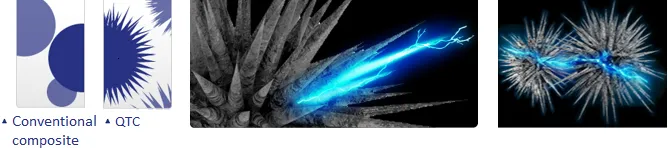
Conventional Composite vs. QTC® (L), QTC® Spike Configurations (C, R)
(Source: Peratech)
Spikes on the metal filler particle surface allow a higher concentration of electron charge to build. This in turn creates localized high electric fields at their tips. The increased charge on the spikes reduces the distance and energy required for the electrons to tunnel and allow conduction. This phenomenon is known as field-assisted tunneling.
When the QTC® is compressed, the metal filler particles move closer, allowing electrical conduction. Under QTC® compression, barrier widths are further reduced leading to:
- an exponential increase in the probability of tunnelling and
- an exponential decrease in electrical resistance
Thus, changing the barrier width through compression, tension, or torsion gives QTC® its controllable electrical properties.
General Motors' SMPs Optimize Aerodynamics in Automobiles
Shape Memory Polymers (SMPs) and other smart materials can impact the design and development of automobiles. One of the General Motors' Chevrolet uses is in high-impact PolyPropylene (PP) and ThermoPlastic Olefin (TPO) air dams and louvers. These parts control airflow into the engine compartment, improving vehicles' aerodynamics and performance.
These new SMPs can change the look and feel of cars and trucks.

SMP PP Rain Activated Wipers (T) and Stiffening Panels (B, L); SMP TPO Bumpers (L, Front)
(Source: General Motors Corporation)
TE Connectivity's EAP Biopolymers for Biomedicine and Medical Devices
Swiss-based TE Connectivity's Creganna/Micromuscle is used to build electroactive mechanical devices or micro muscles. It is based on proprietary PolyPyrrole (PPy) ElectroActive Polymer (EAP) blends with PolyLactic Acid (PLA), PolyHydroxyAlkanoate (PHA), PolyCaproLactone (PCL), and PolyVinyl Alcohol (PVA) biopolymer technology. The development focuses on medical device applications in micro-robotics, drug delivery, and cardiovascular areas. It is a novel method to reconnect blood vessels using an electroactive blood vessel connector surgically.
PPy biopolymer blend actuators have unique properties that are well-suited for biomedicine. These include:
- Demonstrated biocompatibility/electron beam sterilizability
- Reversible/repeatable volume change
- Small driving voltages (1-2 Volts) and low currents [µA-mA, or microampere (μA) to milliampere (mA)]
- Functions in liquid environments (saline solutions, urine, blood, and cell culture media)
- Design flexibility (a wide variety of shapes/sizes are possible)
The 'Microanastomosis Connector' simplifies the reconnection of two ends of divided small blood vessels during hand, heart, or brain transplantation surgery.
- It is developed for 1 to 3-millimeter diameter blood vessels.
- It is an implantable tube with contractible and expandable features achieved by applying a voltage of less than 1 Volt. The multilayered tube is contracted in less than a minute and inserted into the vessel ends to be joined.
- When the 'Connector' has been properly placed, it is expanded by normalizing the applied potential to form a tight connection with the vessel walls. The multilayers of the 'Connector' tube replicate a thin foil can roll/unroll action that causes expansion/contraction of the tube.

In-vitro Blood Vessel Connector (T, R) Tube Surgery (C)
(Source: TE Connectivity)
An electrical micro-steerable implantable catheter has been developed that makes use of EAP for steering. A prototype demonstrated in a vessel system actively steers a common guide wire modified with an EAP biopolymer coating. Applying a small potential to the guide wire allowed the position of the tip to be controlled. The time to move from one extreme position to the other was a few seconds.

EAP Steerable Guidewire
(Source: TE Connectivity)
Conclusion
The progression of printing technology from Gutenberg's press to 4D printing shows a leap in innovation. Each new dimension added to printing capabilities has opened up possibilities in many industries, for example, from SMPs in automobiles to EAP biopolymers in medical devices. These smart materials are revolutionizing how we approach design, manufacturing, and problem-solving.
As we look to the future, it's clear that the boundaries of printing technology will continue to expand. This promises even more exciting developments that will shape our world in ways we can only begin to imagine. The journey from 2D to 4D printing is not just a technological evolution, but a testament to the quest for improvement.
Latest Trends in Next-gen Smart Polymers
Get insights from our industry expert Donald Rosato about the latest innovations and trends in next-generation smart polymers. Learn how to transform everything from self-healing car parts to biocompatible medical devices. Utilize your chance to unlock the immense potential of smart polymers.