

Epoxies used as prepreg materials
Last update on Sep 16, 2025
This article was originally published in 2013 and revised in 2025.
Prepreg materials were once only prevalently used in the aerospace and high performance sectors of the general composite area. Recently, however, they have become increasingly more common across numerous sectors of the composites industry. The reasons for these increased uses include the mechanical performance that prepregs provide their consistent properties and their ease of use.
Within the prepreg world and also in the general composites field, there is an ongoing trend for increased thermal resistance requirements. Potential markets for these enhanced products include transportation, electronics and electrical insulation.
However, the high temperature requirement for these markets needs to be achieved without a sacrifice of the other performance and/or processing advantages of the resins such as fast curing at the desired reaction temperature. Thus, the optimum balance between the already-existing performances features with the increased temperature resistance needs to be achieved to meet this developing marketplace need.
In this guide, different chemical approaches are highlighted to obtain high temperature resistance of the epoxy materials without a loss in the desirable processing features of the resins. In addition, information is provided about ways to enhance the curing features of the epoxies to make them react only at the desired reaction temperature and not during the storage and prepreg production process. The latency of the epoxies during storage is an important feature that cannot be compromised.
Requirements for high-performance prepreg systems
Reinforced ceramics and metal matrix composites have the ability to withstand the high temperatures that are required in the new applications. However, many end-users prefer polymer resins to ceramics and metals. This is because polymers perform better under fatigue than more brittle ceramics and are much lighter in weight than most metals.
An array of thermosets, including materials that are based on epoxies, have been developed to handle moderate-to-high temperatures and tough environmental conditions with ease. In addition, weight savings and lower life-cycle costs are included in the bargain at the same time.
Along with the stated high temperature performance, some of the other requirements for these new prepreg systems are low shrinkage and low water absorption in the final part as well as a range of short to long storage life. The specific storage life requirements depend on the final product applications.
Thus, a range of latency values are needed, depending on the needs of the prepreg producer. However, excellence in molding ability is a definite requirement and, hence, adequate flowability of the resin is needed. Fast curing is often the target but it may have to be combined with relatively long latency during resin storage, processing, and application.
Several of the new applications for prepregs require the retention of the mechanical properties in hot and wet conditions. This property retention is related to the water absorption features of the resin. The absorption of water allows for a plasticizing effect, lowering the glass transition temperature or Tg. Since the Tg is related to the property retention at elevated temperatures, the absorption of water directly affects the property retention features. In order to meet this requirement, the epoxy resin should have very low moisture absorption.
Epoxy composites have previously been used in many applications, due primarily to their superior mechanical strength and thermal stability. For certain high-end applications in oil and gas, electrical laminates, aerospace and transportation, epoxy thermosets of higher thermal resistance are required, primarily due to the need to maintain properties under a harsh application environment and/or difficult processing conditions.
In general, thermosets with high glass transition temperatures or Tg's are often achieved through the use of materials that are solid or semi-solid at room temperature. The high viscosity of these resins often results in added difficulties in the fabrication of the final composites. Thus, there is a continued need to develop epoxy resins that possess high temperature resistance but also offer good processing features.
Approaches to address these material needs
There have been several technical approaches developed to address these material needs.
Multifunctional epoxy resins
One general approach has involved the use of epoxies of higher functionalities, known as multifunctional epoxies. These materials are different from conventional di-functional epoxies and both tri- and tetra-functional epoxies are commercially available. Typical physico-chemical properties of standard di-functional and multifunctional epoxies are given in Table 1.
Epoxy Resin | Viscosity @ 25°C (P.s) | Epoxy Equivalent (g/eq) | Functionality (eq/mol) |
|---|---|---|---|
DGEBA | 10¹ | 185 | 2 |
TGPAP | 0.65 | 100-110 | 3 |
TGDDM | 200-300² | 115-120 | 4 |
| DGEBA: Diglycidyl ether of bisphenol A, ¹Non distilled, standard grade TGPAP: Triglycidyl ether of p-amino phenol TGDDM: Tetraglycidylether of 4,4' diaminodiphenyl methane, ²Medium molecular weight (e.g. Araldite® MY 9512) @ 30°C | |||
Table 1: Typical physico-chemical properties of several epoxy resins
TGPAP vs. TGMAP: Performance comparison
The TGPAP resin shown in Table 1 has ease of processing and high crosslinking density of its cured network. When cured with 4,4' DDS (diaminodiphenyl sulfone), the final Tg is about 250°C. On the other hand, when the epoxidized hydroxyl group is changed from the para position as in TGPAP to the meta position, a molecule known as TGMAP is produced.
Chemically, TGMAP is the triglycidylether of meta-aminophenol. It is commercially available from Huntsman Advanced Materials under the name Araldite® MY 0610. On the other hand, TGPAP is provided by Huntsman Advanced Materials under the name Araldite® MY 0510.
As shown in Figure 1 below, the TGMAP molecule, designated Araldite® MY 0610 in the figure, yields cured networks with significantly higher modulus than TGPAP, designated Araldite® MY 0510, without a drastic decrease in thermal resistance. It has also been demonstrated that the asymmetric structure possessed by resins that are based on TGMAP plays a positive role in the toughness of the cured resin.
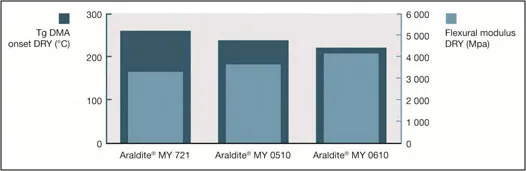
Figure 1: Comparison of Tg's and modulus of TGDDM, TGMAP, and TGPAP cured networks
Rigid chemical unit incorporation
Another approach is to explicitly incorporate rigid chemical units into the epoxy molecule. For example, in epoxidized phenol novolacs or EPN's, dicyclopentadiene entities are introduced between each phenolic group of the prepolymer structure. An example of such a resin is Tactix® 556 from Huntsman Advanced Materials.
The chemical modification allows for the creation of a chemical structure that has a very hydrophobic skeleton so that the epoxy resin absorbs significantly less water than standard multifunctional epoxies. This effect is achieved without a sacrifice in the thermal resistance of the cured network. These features make resins that are based on this EPN ideal for new applications where the retention of mechanical properties in hot and wet conditions is critical.
Modified hardener formulations
The other approach being actively pursued is to modify the hardener portion of the formulation for high temperature prepregs. For example, diaminodiphenyl sulfone (DDS) can be modified in several ways to produce hardeners with similar cured properties but with melting temperatures far below those of crystalline DDS, that melts at about 175-180°C.
In addition, amorphous hardeners can be produced through an appropriate chemical modification of DDS. When cured with either glycidylamine or bisphenol-A based epoxies, these hardeners yield resins with thermo-mechanical performance that is equivalent to those produced using 3,3' DDS as the hardener. Further, due to the fact that they are DDS-based hardeners, their toxicological assessment is quite favorable.
Polymerization control and processing optimization
Thus far, all of the discussion has focused on efforts to increase the thermal resistance of epoxy resins for use in prepregs. It is also crucial that processing conditions meet customer, market or application requirements.
Among the resin processing conditions, a control of the polymerization kinetics is a key factor. Fast curing of the resin is often the target, but it must be combined with more or less latency during the formulation processing and storage.
Advanced polymerization accelerators
This combination of features has been achieved through the use of a variety of polymerization accelerators. Several of those accelerators, such as Aradur® 1167 or Accelerator DY 061 available from Huntsman Advanced Materials, provide a snap curing-like effect at the desired curing temperature.
Through the use of such accelerators, a high degree of conversion for the cured network is achieved at a relatively low temperature. The accelerators are available in both liquid and powder form. They offer alternatives to boron complex accelerators that have been used in the past. These new accelerators provide improved toxicological profiles compared to the boron complexes.
Alternative high-temperature thermoset materials
Of course, there are other resin solutions to achieve high temperature resistance while being readily processable that are not based on the use of epoxies. Among some examples of alternative thermoset materials are thermosetting polyimides, cyanate esters, and bismaleimides. However, the use of each of those materials has limitations that have prevented them from more widespread use.
Limitations of alternative materials
For example, most polyimides tend to absorb moisture after cure. In addition, polyimides are quite expensive, due primarily to the high cost of the monomers used in their synthesis. Bismaleimides and cyanate esters often suffer from brittleness issues that make them unsuitable for many applications. Epoxy resins can be tailored, through the appropriate chemistry, to provide the needed balance of physical properties and processing.
Conclusion
When the relatively low cost of epoxy resins is taken into consideration along with the performance features of new materials that have been discussed, epoxies represent a primary material of choice for many applications that require the development of high-temperature prepreg materials.