

Plastics Reshaping Wearable Medical Devices
Last update on Mar 24, 2017
 Developments in medical technology have increased the demand for advanced materials and their use in various applications in the medical industry in everything from packaging liquids and solids to replacing biological structures in humans.
Key drivers for increased demand for medical devices include growing and aging population, advanced medical procedures involving electronics and complicated/contagious diseases.
Metals and ceramics are prevalent in the medical industry. However, the unique properties of polymeric materials and their blends exhibit potential as better replacements for conventional materials.
Some of the prominent areas for the application of plastic materials in medicine include:
- General Medical Supplies: Bandages, gloves, blood bags, catheters, syringes, IV kits and tubing
- Diagnostic and Surgical Equipment: MRI machines, ECG monitors, and surgical equipment
- ENT: Hearing aids
- Orthopedics: Prosthesis for joints such as shoulder, elbow, hip, and knee has seen substantial adoption
- Drug Delivery Systems: As the name suggests this includes implants which can deliver drugs to the determined target. This has recently seen keen interest with demand towards the controlled release of drugs into the body
- Dental: Teeth and gums are prone to decay/destruction by bacteria. In such cases, dental implants are useful
- Cardiovascular Applications: Valves and arteries tend to loose shape or get blocked due to fat deposits or other reasons. Replacement or unblocking devices can be incorporated to treat the affected areas
- Other applications such as intraocular lenses can be used to treat disability related to eyes
This article includes an overview of significant polymeric materials used in medical applications, with a specific focus on wearable medical devices. But before that, let's understand the need for plastics in medical industry.
Why plastics?
Various materials cater to the industry of medical devices. These include metals, composites, and polymers. Early implementation of medical devices for treating humans included materials such as metals and ceramics. Table below shows some of the materials and their applications in the medical industry:
| Material | Applications |
| Stainless Steel |
|
| Titanium and its alloys |
|
| Alumina/Zirconia |
|
| Porcelain |
|
| Polymers/plastics |
|
Table below shows a qualitative comparison between various materials used in the industry:
| Property | Metal | Ceramics | Plastics | Glass |
| Toughness | ● | ● | ● | ● |
| Transparency | ● | ● | ● | ● |
| Chemical Resistance | ● | ● | ● | ● |
| Flexibility | ● | ● | ● | ● |
| Weight/Volume Ratio | ● | ● | ● | ● |
| Economical | ● | ● | ● | ● |
| Design Flexibility | ● | ● | ● | ● |
| Bio-compatibility | ● | ● | ● | ● |
| Sterilization Stability | ● | ● | ● | ● |
| Thermal/Electric Insulation | ● | ● | ● | ● |
| Ease of Processing | ● | ● | ● | ● |
| Thermal Resistance | ● | ● | ● | ● |
| Fire Resistance | ● | ● | ● | ● |
| ● Very High | ● High | ● Medium | ● Low | ● Low-High | ● Medium-Very High |
Key Properties that are Essential in Medical Devices
Below are some of the critical properties essential for medical devices:
| Key Property | Description |
| Resist Temperature Based Sterilization | Temperature over 100°C with cycle times ranging from 3 minutes to 3 hours. |
| Resist Gas/Chemical based sterilization | Resistant to gasses such as ethylene oxide, hydrogen peroxide, ozone, and so on. |
| Resist Radiation based sterilization | Resistant to Electron beam, Plasma. |
| Chemical resistance (Manufacturing) | Resistant to Solvents such as MEK, THF, MeCl2, alcohols, other acids, and bases. |
| Chemical resistance (point of care facilities) | Resistant to bleaches, disinfectants, detergents, lipids, and so on. |
| Bio-compatibility | Reactionless contact with biological materials such as skin, tissues, and fluids. |
| Food-safe | Materials need to be food grade/safe especially in applications such as packaging drugs. |
| Shelf life | Ability of medical device to retain properties after going through stages such as storage, distribution, reuse etc. |
| Convenient Assembly | Ability to join/assemble related biomedical parts. |
Properties of essential medical devices
Evolution of Plastics in Medical Applications
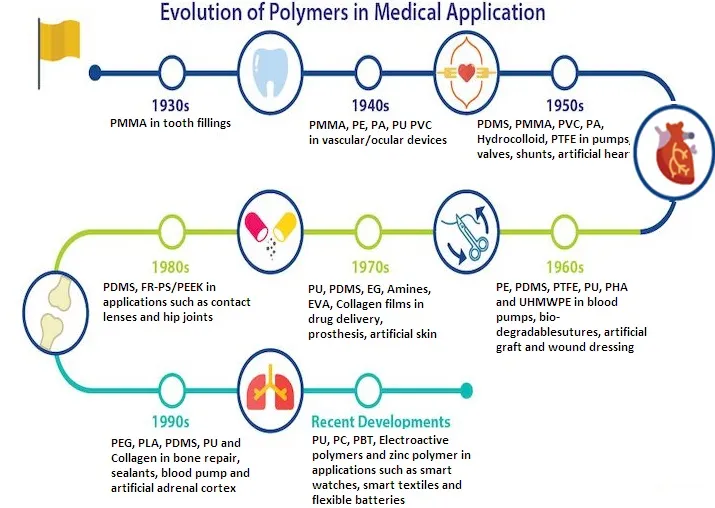
Polymeric systems find applications in a variety of segments. For example, early 18th century saw the usage of metal catheters which were replaced by disposable catheters in the 1940s. Below is how various polymeric materials have been used in medical applications over the period:
| Materials in the above chart: | |
| PMMA: Poly methyl methacrylate PDMS: Polydimethylsiloxane PTFE: Polytetrafluoroethylene PEG: Polyethylene glycol EVA: Ethylene vinyl acetate PBT: Polybutylene terephthalate | PE: Polyethylene PA: Polyamide/Nylon PU: Polyurethane PVC: Polyvinyl Chloride PC: Polycarbonate FR-PS/PEEK: Fiber reinforced – polystyrene or Polyether ether ketone |
Technology Emphasis — Wearable Medical Devices
Recent developments in the smart devices enabled bio-medical devices resulted in improved convenience to the consumers/patients. This has led to remote/active diagnosis, therapeutics, and indication.
Chronic conditions such as heart failure may cause immediate death; this is mainly due to lack/failure of detecting/analyzing the symptoms. Heart disease per say is a progressive disease. Symptoms of potential heart failure are:
- Fatigue
- Swelling
- Shoulder pain, and
- Abnormal heart rates
To analyze these conditions visiting a diagnostic center is essential. But, thanks to smart wearable devices, technology grew to a stage where the simplest of temperature/heartbeat could be tested till active drug administration or recommending therapies.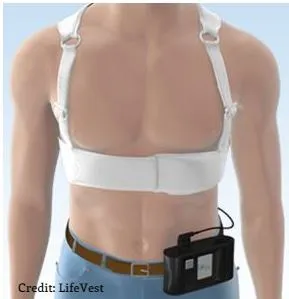 Similar products are already available in the market. Beside is an illustration of 'LifeVest wearable defibrillator' by Zoll technologies1. This wearable device not only monitors patterns of cardiac conditions, but it also delivers a shock treatment to restore normal heart beat rate.
Similar technologies are being researched for diagnosing/treating various fitness/medical parameters including:
- Heart rate
- BMI calculator
- Arthritis
- Sensing aids
- Pain management
- Temperature
- Body posture
- Glucose monitoring, and
- Digestion monitoring
Various polymeric materials contribute to the useful and inexpensive wearable devices. Here's an indicative list of polymers used in wearable medical devices:
- Polyurethane: Elastomeric/foam made wearable devices.
- Adhesives (Hydrocolloid polymer, epoxy, polyurethane, acrylic): Adhesives for sticking patches.
- Polydimethylsiloxane: Flexible materials where transparency and energy conservation is essential.
- Polyimides/Polyesters: Structural materials where films, non-woven or textiles, used in flexible electronics for example.
- Polypyrrole/polythiopene/Polyaniline: Conducting polymers replacing metals.
- Single-walled nanotubes: Electronic skin.
- Cationic self-assembled polymers: Impact measurement and drug delivery systems.
- Polyethylene glycol gel: Addition of colorants can be used as visual indicators in objects such as diapers.
Other structural polymers include commodity/engineering polymers, such as:
- Polyethylene
- Polypropylene
- Polycarbonate
- Polyamides
- Polyvinyl Chloride
- Polyvinyl Alcohol
- Polyesters, and
- Polyamides
Notable material suppliers include:
- DuPont: PE872, PE772, PE410, PE773
- BASF: HyGentic®, Ultraform®
- Dow Chemicals: Health+™, ASPUN™, DOWLEX™
- INEOS: Eltex®
- SABIC: LEXAN™, ULTEM™, CYCOLOY™
- Covestro: DUREFLEX™ , PATILON™
- Bayer: Makroblend®, Makrolon®, Apec®, Texin®
- Henkel: Loctite®, Indigo®, Flashcure®, Nuva-Sil®
The selection of material depends on the class of medical application, such as:
- Permanent implantation
- Temporary implantation
- Minimal contact with human tissues or fluids
Use of Polymers in Various Wearable Medical Devices
 | Companies such as BlackBox Biometrics have developed wearable concussion sensors, which include a printed circuit board covered with plastics/polymers. This sensor is primarily used for measuring traumatic brain injuries of athletes and soldiers. |
 | Advanced innovative products such as Vitaliti™ are used to monitor more than 15 medical conditions. Vitaliti has been developed by CloudDx. To create such lightweight and safe devices, various polymers are used in components such as body and circuits. |
 | MIT has developed a cross-linkable silicone-based polymer that can be applied to skin as a cream and is cured via a catalyst liquid. The polymer forms an artificial layer over the skin and can be used for both therapeutic and cosmetic applications. |
 | Soft-sensing suits are being made from nylon strips, such as Ecoflex® rubbers, which contain sensors made from flexible circuits. This suit can be used to monitor hip, knee, and ankle sagittal plane joint angles. |
 | Wearable patches/pods are already available in the market and are extensively used for drug delivery in treating conditions such as diabetes, tobacco abuse, and hormonal imbalance. Insulet Corp is a key manufacturer of wearable patches. |
 | The US FDA has approved wrist bands such as Pulsewave®, which provides real-time non-invasive readings, including heart rate, blood pressure, and respiration rates. These devices use conductive elastic polymers, such as polydimethylsiloxane, and other elastomers. |
 | Extensive research studies are being carried out for monitoring joints. These studies include monitoring of knee angle and pain sensors for active monitoring. Such devices are either worn as a patch or embedded in a strap made from materials such as nylon. |
 | Footwear and clothing applications include monitoring of strain and compression patterns. These products are made of materials such as polyurethane, polydiacetylene, and other electrospun polymers. |
 | Color-changing compositions are being used in diapers and medical dressings; they change color when they come in contact human liquids or blood. Polymer/ co-polymers of olefin-based materials are used in these products. |
 | Adhesives/sealants play a crucial role in holding medical components near the human body. Gentle adhesives, such as MEDIFIX Solutions™, HydroSoft™ adhesive, and AR SoftWear™, are available in market. |
Conclusion
Applications of plastics/polymers
have gained importance over the past in various applications due to their unique properties. Polymeric materials when combined with unique sensing/detecting properties of electronics can be used in advanced applications. One such example is wearable medical devices.
Research has progressed in using polymers in both structural and functional roles. These devices can be used to diagnose, treat, indicate and perform remote monitoring. With increased research focus towards wearable medical devices, it is interesting to observe the latest developments in functional materials.
- https://lifevest.zoll.com