

Plastic Recyclate Traceability and Use: An Expansion
Last update on Jul 4, 2022
Widespread adoption of recycled materials requires expertise from a wide range of companies across the plastics industry value chain. The need to recycle often incompatible polymer resins has increased the advanced polymer compatibilizer development. Furthermore, other key additives are broadly assisting plastics recycling, from property performance enhancement, delayed decomposition, and traceability.
A recent advancement in the traceability of recycled content in plastics is well worth reviewing. Currently, the mass balance approach, where total inputs balanced against total outputs, is in vogue for measuring finished plastic product recyclate percentage. But this approach can be improved upon in terms of high costs, auditing complexity, and data security.
What is needed here is a simple, low-cost Quality Control (QC) technique. Enter for your consideration the U.K.'s Manchester University traceability advancement. It centers on a fluorescent additive that quantifies and regulatory confirms recycle content. It is called ReCon^2. Plastic recyclers and compounders can produce a range of QC fluorescent masterbatches that measure within a 5% weight level a traceable recycle concentration, verified by standard lab spectroscopy analysis.
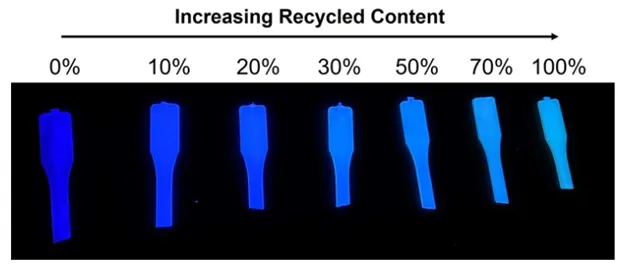
Manchester University's fluorescent tracker additive masterbatches range spectrally analyzed
The need to recycle incompatible polymer resins has accelerated the development of advanced polymer compatibilizers. Other key additives, ranging from improved property performance to delayed decomposition, are broadly assisting plastics recycling. Adoption of recycled materials requires expertise from a diverse range of companies across the plastics industry value chain.
Fluorescent traceability is particularly suited for measuring recycle content use in volume packaging plastics such as Low-density polyethylene (LDPE), high-density polyethylene (HDPE), polypropylene (PP), and polyethylene terephthalate (PET). Additional work currently is qualifying its use in polystyrene (PS), polyvinyl chloride (PVC), chemically recycled resin feedstocks, and engineering plastics.
Moving forward, recycling technologies will encompass a myriad of mechanical recycling techniques, as well as solvent-based processes, while the development of chemical recycling continues to gain increasing interest. Mechanical recycling of plastics is the most common form of recycling technology currently in use. It is widely used for post-consumer and post-industrial thermoplastics, such as PP, PE, or PET. Other polymers that might be found in recycling feedstocks include PVC and polyamide (PA or nylon). Functional additives, specialty compatibilizers, and customized recycling equipment will also play critical plastics sustainability roles.
Let's now turn our attention to reviewing five recycled plastic content material innovations.
DSM’s Re-purposed Polyamide for Ford’s Sport Vehicle’s Wiring Harness Clips
To start with, Ford Motor Company is using DSM's Akulon RePurposed Polyamide (PA or Nylon) PA6 engineering plastic from recycled ocean plastic fishing nets in its current model year Bronco Sport vehicle's wiring harness clips. These clips attach to the back seat to hold in place electrical cabling that provides rear cargo section functionality power.

DSM Akulon RePurposed recycled ocean plastic PA6, ford bronco sport, wiring harness clip
Akulon RePurposed Polyamide PA6 is a 70% recycled material. It shows no property deterioration compared to virgin PA6, even though the fishing nets from which it is generated have been exposed to lengthy salt water and sunlight environments. A very thorough and proprietary DSM PA6 cleaning process is responsible for this quality level. Also, this recycled PA6 is compounded easily with glass fiber providing superior application stiffness. Other recent applications for this material are watches, surfboards, and structural furniture components like frames and vertical supports. It recently won a Society of Plastics Engineers (SPE) Automotive Division innovation award.
LyondellBasel’s Renewable Feedstock Content-based Compounds in Nestlé’s Coffee Capsules
Next, LyondellBasel has developed with its CirculenRenew product line polypropylene (PP) and polyethylene (PE) compounds based on C14 renewable feedstock content. This feedstock is 100% produced from biobased waste like cooking oils. CirculenRenew's C14 renewable feedstock content has third party certification of analysis as measured by the mass balance approach. These renewable PP and PE compounds are easy drop-in replacements for their fossil fuel equivalents requiring no formulation modification to run in existing standard plastics processes such as injection molding, extrusion, or thermoforming. To this end, LyondellBasel has teamed up with Greiner Packaging to volume thermoform renewable content PP capsules for Nestlé's Nescafé Dolce Gusto coffee brand.

LyondellBasell CirculenRenew PP in Nestlé coffee capsules
As we are all aware coffee capsules do not have the best reputation in the public's mind, as they are single use, quickly disposed after use, and traditionally consume large volumes of virgin resin. So, renewable content PP capsules are a move in the right direction, if properly harnessed to mechanical recycling and general plastics reuse. Furthermore, both LyondellBasel and Greiner Packaging manufacturing sites are ISCC PLUS certified. Stated simply, ISCC PLUS is a sustainability certification program for bio-based and circular (recycled) raw materials for all markets and sectors not regulated as transportation fuels under the European Renewable Energy Directive (EU RED) or Fuel Quality Directive (FQD), which are covered under the ISSC EU certification scheme. LyondellBasell's CirculenRenew and related CirculenRevive based on post-consumer recyclate are under current further development in engineering plastics, colorants, thermoplastic composites, as well as advanced Catalloy and polybutene-1 polymer systems.
SABIC’s Recycled Content-based Drop-in Replacements for Virgin Materials
Continuing, SABIC has commercialized their initial automotive, mechanically recycled content, plastic compounds emphasizing their Trucircle development approach. By this method, plastic processors can select state-of-the-art material alternatives, that in turn will give their end use customers and ultimately final consumers buying confidence that materials used are recycle content certified in a true circular, repurposed, planet protecting fashion.

SABIC Trucircle recycle content automotive compound development approach
The new SABIC compounds include a talc filled yet high flow polypropylene (PP) T2E-3320EH PP grade, a UV-stabilized, unfilled polycarbonate (PC)/polyethylene terephthalate (PET) blend Xenoy T2NX2500UV resin, and a mineral filled PC/PET Xenoy T2NX5230 blend. All three compounds have up to 29% mechanically recycled content and are drop-in replacements for existing virgin equivalent materials. They are targeted at interior and exterior automotive applications such as body panels, trim, roof spoilers, instrument panels, and heating/ventilation/air conditioning (HVAC) components/housings.
Additionally, SABIC has commercialized a circular PC resin based on upcycled Post Consumer Recyclate (PCR) plastics, that has a 23% lower carbon footprint than its virgin equivalent, and is market targeted in automotive, electrical/electronics, medical/healthcare, and consumer products.
Avient 62% Recycle Content-based TPE for Woman’s Razor Handle
Delving further, Avient has application qualified their reSound R recycled content ThermoPlastic Elastomer (TPE) in the Clichy, France based BIC Soleil Click 5 woman's razor handle. The TPE has a 62% recycle content, is highly colorable, and provides a unique soft yet grippy handle feel. These reSound R TPEs are drop-in replacements, performance wise for standard Avient grades. Avient's reSound R materials were recently presented with a Plastics Recycling Awards Europe finalist ranking.
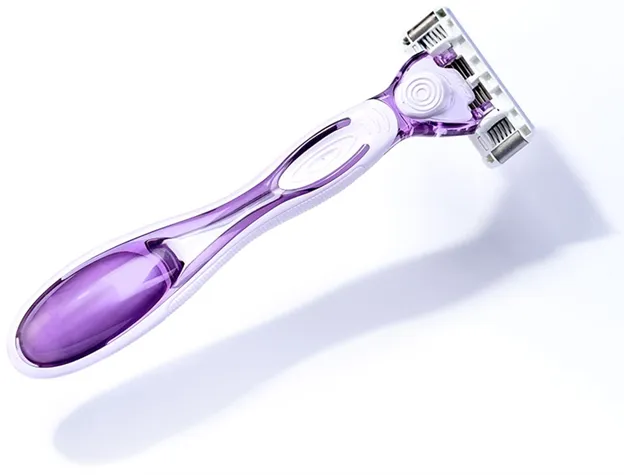
Avient's reSound R TPE in BIC Soleil razor handle
Also, Avient has undertaken TPE development in reSound R grades to attain recycle content levels over 85%, with the goal of replacing traditional TPEs in durable applications including automotive, athletic footwear, lawn/garden, office products, and personal care. Finally, BIC corporate has a 2030 goal of using 50% non-virgin across all their disposable, consumer product lines.
Covestro and Fairphone’s PCR-based Ethical Smartphones with Snap-fit Design
Let's conclude with Covestro's collaboration with Dutch based Fairphone in what they refer to as 'ethical smartphones,' that feature a very modular, snap-fit design for ease of reparability. Covestro's plastics contributions include:
- A partially recycled thermoplastic Polyurethane (TPU) elastomer used in the exterior, protective cases in the older Fairphone 3 and newer 4 models.
- 30-50% post-consumer based recycled polycarbonate (PC) designed into the Fairphone 4's rear hard cover, high stress mid-frame, and impact resistant charger housing.
The recycled PC is an identical propertied, drop-in replacement for its virgin PC equivalent, and brings a 30% CO2 reduction. The recycled TPU is available in gray, green, or pink colors, has a lower, energy saving molding melt temperature, and is a performance equivalent to its virgin TPU analog.

Covestro's recycled TPU Fairphone 4 protective case & recycled PC rear cover/middle frame/wireless charger