

Expanded Polystyrene (EPS): How to select the right grade?
Last update on Apr 22, 2026
What is expanded polystyrene (EPS)?
Expanded PolyStyrene (EPS) is a white foam plastic material. It is produced from solid beads of polystyrene. It is used for packaging and construction. It is a closed-cell, rigid foam material produced from:
- Styrene – which forms the cellular structure
- Pentane – which is used as a blowing agent
Both styrene and pentane are hydrocarbon compounds. They are obtained from petroleum and natural gas byproducts.
EPS is 98% air and it is recyclable. It is a very lightweight material with the following benefits:
- It has very low thermal conductivity, low moisture absorption, and excellent cushioning properties.
- Its physical properties do not change within its service temperature range (i.e., up to 167°F/75°C) for long-term temperature exposure.
- Its chemical resistance is nearly equivalent to the material upon which it is based – polystyrene.
One of the serious limitations of polystyrene foam is its low maximum operating temperature of ~80°C.

Understanding the material starts with how it’s created, so next we’ll walk through the steps that turn raw polystyrene beads into EPS foam.
How is expanded polystyrene made?
The conversion of expandable polystyrene to expanded polystyrene is carried out in three stages:
- Pre-expansion,
- Maturing/Stabilization, and
- Molding
Polystyrene is produced from crude oil refinery product styrene. For manufacturing EPS, the polystyrene beads are impregnated with the foaming agent pentane. Polystyrene granulate is prefoamed at temperatures above 90°C.
This temperature causes the foaming agent to evaporate. Hence inflating the thermoplastic base material to 20-50 times its original size.
After this, the beads are stored for 6-12 hours allowing them to reach equilibrium. Then beads are conveyed to the mold to produce forms suited as per application.
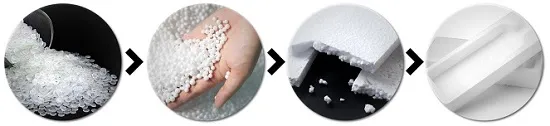
Manufacturing Of Expanded Polystyrene Sheets/Molds
During the final stage, the stabilized beads are molded in:
- either large blocks (Block Molding Process)
- or designed in custom shapes (Shape Molding Process).
The material can be modified by the addition of additives such as flame retardant to further enhance the fire behavior of EPS.
Once you know how EPS is made, it helps to see why manufacturers and designers choose it, so here are the main benefits this foam offers.
What are the benefits of EPS?
EPS is a lightweight material with good insulation characteristics offering benefits such as:
- Thermal properties (insulation) – EPS has very low thermal conductivity. This is due to its closed-cell structure consisting of 98% air. This air trapped within the cells is a very poor heat conductor. Hence provides the foam with excellent thermal insulation properties. The thermal conductivity of expanded polystyrene foam of density 20 kg/m3 is 0.035 – 0.037 W/(m·K) at 10°C.
ASTM C578 is a Standard Specification for Rigid Cellular Polystyrene Thermal Insulation. It addresses the physical properties and performance characteristics of EPS foam as it relates to thermal insulation in construction applications.
Mechanical strength – Flexible production makes EPS versatile in strength. This strength can be adjusted to suit specific applications. EPS with high compressive strength is used for heavy load-bearing applications. For void-forming EPS, lower compressive strength can be used.
Generally, strength characteristics increase with density. However, the cushioning characteristics of EPS foam packaging are affected by the geometry of the molded part and, to a lesser extent, by bead size and processing conditions, as well as density.
Density (pcf) Stress @ 10% Compression (psi) Flexural Strength (psi) Tensile Strength (psi) Shear Strength (psi) 1.0 13 29 31 31 1.5 24 43 51 53 2.0 30 58 62 70 2.5 42 75 74 92 3.0 64 88 88 118 3.3 67 105 98 140 4.0 80 125 108 175 Typical properties of EPS molding packaging (70°F test temperature)(Souce: EPS Industry Alliance)
- Dimensional stability – EPS offers exceptional dimensional stability. It remains virtually unaffected by a wide range of ambient factors. The maximum dimensional change of EPS foam can be expected to be less than 2%. This puts EPS in accordance with ASTM Test Method D2126.
- Electrical properties – The dielectric strength of EPS is approximately 2KV/mm. Its dielectric constant is measured in the frequency range of 100-400 MHZ. At gross densities from 20-40 kg/m3 the dielectric constant lies between 1.02-1.04. Molded EPS can be treated with antistatic agents to comply with electronic industry and military packaging specifications.
- Water absorption – EPS is not hygroscopic. Even when immersed in water it absorbs only a small amount of water. As the cell walls are waterproof, water can only penetrate the foam through the tiny channels between the fused beads.
- Chemical resistance – Water and aqueous solutions of salts and alkalis do not affect expanded polystyrene. However, EPS is readily attacked by organic solvents.
- Weathering and aging resistance – EPS is resistant to aging. However, exposure to direct sunshine (ultraviolet radiation) leads to a yellowing of the surface. This is accompanied by slight embrittlement of the upper layer. Yellowing has no significance for the mechanical strength of insulation, because of the low depth of penetration.
Fire resistance – EPS is flammable. Modification with flame retardants significantly minimizes the ignitability of the foam and the spread of flames.
 |
Benefits of EPS
It’s easy to confuse EPS with similar foam insulations, so before moving on let’s compare it with XPS to highlight the key differences.
What is the difference between EPS vs XPS?
Recyclability and sustainability of EPS
Key Applications

EPS is widely used in building and construction industry thanks to its insulation properties

EPS is widely used material to produce food service containers like drink cups, food trays and clamshell containers

EPS can be molded into any shape e.g., widely used in sports helmets liners