

Thickeners: How to select the right grade for cosmetics?
Last update on Jun 11, 2026
Thickeners are cosmetic ingredients used to increase viscosity, improve texture, and stabilize formulations. They can be used in creams, lotions, gels, and serums. Thickeners are also known as rheology modifiers and flow enhancers.
By modifying the internal structure of formulations, rheology modifiers play a key role in delivering products that look appealing and perform reliably over time. Beyond rheology control, they offer unique advantages tailored to specific formulation needs and market trends, such as clean label or high-performance systems.
However, selecting the right thickener goes beyond achieving the desired texture. Compatibility with other ingredients, stability under different conditions, and regulatory compliance are equally critical to ensure product success.
This guide takes you beyond the basics of thickeners, showing how to navigate their challenges, optimize their performance, and make informed formulation decisions that lead to stable, high-quality end products.
What are thickeners?
Thickeners or rheology/viscosity modifiers play a critical role in increasing the thickness (viscosity) of the formulation. In cosmetics and personal care formulations, they control texture, stability, and overall performance.
Rheology modifiers can transform formulations from thin, watery liquids into desirable forms such as creams, gels, lotions, or serums. This makes products easier to apply and more appealing to consumers.
Thickeners function by modifying the internal structure of a formulation. Depending on their chemistry, they may:
- Absorb and retain water, causing the system to swell
- Form a network or gel structure within the formulation
- Interact with other ingredients (like oils or surfactants)
- Increase resistance to flow (viscosity)
This results in improved consistency and stability.

Properties
Besides controlling flow and rheological properties, thickening agents also have other functions that aid in designing stable cosmetics. Their key features include:
- Spreadability: Enhance the spreadability of cosmetic formulations for smooth application.
- Stabilization: Prevent separation of oil and water phases (phase separation). This improves emulsion stability in creams and lotions
- Suspension: Keep particles (pigments, actives) evenly distributed in the formulation with no sedimentation at the bottom. This improves the shelf life and usability.
- Sensory enhancement: Improve feel, spreadability, and after-touch.
- Appearance improvement: Provide richness and body to formulations.
Hence, they are suitable for creams and lotions used in skin care, hair care, and sun care products.

Types of rheology modifiers
Natural thickeners
Natural thickeners are derived from plant-based sources and are used in clean label and sustainable formulations. They offer versatile thickening properties.
Examples include:
- Gums, such as xanthan gum and guar gum
- Cellulose derivatives such as hydroxyethyl cellulose
Synthetic thickeners
Synthetic thickeners are chemically synthesized. They are engineered to deliver precise viscosity control and high formulation stability.
Examples include:
- Carbomer
- Other acrylate-based polymers
Associative thickeners
Associative thickeners offer multifunctional benefits by interacting with other formulation components. Thus, they help in improving suspension, stabilization, and emulsion modification.
Examples include:
- Polymeric rheology modifiers, such as acrylates/C10-30 alkyl acrylate crosspolymer
- Hydrophobically modified polymers
Select from a wide range of commercial grades of rheology modifiers across key chemical families available in our Master Catalog for your next formulation:
 |  |  |
 |  |  |
By choosing the right rheology modifier, you can create an effective product that is easy to use and comfortable to wear.
Now that we know the basics and types of thickening agents, let's explore common thickener incompatibility issues and their test methods to be able to formulate stable end-products.
Addressing thickener incompatibility issues
Rheology modifiers for cosmetics must be compatible with other formulation components. This ensures optimal performance, stability, and aesthetics. Incompatibility between thickeners and ingredients such as emulsifiers, surfactants, actives, or pH systems can cause formulation defects. This can, in turn, impact the product quality and shelf life.
Common incompatibility issues include phase separation, ingredient inactivation, and overall formulation instability.
Phase separation
Phase separation refers to the separation of different phases within the formulation. It results in the formation of distinct layers or visible boundaries. It occurs when the chosen thickening agent for cosmetics is incompatible with base ingredients such as oils, emollients, solvents, surfactants, preservatives, active ingredients (like antioxidants, sunscreen agents), or pH levels of the formulation.
Phase separation can negatively impact the:
- stability,
- appearance, and
- performance of the product
This phenomenon can manifest in different ways depending on the type of formulation and the nature of the incompatibility. In emulsion systems consisting of oil and water phases, phase separation can lead to the separation of these phases. This results in an unstable formulation.
The rheology modifier plays a critical role in stabilizing the emulsion. It provides suitable viscosity and promotes the uniform dispersion of the oil and water phases. When the thickener is incompatible with the emulsifier or other ingredients, it can disrupt the balance between the oil and water phases. This causes them to separate.

Factors influencing phase separation
Incompatibility with emulsifiers
Emulsifiers are responsible for maintaining the stability of emulsions. They form a protective layer around the dispersed droplets. The emulsion process is affected if the thickener is incompatible with the emulsifier. The oil and water phases do not stabilize. This leads to phase separation, causing the oil and water to separate into distinct layers. |
Improper balance of oil and water phases
The thickener provides viscosity and texture to the formulation. If the thickener is incompatible with the oil and water phases, it can disrupt the equilibrium between these phases. This imbalance can cause phase separation. This results in the denser phase settling at the bottom and the lighter phase floating on top. |
Chemical interactions affecting stability
The thickener may undergo chemical interactions with other formulation components. For example, surfactants or active ingredients. These interactions can lead to the formation of complexes. It can also cause chemical changes. They can affect the stability of the formulation. Chemical reactions can disrupt the emulsion structure. This results in phase separation. |
Inadequate compatibility with pH
The pH of the formulation plays a crucial role in stability. Phase separation occurs if the thickener is not compatible with the pH of the formulation. pH-related incompatibilities can affect the thickener's ability to provide viscosity. This, in turn, affects the stabilization of the formulation. |
Impact of phase separation on product performance
- Compromised stability: Phase separation leads to an unstable formulation that is prone to separation. It changes in texture over time. The lack of stability affects the product's shelf life. It can result in inconsistent performance upon application.
- Undesirable appearance: Phase separation can cause the formulation to appear visually unappealing. The formation of distinct layers or boundaries is displeasing. This can impact consumer perception and acceptance of the product.
- Altered texture and sensory attributes: The separation of phases can result in changes in texture, consistency, and sensory attributes of the formulation. This can lead to a compromised user experience. The product may feel grainy, uneven, or unpleasant on the skin.
Ingredient inactivation
Ingredient inactivation can occur in cosmetic formulations when the chosen thickener is incompatible with other formulation components. This leads to reduced efficacy. It can alter the properties of the active ingredients. This can compromise the performance and desired benefits of the product.
Factors influencing ingredient inactivation
Chemical interactions
Incompatibilities between the thickener and active ingredients can cause chemical interactions. These can alter the properties of the active ingredients. This leads to the formation of complexes, degradation of active ingredients, or changes in their solubility or stability. As a result, the active ingredient may lose its intended functionality. It can also exhibit reduced efficacy. |
pH-dependent interactions
Active ingredients may have pH-dependent properties. They need specific pH conditions for optimal activity. If the thickener is not compatible with the desired pH range, it can lead to inactivation. It can also cause reduced efficacy. The thickener's effect on the formulation pH can interfere with the active ingredient's stability. It can impact its ability to exert its intended benefits. |
Binding or encapsulation effects
Some thickeners may bind or encapsulate active ingredients. This can limit the availability or hinder their release in the formulation. This can prevent the active ingredient from interacting with the target site. It can also hinder the absorption or penetration into the skin. Incompatibility with the thickener can result in inadequate delivery. It can lead to insufficient activity of the active ingredient. |
Instability in formulation
This occurs due to the incompatibility between the thickener and other formulation components. The stability of active ingredients can be affected by certain instabilities. For example, phase separation or changes in viscosity. Ingredient inactivation can occur when the formulation becomes compromised. This can be due to instability caused by incompatibility with the thickener. |
Impact of ingredient inactivation on product performance
- Reduced efficacy: This causes inactivation of the active ingredients. This leads to diminished product performance. The desired benefits, like moisturization, anti-aging effects, or UV protection, may not be achieved at their intended levels.
- Altered properties: Incompatibility with the thickener can alter the properties of the active ingredients. For example, changes in solubility, stability, or release profiles. Altered properties can affect the bioavailability and delivery of the active ingredient. This leads to compromised functionality.
- Decreased shelf life: Incompatibility can lead to decreased stability of the formulation over time. This can result in a shorter shelf life for the product. This is because the active ingredients may degrade or lose their potency due to incompatibility.
Compromised formulation stability
Overall instability in the formulation occurs when the chosen thickener is incompatible with other formulation components. It is a significant concern in cosmetic formulations. It can result in various issues that affect the performance, appearance, and shelf life of the product.

Various types of instability observed in different formulations
(F1) Congealing & creaming; (F2) Formation of lumps & Phase separation; (F3) Oil separation; (F4) Stable moisturizing cream; (F5) Stable moisturizing lotion
Factors influencing compromised stability
Viscosity control in the formulation
The thickener plays a crucial role in providing the desired viscosity to the formulation. But incompatibilities with other ingredients can lead to unwanted changes in viscosity. The viscosity changes can compromise the application, spreadability, and user experience of the product. For example, the thickener may lose its thickening properties. This results in decreased viscosity. It also leads to a thinner consistency. On the other hand, the interactions between the thickener and other ingredients can also cause an increase in viscosity. This makes the formulation thick and difficult to spread. |
Navigating texture alteration
Incompatibilities can result in undesirable texture changes, such as graininess, clumping, or gelling. Texture can negatively affect sensory attributes. It also affects the user's perception of the product. It may lead to an unpleasant feel, difficulty in product application, or uneven distribution of the formulation on the skin or hair. |
Changes in color and fragrance
Incompatibilities between the thickener and certain ingredients lead to changes in the color or odor of the formulation. For example, colorants or fragrance components. These changes can result in an undesirable appearance or scent. The product may develop discoloration or off-putting odors. This impacts consumer acceptance and satisfaction. |
Stability during storage
Formulations need to maintain stability throughout their shelf life. This ensures consistent performance and quality. Incompatibilities can compromise the stability of the product during storage. This can lead to issues such as sedimentation, syneresis (water separation), or phase separation. The formulation may lose its homogeneity. This results in an uneven distribution of ingredients and compromised performance upon application. |
Degradation of ingredients
Thickener incompatibilities can also contribute to the degradation of other formulation components. For example, active ingredients or preservatives. Their chemical reactions can result in degradation or reduced efficacy. Ingredient degradation can compromise the performance and effectiveness of the product. |
Methods to identify incompatibility issues
Compatibility testing is recommended to address phase separation, ingredient inactivation, and compromised stability. It ensures compatibility between the thickener and other formulation components. Various methods help to identify incompatibilities or potential formulation issues. These include:
- visual inspection,
- stability testing, and
- physical property analysis
Conducting these tests helps in identifying the incompatibilities early in the development process. This ensures that the thickener integrates well with other ingredients. It contributes to the desired properties and stability of the cosmetic formulation.
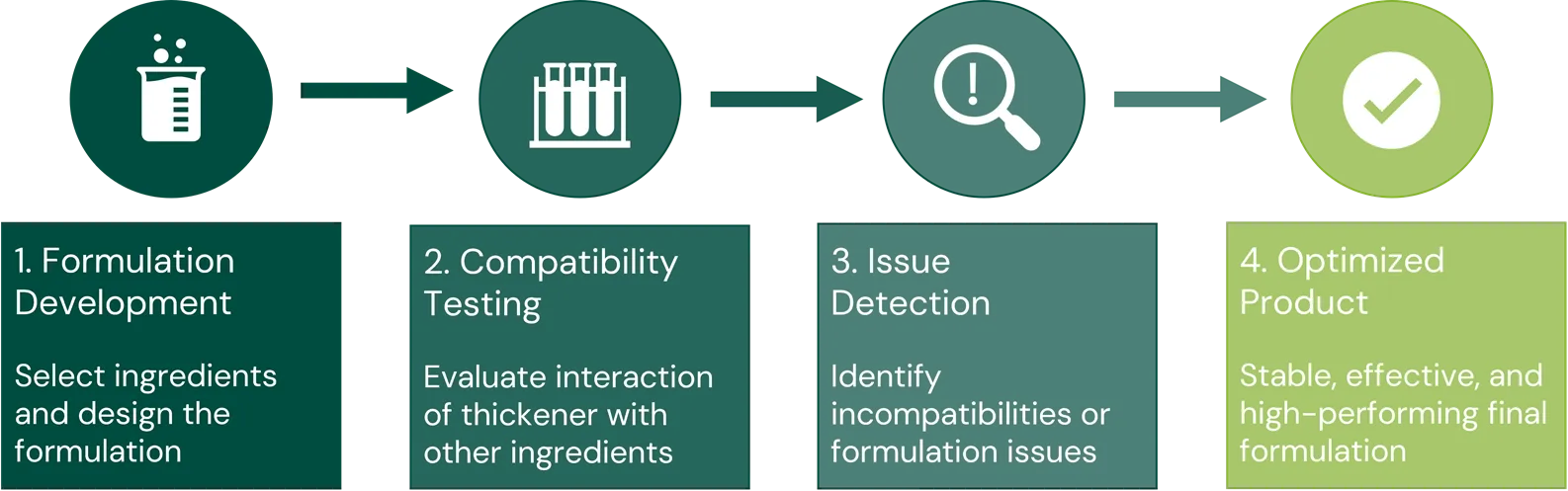
Overview of compatibility testing
Visual inspection
Visual inspection involves observing the formulation for changes. These include changes in appearance, such as color changes, phase separation, or the formation of sediments. This initial assessment can provide valuable indications of compatibility issues. Incompatibilities may manifest in various ways. For example, changes in clarity, homogeneity, or visual appearance of the formulation.
Stability testing
In stability testing, the formulation is subjected to various conditions. This test evaluates the physical and chemical stability. For example, temperature variations, freeze-thaw cycles, and prolonged storage periods. Stability tests can help identify any potential issues that may arise during the product's shelf life. Common stability tests include:
- Freeze-thaw stability: In this, the formulation is subjected to multiple cycles of freezing and thawing. This simulates temperature fluctuations. This test assesses the formulation's ability to withstand the temperature changes. The formulation must not experience phase separation, texture changes, or other stability issues.
- Accelerated stability testing: Here, the formulation is exposed to elevated temperatures and humidity conditions. This happens for an extended period, for about weeks or months, to check the stability over time. This test helps to predict the performance of the formulation under normal storage conditions.
- Long-term stability testing: Here, the formulation is stored under recommended storage conditions. This happens for an extended period, up to the intended shelf life of the product. It helps to assess the stability and compatibility of the formulation over an extended duration.
Physical property analysis
Physical property analysis involves evaluating specific characteristics of the formulation. It enables the identification of changes or issues caused by the thickener. Some common physical property analysis methods include:
- pH measurement: The pH of the formulation should remain within the desired range. This ensures stability and compatibility. pH changes caused by the thickener may indicate incompatibility with other ingredients. Especially if the formulation contains pH-sensitive components.
- Viscosity measurement: The viscosity of the formulation should be within the desired range. This helps to achieve the intended texture and performance. Regular viscosity measurements can help identify any changes or interactions between the thickener and other formulation components.
- Rheological analysis: It determines the flow behavior and consistency of the formulation. These tests include shear stress/shear rate analysis and yield stress determination. They can help identify any changes in rheological properties. These changes can arise due to incompatibilities between the thickener and other ingredients.
Assessing the overall performance of the formulation
It is essential to assess the impact of the thickener on the overall performance of the formulation. This includes evaluating attributes such as:
|
|
Consumer perception studies and sensory evaluations can provide feedback on the formulation's performance. It also determines the compatibility with the chosen thickener.
Having addressed the key incompatibility challenges and methods to detect them, the next step is to learn to select the right thickener to avoid these issues and ensure optimal formulation performance.
Factors influencing thickeners selection
Test methods to evaluate thickeners performance
Regulatory guidelines governing thickener selection
Key applications
- Li Y, Zhou Z, Zhao X, Zhao H, Qu X. The Rheological and Skin Sensory Properties of Cosmetic Emulsions: Influence of Thickening Agents. J Cosmet Sci. 2018 Jan/Feb;69(1):67-75. PMID: 29658879.
- Varpe BD, Kulkarni AA, Mali AS. Aloe vera Compositions Used for Medicinal Applications: A Patent Review (2013-till 2020). Recent Pat Food Nutr Agric. 2021;12(2):104-111. doi:10.2174/2212798411999201228192616. PMID: 33371842. Rheological characterization of flow inception of thixotropic yield stress fluids using vane and T-bar geometries - Scientific Figure on ResearchGate.
- Horoiwa, Thais & Oliveira, Aurenice & Migotto, Amanda & Cerize, Natalia. (2019). Process Evaluation of Sugar-Based Polymeric Colloidal Nanocarrier Formation. Materials Research. 22. 10.1590/1980-5373-mr-2018-0074.
- Rheological characterization of flow inception of thixotropic yield stress fluids using vane and T-bar geometries - Scientific Figure on ResearchGate.
- Image (Phase Separation)- Horoiwa, Thais & Oliveira, Aurenice & Migotto, Amanda & Cerize, Natalia. (2019). Process Evaluation of Sugar-Based Polymeric Colloidal Nanocarrier Formation. Materials Research. 22. 10.1590/1980-5373-mr-2018-0074. Licensed under Creative Commons.
- (n.d.). Ingredient: Xanthan Gum. European Commission.
- (n.d). Canva Image. (Stefano Oppo from Corelens).

Thickeners used in creams and lotions offer a range of sensory experiences

In gels and serums thickeners fight against aging signs

The viscosity in shampoos and conditioners is brought about by the thickeners