

Film forming – Methods and materials
Last update on Jul 23, 2009
This article was originally published on July 23, 2009 and revised in 2025.
Polymers and colloids in cosmetic applications
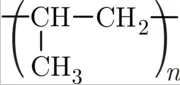
Repeating unit ("n") of polypropylene molecule
These polymers can be either water or oil soluble depending on the type of molecule used. The longer the chain, the higher the molecular weight. They can be in either liquid or solid form. These polymers, depending on their molecular weight and molecule type act as film formers for may applications such as mascara, hair fixatives, nail polish hardeners, and sunscreens.
Depending on the type of polymer, the properties can be custom designed to fit a specific application, which is the type of chemistry used today for many high profile products. Examples of some polymeric film formers are cellulose gums, nylon, PVP (polyvinyl pyrolidone), silicones, as well as ethoxylated and propoxylated (such as polypropylene) ingredients. The molecular weight in these polymers are varied and the different grades are used in different types of products in order to provide higher viscosity, thicker films, gloss, increased water or oil solubility, and ingredient solubilization just to name a few.
Another type of film former is a colloid. Technically, a colloid is a group of tiny particles that are caught up with in liquid or solid matrix. The colloid itself usually falls between 2 and 500 nanometers in size depending on the system it is used in. These particles can be natural (mineral based) or synthetic and can also vary in molecular weight depending on the film property requirements. Some common examples of colloidal systems are kaolin, a type of clay, latex and acrylics.
Some other specific types of clays are hectorite and bentonite both of which create film forming layers when combined with water. Latex polymers and acrylics are usually water soluble and are milky white in appearance due to the particles trapped in the matrix. Some examples of where latex polymers are used are shampoos, toothpaste, makeup, and mascara. In a latex system, the liquid vehicle evaporates leaving the particles to form a film, which then can be water resistant or impermeable to different types of oils. These latex particles are usually 1 to 2 microns in size.
Natural and synthetic resins with varied properties
The next type of film formers are called resins. Natural resins are clear to translucent yellow or brown, solid or semisolid, viscous substances of plant origin, such as shellac, amber or rosin. Synthetic resins are materials that are physically similar and may be polymerized or are chemically modified natural resins.
These include various thermoplastic resin materials such as polyethylene and polyurethane. Both polyethylene and polyurethane can come in a variety of molecular weights to vary film properties. They can be either water soluble or oil soluble. Polyethylenes are waxy oil soluble materials that can vary in hardness and melt point depending on the properties desired. They are used mainly in mascara, lipstick and antiperspirant sticks. Polyurethanes create water soluble films and can be used in sunscreen products to improve water resistance and improved longevity and wearability.
| Property | Hydrogels | Polyurethane | Acrylics | Silicones |
|---|---|---|---|---|
| Tensile strength | Low | Medium to high | Low | Low |
| Adhesion | Low | Medium | Medium | Low |
| Elongation | Low | High | Low | Medium |
| Lubricity | High | Medium | Medium | High |
| Abrasion resistance | Low | Medium | Medium | Low |
| Oil resistance | Medium | High | High | Low |
| Water resistance | Low | Medium | High | High |
In most cases for cosmetic use, film formers are used in conjunction with volatile solvents. The volatile material evaporates off thereby leaving the film former on the surface of the skin or hair. The volatile solvents of choice are water, isododecane or cyclomethicone, all of which work well in various cosmetic systems where film forming is desirable.
Many film formers can also be used a surface treatments on powders giving them more water or oil resistance. Selection of the proper film former is essential in creating a product with specific characteristics and optimum functionality. The use level will vary depending on the active level of the specific film former and how much of a film is desired in the product.
But each film former has its own characteristics, functions and properties and not all film formers function the same way or are designed for all cosmetic systems. The chart above is courtesy of Kobo Products and it shows the physical properties of different film formers which can help the cosmetic formulator when deciding on what film former to use for a specific application.