
Category overview
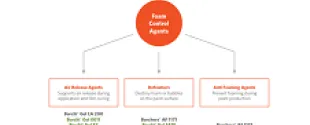
Defoamers are typically opaque to translucent liquids or pastes formulated to control and eliminate foam during the production, application, and drying of coatings. Functionally, they disrupt foam formation by breaking air bubbles and preventing their stabilization, resulting in smoother film formation and improved surface appearance. They are indispensable in architectural, industrial, and high-speed production coatings.
Current trends in the coatings industry include the development of low-VOC, silicone-free, and bio-based defoamers that align with sustainability objectives while minimizing side effects like surface haze or poor recoatability. Available in oil-based, silicone-based, and polymer-based sub-types, these additives are selected based on resin compatibility and application method.
Applications


Claims / benefits
Properties
| Others properties | Value & unit | Test condition | test method |
|---|---|---|---|
Density (1010) | Visible After Login | Visible After Login | Visible After Login |
Flash Point (581) | Visible After Login | Visible After Login | Visible After Login |
Viscosity (724) | Visible After Login | Visible After Login | Visible After Login |

Products
Recently launched products
TEGO® Foamex 8051
by Evonik
- Recently launched
- Sustainable option
TEGO® Foamex 812 eCO
by Evonik
- Recently launched
- Sustainable option
TEGO® Foamex 8420
by Evonik
- Recently launched
- Sustainable option
Most popular products

Dispelair® CF 246
by DKSH
- Sustainable option
- Support available
- Original documents

Borchi® Gol 0011
by Borchers (Milliken)
- Sustainable option
- Support available
- Original documents
Borchi® Gol LA 200
by Borchers (Milliken)
- Sustainable option
- Support available
- Original documents
Popular suppliers

FAQs
How do I select the right defoamer?
Match the defoamer to your system (waterbased vs. solventbased), application method, and defect sensitivity. Consider compatibility with other additives, required dosage, and whether you need in-can (storage) or in-film (application) control, or both. Since performance is very formulation-specific, testing at low addition rates first is the most reliable way to confirm the right choice.
Why do I still see bubbles or craters even though I added a defoamer?
This usually means the defoamer isn't matched to your system, or the dose or mixing stage is off. Some defoamers lose effectiveness over time ("knock-in") or under certain shear conditions, so bubbles that seemed controlled at first can reappear later in the process or after storage. Reviewing dosage, addition point, and compatibility with your resin usually resolves it.
Can too much defoamer cause problems?
Yes. Overdosing is one of the most common defoamer mistakes. Too much can cause craters, fisheyes, poor intercoat adhesion, or reduced gloss, sometimes making the finish worse than having no defoamer at all. Defoamers work best in small, carefully optimized amounts, so incremental testing from a low starting dose is key to controlling foam without introducing new defects.
Defoamer vs. air release agent – how are they different?
Defoamers actively destroy foam bubbles quickly, both in the can and during application. Air release agents work more gradually, letting tiny air bubbles trapped inside the coating rise to the surface and escape before the film dries. Many real-world formulations use both together, since one handles surface foam and the other handles bubbles trapped deeper in the film.
Are defoamers environmentally friendly?
It varies by chemistry. Silicone-based defoamers are highly effective but can cause craters or recoat issues if overdosed. Mineral-oil-free and silicone-free alternatives are increasingly available, offering lower environmental impact, easier re-coating, and fewer surface defects. Checking VOC content, biodegradability, and REACH/regulatory data helps compare options for a given formulation.