

Smarter binders, simpler formulations: Vinavil at ACS 2026
Last update on May 20, 2026
An Interview with Hemant Shah, Vice President of Business and Sales for North America at Vinavil
Vinavil showcased two innovative polymer solutions at the American Coatings Show 2026:
- Crilat 4825: An elastomeric acrylic engineered for long-lasting facade protection
- Crilat 5800: A versatile core-shell binder designed to adhere across virtually every substrate
These latest binder technologies are designed to enhance coating durability, improve application efficiency, and ensure substrate compatibility.
We recently interviewed Hemant Shah, Vice President of Business and Sales for North America at Vinavil, to understand what sets Crilat 4825 and Crilat 5800 apart and what they mean for formulators.
#1. At ACS 2026, Vinavil introduced Crilat 4825 and Crilat 5800. What was the vision behind these two new polymer solutions, and what key market needs do they address?
At Vinavil, our innovation strategy centers on a clear objective: simplify formulation while elevating performance and sustainability.
With Crilat 4825, we focused on the growing need for long-lasting exterior protection, particularly in masonry and facade, coatings where durability, crack-bridging, and weather resistance are critical.
With Crilat 5800, the vision was different but complementary: to develop a versatile, multi-substrate binder that addresses the rising demand for coatings that adhere across diverse and challenging surfaces, including low surface energy (LSE) plastics, without the need for complex multi-primer systems.
Together, these products reflect two pillars of our approach:
- Targeted performance: Crilat 4825
- Formulation simplification and versatility: Crilat 5800
#2. Crilat 4825 is positioned as a next-generation elastomeric acrylic for masonry coatings. What differentiates it from conventional elastomeric binders in terms of crack-bridging and long-term facade protection?
Crilat 4825 goes beyond traditional elastomeric binders by combining several key performance attributes:
- Superior crack-bridging capability, enabled by an optimized polymer architecture and high elasticity
- Enhanced durability under harsh environmental exposure
- Improved resistance to water ingress: A primary driver of facade degradation
Unlike conventional systems that may lose elasticity or degrade over time, Crilat 4825 is engineered to maintain flexibility and integrity throughout an extended service life, delivering both aesthetic retention and structural protection.

Key performance attributes of Crilat 4825
#3. Low-temperature flexibility (Tg: –25°C) and very low water absorption are key claims for Crilat 4825. How do these properties translate into real-world benefits for exterior coatings in demanding climates?
These technical properties deliver concrete advantages in the field:
Low Tg (–25°C): This ensures:
- Flexibility is maintained in cold climates
- Prevents cracking during thermal cycling
- Coating integrity holds in winter conditions
Very low water absorption: This results in:
- Reduced water penetration into substrates
- Lower risk of blistering, efflorescence, and freeze-thaw damage
- Enhanced long-term durability and adhesion
Together, these properties enable coatings that perform reliably across extreme weather conditions from sub-zero winters to humid tropical environments.
#4. From a formulator's perspective, how easy is it to incorporate Crilat 4825 into existing elastomeric coating systems? Any formulation tips or optimization strategies you would recommend?
Crilat 4825 is designed with formulators in mind offering an easy drop-in replacement for many existing elastomeric systems. It is compatible with standard formulation components and supports both high-build and flexible coating designs.
Key formulation tips:
- Optimize PVC and film thickness to maximize crack-bridging performance
- Use an appropriate coalescent balance to maintain low-temperature film formation
- Leverage hydrophobic additive synergies to further boost water resistance
The result is high performance without added formulation complexity.
 |
#5. Crilat 5800 is described as a "one polymer – every surface" solution. How does its core-shell and self-crosslinking structure enable adhesion across such diverse substrates as plastics, metals, and concrete?
Crilat 5800 leverages a core-shell architecture combined with self-crosslinking functionality, which delivers three critical attributes:
- Hard/soft phase balance for film durability and integrity
- Reactive crosslinking sites that improve mechanical strength and chemical resistance
- Surface-active design elements that enhance wetting and adhesion
This structure enables the polymer to adapt to different substrate chemistries, supporting strong adhesion across plastics (including LSE substrates), metals, wood, concrete, and more.
#6. Adhesion to low surface energy substrates like polypropylene is notoriously challenging. How does Crilat 5800 overcome this, and what advantages does it offer over traditional multi-primer systems?
Adhesion to non-polar substrates like polypropylene is difficult due to their low-energy surfaces that resist wetting and bonding.
Crilat 5800 addresses this through:
- Engineered polymer surface interaction mechanisms
- Optimized particle morphology and functional groups
- Enhanced interfacial wetting and mechanical anchoring
Key advantages over traditional multi-primer systems:
- Eliminates or significantly reduces the need for specialty primers
- Simplifies the coating stack: Fewer layers, fewer steps
- Maintains the benefits of a low-VOC, water-based formulation

Key advantages of Crilat 5800 over traditional multi-primer systems
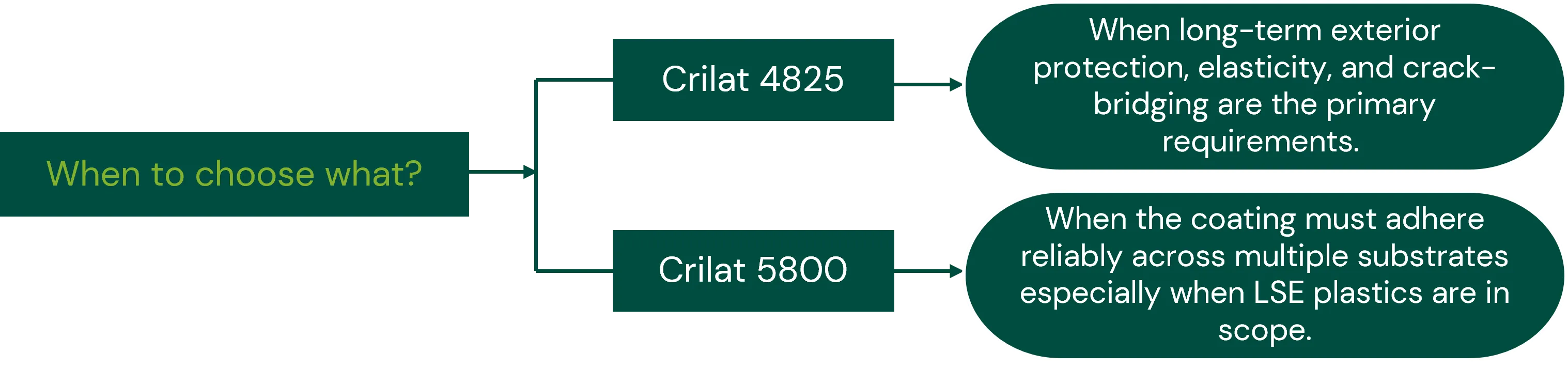
#7. How would you position Crilat 4825 vs. Crilat 5800 for formulators evaluating both products — and when should one be preferred over the other?
These two products are complementary, not competitive. Each is engineered for a distinct set of challenges:
| Product | Best use | Key strength |
| Crilat 4825 | Masonry, facade, and elastomeric coatings | Flexibility, crack-bridging, weather durability |
| Crilat 5800 | Multi-substrate coatings (plastic, metal, wood, concrete) | Adhesion versatility, formulation simplification |
Select the most suitable product between Crilat 4825 and Crilat 5800 based on your coating requirements and substrate targets:
#8. Looking ahead, how do you see polymer innovations like Crilat 4825 and Crilat 5800 shaping the future of sustainable and high-performance coatings?
Crilat 4825 and Crilat 5800 reflect the direction the coatings industry is heading:
- Higher durability → Longer service life → Reduced environmental footprint
- Low-VOC, water-based technologies displacing solvent-based systems
- Simplified formulations: Fewer raw materials, fewer process steps, lower total cost
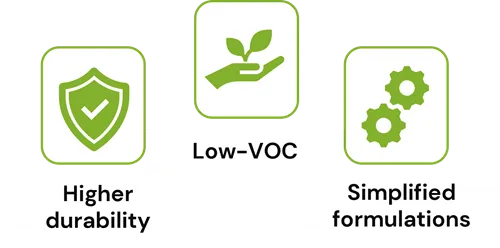
Crilat 4825 & Crilat 5800 align with sustainable and high-performance coating trends
We believe the industry is moving towards "smarter polymers that do more and last longer with less environmental impact."
At Vinavil, our goal is to combine performance, sustainability, and formulation efficiency, helping customers meet both regulatory demands and evolving market expectations.
Find product details here:
 |  |
Vinavil — View supplier offerings here ➤

Hemant Shah is Vice President of Business and Sales for North America at Vinavil, based at MAPEI North America headquarters in Florida. With over 35 years of experience in the adhesives and polymer industry across North America and the Middle East, he leads regional business strategy and commercial operations, working alongside Managing Director Taako Brouwer to align North American initiatives with Vinavil's global objectives. |
DISCLAIMER: All images and tables used in this article are copyright of Vinavil.