

Powder coatings: How to formulate with right ingredients?
Last update on Apr 2, 2026
However, the success of a powder coating formulation depends on careful selection of its constituent materials. Incorrect choice of resin, pigment, additive or binder can lead to reduced coating performance, increased costs, and other environmental issues.
This guide aims to provide a systematic approach to powder coating material selection, covering the key considerations, properties, and characteristics of each raw material. We will also help powder coating professionals to make informed material selection decisions and create high-performance, sustainable coatings that meet the demands of their applications.
What is Powder Coating?
The technology for coating products with dry powder is called powder coating (Plural: powder coatings). This type of coating has been available since the 1950s. Here's how a powder coating works:
- Raw materials: The coating material starts with a dry powder made from finely ground resins, pigments, and other additives. As with any coating, formulation variables are critical to the processing and performance characteristics. Our material selection platform showcases 5,900 raw materials used in powder coatings. You can compare grades using filters, request samples, and download technical datasheets from our Master Catalog with ease.
- Application: The powder adheres to a preheated substrate surface in the fluidized bed process, or it adheres electrostatically to the spray process.
- Curing process: Once coated, the item is heated further in a curing oven. The particles flow and fuse into a strong, adhering coating. The result is a high-quality coating with an attractive finish and excellent durability.
Powder coatings vs. conventional liquids
Unlike liquid paint, it contains no solvents. The powder coating formulation is much like a liquid coating formulation except that most of the components are in solid, melt-processable form.
The final properties of the powder coatings are often superior to liquid coating systems. The reason for the fast growth of this technology has been more related to the evidence that powder coatings provide maximize production and improve efficiencies. When compared to liquid coatings, powder coating formulations offer several benefits and limitations as listed below.
| ADVANTAGES | DISADVANTAGES |
Performance
Appearance & Finish
Efficiency & Productivity
Cost & Operational Benefits
Environmental & Compliance Benefits
| Quality & Finish
Application
Operational Challenges
|
Prior knowledge about the benefits and limitations of powder coatings help you make informed material choices. Let's move on to find out the raw materials used to create powder coating formulations.
Raw materials for powder coatings
The main raw material components used in powder coating formulations include:
Resins
Resins are the key component of powder coatings. The range of resins used is increasing steadily in an attempt to meet the more demanding needs of new market sectors. This component in the formulation will largely determine the processing and end-use performance properties of powder coatings. There are two main classifications for powder coatings: thermoplastic and thermoset. The final coating has a different chemical structure than the applied powder.
Thermoplastics powders
A thermoplastic powder coating melts and flows when heat is applied but continues to have the same chemical composition once it cools to a solid coating. They are typically high molecular weight materials that require high temperatures to melt and flow.
The primary advantage of thermoplastic powder coatings is that they form a smoother finish and require less energy. They are commonly applied by fluidized bed application, and the parts are both preheated and post-heated. Most of the thermoplastic powder coatings have marginal adhesion so that the substrate must be pretreated and sometimes primed prior to coating application.
The common examples of thermoplastic powder coatings are given below.
Polyvinyl chloride (PVC)
PVC coatings find use in FDA-approved applications such as frozen food shelving and dishwasher baskets. Other uses include general-purpose electrical insulation, chain link fence wire, and outdoor furniture. Key features of PVC coatings include:
- Softness, glossy surface & flexibility
- Impact strength & resilience
- Salt spray & weathering resistance
- Chemical & water resistance
Special primers are generally required for optimal adhesion. Two types of vinyl powder are used: dry blends and melt mixed. The dry blends are less expensive, but the melt mixed materials are superior in performance.
Polyolefin
Polyethylene and polypropylene powder coatings provide soft and waxy films that have characteristics very similar to their plastic counterparts. Polyolefin powder coatings are used primarily for their low cost and ease of application. However, certain properties make them attractive in many applications including:
- Toughness
- Low water absorption
- Excellent detergent and chemical resistance
- Good electrical insulation characteristics
- High durability, and
- Some solvents can break them down quickly
Polyolefins are often used to coat laboratory equipment because the surface is easily cleaned. They are also used for food handling equipment and for automotive applications such as battery hold-downs.
Nylon
Nylon powders are practically all based nylon 11. Nylon 6/10 is sometimes used but at high cost. Nylon powders are used to produce powder coatings which of a wide range of benefits, including:
- Toughness
- Excellent abrasion, wear, and impact resistance
- A low coefficient of friction
- Good chemical and solvent resistance
- Smooth surface finish
Generally, a primer must be used with nylon powder coatings to achieve the adhesion level needed for higher performance applications. Nylons can be formulated for food contact applications, outdoor applications such as light fixtures or seating and marine applications where they completely encapsulate fittings, bolts, and other hardware items.
Polyester
Thermoplastic polyester powder materials have better than average adhesion properties without the need for a primer. They also exhibit good UV resistance and weatherability. Polyester powder coatings are somewhat more difficult to apply than nylon materials and are not as resistant to abrasion or solvent.
Polyester coatings are often applied to such items as outdoor metal furniture due to their good weatherability, corrosion resistance, and general durability.
Polyvinylidene fluoride
Polyvinylidiene fluoride (PVF) based coating resins have excellent weathering characteristics and excellent resistance to chemicals exception for certain hydrocarbon solvents. They are used to coat piping and valves used in the chemical process industries. Usually a chromate primer is recommended.
Below is a list of physical and coating properties for different types of thermoplastic powder coatings.
| Property | Vinyl | Nylon | Polyester |
| Primer Required | Yes | Yes | Yes |
| Melting Point, °C | 130-150 | 186 | 160-170 |
| Typical Pre/Post Heat, °C | 284 / 230 | 310 / 250 | 300 / 250 |
| Adhesion | G-E | E | E |
| Surface Appearance | Smooth | Smooth | Slight Peel |
| Gloss, 60° | 40-90 | 20-95 | 60-95 |
| Pencil Hardness | HB-2H | B | B-H |
| Salt Spray Resistance | G | E | G |
| Weathering | G | G | E |
| Humidity | E | E | G |
| Acid Resistance | E | F | G |
| Alkali Resistance | E | E | G |
| Solvent Resistance | F | E | F |
| E = Excellent, G = Good, F = Fair | |||
Thermosetting powders
A thermosetting powder coating also melts when exposed to heat. However, after they flow to form a continuous film, they chemically crosslink on additional heating.
Unlike thermoplastic powder coatings, thermosetting powders are heat stable and will not revert back to the molten stage when reheated after curing. They are also tougher, have better adhesion to metal substrates, and more resistant to solvents and chemicals. Thermosetting powders account for about 95% of all powder coatings.
Epoxy powder coatings
Epoxy coatings are used wherever a hard, electrically insulating coating is required to provide protection over a wide temperature range. Depending on the particular epoxy resin selected, these coatings can be used up to 150°C or higher. Epoxy powder coatings have a dielectric strength of up to 1200 volts/mil., in thicknesses over 10 mils (250 µm). They are, therefore, ideal as functional electrical insulators as well as a protective coating
Chemical resistance to most solvents and mild acids and bases is good, and epoxy powder coatings provide excellent toughness and corrosion resistance. Adhesion to metal substrates is excellent, and generally epoxy powder coatings do not require a primer. Epoxies are often used for decorative applications. They can be formulated to provide a variety of colors, glosses, and textures. Typical applications include metal office furniture, shelving, interior car parts, and toys.
The major limitation of epoxy powder coatings is a tendency toward brittleness if the coating is over a few mils thick. They will also chalk when subjected to UV radiation. For this reason, they are rarely used for outdoor applications.
Epoxy-Polyester Hybrid Powder Coatings
Epoxy-polyester hybrids combine epoxy resin with polyester resin to form a powder with many of the same characteristics as the epoxies. This group of powder coatings could be considered part of the epoxy family except for the high percentage of polyester utilized (often in excess of half the resin).
Property wise these resins are very close to their epoxy counterparts:
- Epoxy-polyester hybrid coatings are generally tough, flexible, and competitively priced when compared to pure epoxy coatings.
- Hybrids provide some improvement in weatherability, but they will begin to chalk almost as fast as an epoxy coating. However, after initial chalking, the deterioration is slower.
- Some hybrids are less resistant to chemicals and solvents. Hybrids are likely to be used in many of the same applications as epoxies.
Urethane Polyester Powder Coatings
Urethane polyester powders are one of the two polyester powder coatings being used commercially (the other is polyester TGIC). The primary type that has been used for several years is a urethane cured polyester powder, which is comparable chemically to the exterior quality urethane. Coatings of this type offer:
- Outstanding thin film-appearance
- Toughness with excellent weathering properties
It is common to block the crosslinker in urethane polyesters with e-caprolactam. To begin the crosslinking process, the material must reach a temperature above the blocking agent threshold. With e-caprolactam, unblocking occurs at approximately 182°C. Urethane polyester powder coatings are true competitors to high-quality liquid paints in respect to thin film appearance.
They are used for exterior applications such as patio furniture, automotive wheels and trim, lawnmowers, and a wide range of other products requiring high-quality, decorative finishes.
Polyester TGIC powder coatings
Polyester triglycidyl isocyanurate (TGIC) powders are another type of polyester powder coatings being used commercially. In these coatings a very low molecular weight glycidyl or epoxy-functional curing agent is used to co-react with the polyester. In this way, the polyester constitutes a very high percentage of the resin and provides weather and corrosion resistance incomparable to the urethane cured polyesters. However, their resistance to chemical and solvents is lower.
- TGIC powders have very good adhesion characteristics, corrosion resistance, and exterior durability
- They can typically be cured at lower temperatures than urethanes and have shorter cure cycles
- They also provide good edge coverage and tough, thick films
Typical applications of polyester TGIC powder coatings are where sharp edges and corners exist such as on automotive wheels, air conditioners, lawn furniture, and air conditioner cabinets.
Acrylic powder coatings
Acrylic powders provide good appearance, tough surface, exceptional weatherability, and excellent electrostatic application characteristics. Common acrylic based powder coats include:
- Urethane acrylics
- Urethane acrylics require cure temperatures of 182°C
- They offer excellent thin-film appearance, good chemical resistance and hard films
- Flexibility and impact resistance is usually poor
- Acrylic hybrids
- They combine the acrylic resin with an epoxy binder
- They are somewhat better than a polyester-epoxy hybrid but still not considered acceptable for exterior use
- Acrylic hybrids generally have much better mechanical properties than the other acrylic powder coats
- Glycidyl methacrylate (GMA) acrylics
- GMA acrylics can be cured in less time or at a lower temperature than urethane acrylics, and they also can provide superior weathering characteristics
- They make excellent clear coats over brass or chrome
- Like the urethane acrylics, flexibility is somewhat limited
- Urethane acrylics
Below is a list of physical and coating properties for different types of thermosetting powder coatings.
| Property | Epoxy | Epoxy Hybrids | Urethane Polyester | TGIC Polyester | Acrylic |
| Hardness (Pencil) | HB-7H | HB-2H | HB-4H | HB-4H | HB-4H |
| Impact Resistance (in-lbs) | 60-160 | 40-100 | |||
| Gloss (60°) | 3-100+ | 10-100+ | 15-95 | 20-90 | 10-90 |
| Color | Al colors, clear, textures | ||||
| Salt Spray | 1000 hrs | 1000 hrs min | 1000 hrs | 1000 hrs min | |
| Condensing Humidity | |||||
| Cure Range* | 3 min at 232°C to 25 min at 121°C | 10 min at 204°C to 25 min at 149°C | 10 min at 204°C to 25 min at 177°C | ||
| * Typical 2 mil (50 µm) film – time at metal temperature | |||||
Additives
Curing agents are used according to the type of resin system employed and the final properties required of the coating.
Accelerators are used to increase the cure reaction rate. Select 100+ accelerators for powder coatings.
Pigments are generally solid particulate materials such as titanium dioxide or carbon black.
Fillers are used to reduce the cost of the coating formulation and/or to improve specific properties such as flow, surface texture, lubricity, etc. Common fillers are barytes, calcite, mica, talc, whiting, and wollastonite.
Extenders, such as aluminum silicate, are used to provide opacity and act as a filler.
Degassing agents are particularly important in low-bake systems. They are used to eliminate/dissipate gas bubbles that may cause film porosity and embrittlement or poor finish.
Dry Flow agents improve the free flow of powders within the production delivery systems.
Flow agents enhance film properties and eliminate surface defects by improving the flow of the molten coating. Examples of flow agents include polyacrylates, silicones, surfactants, and fluorinated alkyl esters.
Matting agents are used to reduce the gloss of the cured film.
Texturing agents are used to control/enhance the gloss level of cured films.
Rheological additives provide viscosity control to molten coatings for improved edge coverage or for textured surface effects.
Waxes are added to the formulation to provide slip, hardness, scratch and mar resistance, and to act as free flow powders and anti-bridging agents in processing.
Tribo-charging additives such as antioxidants and light stabilizers are frequently used in powder coatings. Depending on their composition, tribo-static powders require additives, such as HALS to improve their charge ability in addition to their light stabilization properties.
- Heat stabilizers are required to be thermally stable and non-volatile during high-temperature powder extrusion and curing processes (electric and direct-fired gas ovens), and to show no discoloration. Various classes of antioxidants have different thermal stabilization mechanisms. High resistance against UV degradation is necessary for all exterior applications. This is achieved through a synergistic combination of UV absorbers and HALS.
- UV absorbers work by absorbing detrimental UV radiation and harmlessly releasing the energy as heat before it can cause polymer degradation.
- HALS neutralizes any free radicals, thereby preventing polymer degradation. HALS are not dependent on coating thickness for their efficacy.

How are powder coatings made?
The established manufacturing process for powder coatings comprises the following steps:
- The raw powder coating materials are generally mixed dry. This process is called dry blending.
- The blended raw materials are then fed into an extruder. This step takes place at elevated temperatures to mill the pigments and for melt mixing to achieve a homogenous mix.
- The extrudate is then cooled rapidly.
- Milling the flakes of an extrudate into chips to a final size in a multi-stage process. The chips are ground to a very specific particle size distribution depending on the application.
- Removing undersize and oversize particles.

Limitations of powder coating process
To avoid manufacturing mishaps, you should consider the following limitations while creating powder coating formulations.
- Liquid additives (including pigment dispersants) cannot be used unless first converted to a solid form.
- Shearing time equals the dwell time in the extruder - typically around 20 seconds - with no opportunity to extend dispersion time or control it independently; the shear is inadequate for some types of pigments and too much for many effect pigments.
- Care must be taken to ensure that extruder temperatures are low enough to avoid premature crosslinking. Various proposals have been put forward for processes which avoid these problems, but they have not so far had a major impact.
- The particle size is important to the performance and appearance of the coating. The size of the powder particle can have an influence on the behavior of the material in the delivery system, charging systems, and the final film characteristics.
- When reclaimed powder is used, the coater must maintain a consistent particle size distribution. There are several methods by which particle size distribution can be measured.
Methods to apply powder coatings
Powder coating is a dry finishing process, using finely ground particles of pigment and resin. These particles are generally electrostatically charged and sprayed onto electrically grounded parts.
The substrate is first pretreated similarly to conventional liquid-coated parts. The pretreatment process is normally conducted in series with the coating and curing operations. The charged powder particles adhere to the parts and are held there until melted and fused into a smooth coating in a curing oven.
There are essentially two common ways of applying powder coating:
Electrostatic spray
Electrostatic spray method uses a powder-air mixture from a small fluidized bed in a powder feed hopper. The powder is supplied by a hose to the spray gun, which has a charged electrode in the nozzle fed by a high voltage dc power. In some cases, the feed hoppers vibrate to help prevent clogging or clumping of powders prior to entry into the transport lines.
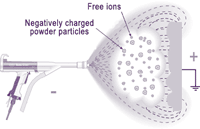
The electrostatic powder spray gun helps in:
- Directing the flow of powder
- Controlling the deposition rate
- Controlling the pattern size, shape, and density of the spray
- Charging the powder being sprayed
The spray guns can be manual (hand-held) or automatic, fixed or reciprocating, and mounted on one or both sides of a conveyorized spray booth.
Electrostatic spray powder coating operations use collectors to reclaim over-spray. This reclaimed powder is then reused, adding significantly to the powder coating's high transfer efficiency.
There are various gun designs that mainly differ in the method of applying electrostatic charge to the powder. In some cases, the powder is electrostatically charged by friction. The advantage is that the powder is free to deposit in an even layer over the entire surface of the part, and deposition into recesses is improved.
The film thickness is dependent on the powder chemistry, preheat temperature, and dwell time.
- Film thicknesses of 1.5 - 5.0 mils (37.5 - 125 µm) can generally be applied on cold products
- If the products are preheated slightly, 20 - 25 mils (500 - 625 µm) coatings can easily be applied in a single coat
Fluidized bed
The fluidized bed coating process is a simple dipping process that can be either conventional or electrostatic.
Conventional fluidized bed process
The fluidized bed is a tank with a porous bottom plate. The plenum below the porous plate supplies low-pressure air uniformly across the plate. The rising air surrounds and suspends the finely divided plastic powder particles, so the powder-air mixture resembles a boiling liquid as shown in the figure.
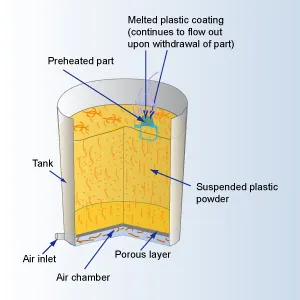
Products that are preheated above the melt temperatures of the powder are dipped in the fluidized bed, where the powder melts and fuses into a continuous coating.
A high transfer efficiency results from little drag out and no dripping. The fluidized bed powder coating method is used to apply heavy coats in one dip i.e. 3 - 10 mils (75 - 250 µm), uniformly to complex-shaped products. It is possible to build a film thickness of 100 mils (2500 µm) using higher preheat temperatures and multiple dips.

Effects of preheat temperature and dipping time on the film build in coating a steel bar with epoxy resin
Electrostatic fluidized bed process
It is essentially a fluidized bed with a high voltage dc grid installed above the porous plate to charge the finely divided particles. Once charged, the particles are repelled by the grid, and they repel each other, forming a cloud of powder above the grid. These electrostatically charged particles are attracted to and coat products that are at ground potential. Film thicknesses are similar to what can be achieved in the electrostatic spray process.
| ADVANTAGES | DISADVANTAGES |
|
|
There are several other processes that have been developed, but they are far less used. These include flame spraying, spraying with a plasma gun, airless hot spray, and coating by electrophoretic deposition.
Curing of powder-coated products
There are four basic methods normally used in the curing of powder-coated parts as discussed below.
- Convection
- Convection ovens can be either gas or electric
- Hot air is circulated around the powder-coated parts, and the parts attain the temperature within the oven
- Infrared
- Infrared ovens, using either gas or electricity as their energy source, emit radiation in the IR wavelength
- The radiated energy is absorbed by the powder and the substrate immediately below the powder, so the entire part need not be heated to the cure temperature. This allows a relatively rapid heat rise causing the powder to flow and cure when exposed for a sufficient time
- A combination of the two
- Combination ovens generally use IR as the first zone to melt the powder quickly. This process is termed near-infrared (NIR) cure, and powders are formulated specifically to take advantage of this process
- The part then progresses into a second zone, which is a convection oven
- Ultraviolet (UV) curing
- UV curing is commonly used with heat-sensitive substrates
- Specifically formulated UV powders flow at very low temperatures (121°C) and can be cured via UV radiation in a matter of seconds
Find below a comparison of general curing conditions for heat curing of conventional thermosetting powders and UV curable powders using the various heating modes described above.
| Heating/Curing | Temperature, °C | Total Curing Time, minutes | Substrate |
| Conventional Thermosetting Powders | |||
| Convection | 140-220 | 30-15 | Metal |
| Infrared + Convection | 140-220 | 25-10 | Metal |
| Infrared | 160-250 | 15-1 | Metal |
| UV Curable Powders | |||
Infrared/Convection for heating (1-2 mins) and UV for curing (secs) | 90-120 | 3-1 | Metal, wood, plastic, others |
Note: Thermoplastic powders require heat only to fuse the powder together into a continuous film while thermosetting powders often require additional heat to cure the film on the product.
Applications of powder coatings
Today, powder coatings have replaced solvent-based coatings and have found the greatest commercial success in applications such as automotive, appliances, outdoor furniture, lawn and garden products, architectural and building/construction, electrical/electronics, non-metallic products and much more.
With over 5,900 powder coating materials available in our Master Catalog, choosing the right grade becomes difficult. But we make this process easier by comparing grades and filtering the best option for you. Let's see the benefits powder coating ingredients offer in each application.
Automotive industry
The automotive industry is increasing its use of powder coatings for economic, quality, and environmental reasons. The powder is being used in the automotive industry for the several parts as listed below.
- Exterior bond intermediate coat known as a "primer surfacer", as well as for finishing of under-the-hood components
- Exterior body intermediate coat
- Wheel finishing (Clear powder coatings)
Clear coats are also now being used over automotive exterior basecoats by some European manufacturers such as BMW and Volvo.
A special area is powder slurries. Here, powder particles are wet ground to 3µm size and stabilized in an aqueous environment. Typically, these compositions are then being wet-spayed. Then flash-dried and fully cured in the second curing step.
Powder coatings for body parts are partially replaced back by liquids. This as wet-on-wet combines the curing of two applied film layers simultaneously.
Grow areas for powder coating in automotive are alloy wheels, breaking parts, plastic/heat-sensitive substrates, and parts that require extra protection as well as a decorative finish. Wheels, hubcaps, door handles, radiators, decorative trim, bumpers, shock absorbers, mirror frames, oil filters, engine blocks, battery trays, and coil springs are some of the many automotive products being powder coated.
Other transportation application areas are (motor) bike frames or ski cabins, bars and handles inside of trams, buses or trains, etc.
Appliances
The appliance industry benefits from the use of thermosetting powder coating in applications requiring the combination of appearance and resistance to abrasion & chemicals, temperature cycling, and abusive ware.
The appliance industry makes use of powder coating on several areas as listed below.
- Front and side panels of ranges and refrigerators,
- Washer tops and lids,
- Dryer drums,
- Air-conditioner cabinets,
- Water heaters,
- Dishwasher racks,
- Freezer cabinets, and
- Cavities of microwave ovens
Powder coatings have also replaced porcelain enamel on many washer and dryer parts. However, powders are being replaced partially by liquid coil coatings. Thermoplastics powder coatings generally have a higher molecular weight compared to thermosetting powders. Their 'softening point', or glass transition temperature, is generally lower than with the classic amorphous thermosetting.
Being partially crystalline compensates for this. Thermoplastic need only to be molten and can be found on the inside of dishwashers. Polyamide thermoplastics have better chemical resistance than polyester-based. But cost increases too.
Thermoplastic and thermosetting powder coatings for food applications can be found on the inside of three-piece food and aerosol cans. To cover and protect the weld. The full body inside the protection of food canisters has been tried, but with epoxy being phased out, this is still a long way to go. Coating speed is also slow.
Outdoor furniture, lawn, and garden products
Excellent durability, UV stability, hardness, abrasion resistance and corrosion resistance combined with higher film thicknesses of powder coatings make them ideal for outdoor furniture and equipments which see rough use outdoors.
- The farm segment has powder-coated tractors and agricultural equipment.
- Golf clubs and carts, ski poles and bindings, snowmobiles, bicycles, and exercise equipment represent applications in the recreation market segment.
- Homeowners have powder coatings on lawn mowers, snow blowers, barbecue grill, patio furniture, garden tools, bird feeders, and pet cages.
Thermoplastics are being used also for outdoor public play furniture. The metal frames are pre-heated and a powder coating is tumbled on the substrate and melt-coat.
Indoor Furniture: School furniture such as tables and chairs are easy to powder coat. Doorknobs can be powder coated inside or outside. But also powder coatings for kitchens and bathrooms are very suitable and decorative. Having high film weight, they give good abrasion and chemical resistance, and humidity protection.
Architectural and construction
The architectural and building market is growing for powder coated products because of the excellent durability and variety of finishes and colors that are available.
The advances in polyester-TGIC and fluoropolymer powders have enabled powder coatings to compete with liquid architectural coatings in durability, weatherability, and resistance to fading.
- These are being used on outdoor stadium seating and other exterior applications that were previously susceptible to degradation from ultraviolet rays
- Aluminum extrusions used on frames for windows and doors are powder coated as are building facades, fixtures, and modular furniture
- Many highway and building projects use powder coating on products such as light poles, guard rails, signs, posts, and fencing
- Light poles, lawn furniture, shopping carts, and shelving often benefit from powder with fluorocarbon (polytetrafluoroethylene) additives for increased resistance to abrasion
- Clear coat powders are often used as an external protective layer on many brass products such as door-knobs, hinges, railing, lamps, and plumbing fixtures. Some powders can substitute for chrome and brass plating in certain applications
Electrical and electronics
Powder coatings are used for exterior housings in the electrical and electronic industries. However, they are also being evaluated for unique, functional applications.
Powder coating of copper and aluminum magnet wire significantly reduces environmental problems in the wire industry. The toughness and durability of powder coatings in applications such as transformer and motor windings provide an added bonus.
Makers of electronic components sometimes use electroconductive and electro-dissipative powder coatings. These coatings provide electrostatic discharge protection of the components that are critical during the manufacture, testing, and transport of electronic goods. These powder coatings are often based upon the Epoxy-Polyester chemistry.
Non-metal or metal substrates
Originally powder coatings were applied as metal finishing coatings only. However, with the development of powder that can be applied and cured at low temperatures, the market has opened to heat-sensitive substrates such as plastics and wood.
- Radiation curing (UV or electron beam) allows the curing of powder on heat-sensitive substrates by reducing the curing temperature to below 121°C. Reducing the curing temperature is not without risk. Either flow or leveling is reduced which impact the appearance in a negative way
- On the other hand, the 'softening point' or glass transition temperature of the powder coating particles is reduced. For special applications only, powders can be stored under lower ambient temperatures to prevent caking
Wood coatings
Wood manufacturers and their customers are now able to powder coat a wide range of wood products by developing:
- Powders with reduced heat requirements, and
- A uniform density wood product
Manufacturers of home and office furniture, kitchen cabinets, children's furniture and outdoor grill tables are discovering that powder coating makes these "hard-use" products retain their new look much longer. MDF is very suitable for powder coating because of its low porosity and homogeneous surface. Curing of powder on MDF can be accomplished by infrared, or UV light in conjunction with infrared or convection ovens.
Plastics coatings
Plastics need to have some kind of conductivity to be able to powder coat.
- Special techniques have been developed to make the surface temporarily conductive
- The charged powder particles will then adhere electro-physically to the substrate
- Next step is to melt-cure the powder particles
Powder coatings for heat-sensitive substrates require a dual-cure treatment.
- First, powder particles must melt to form a homogeneous and pore-free surface. Often the substrate is pre-heated too. This is to reduce any trapped humidity in the substrate (wood!) and to support the leveling later on.
- Second step is curing. This can be the already mentioned NIR, which can be optimized to preferential heat the coating and not the substrate or by UV.
Caution is required to find the correct catalyst for the UV curing in case of pigmented coatings. White powder coatings have only a limited window in their spectrum for UV light penetration. The catalyst must be excited just in this window to start up the polymerization.
What next?
For the extended lifecycle of a powder coating, rigorous testing and analysis is required to ensure product quality is maintained. While the procedures for evaluating coating characteristics remain the same as for cured liquid coatings, the testing of powder coatings differs in the characterization of the powder itself. Get started to learn more about the testing of powder coating formulations.
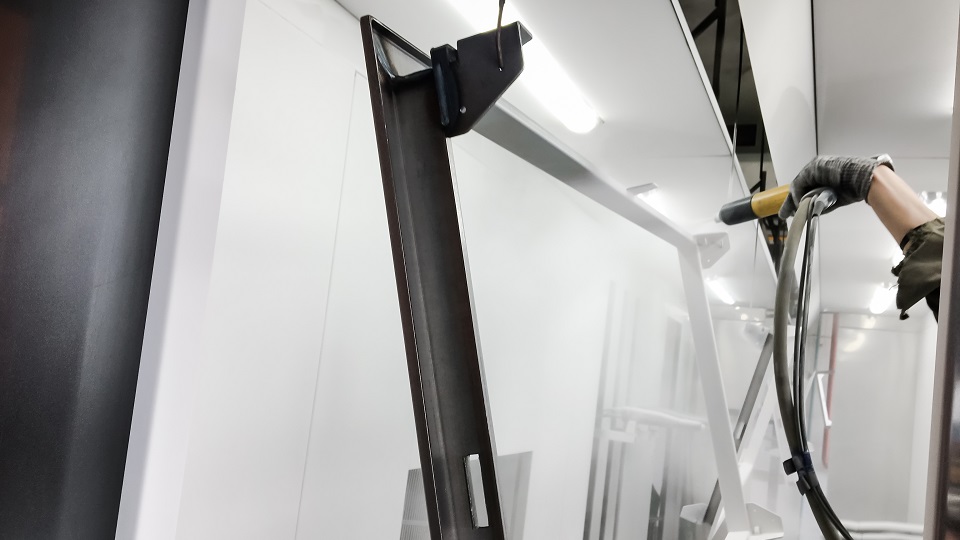
Powder coating is a dry finishing process, using finely ground particles of pigment and resin.
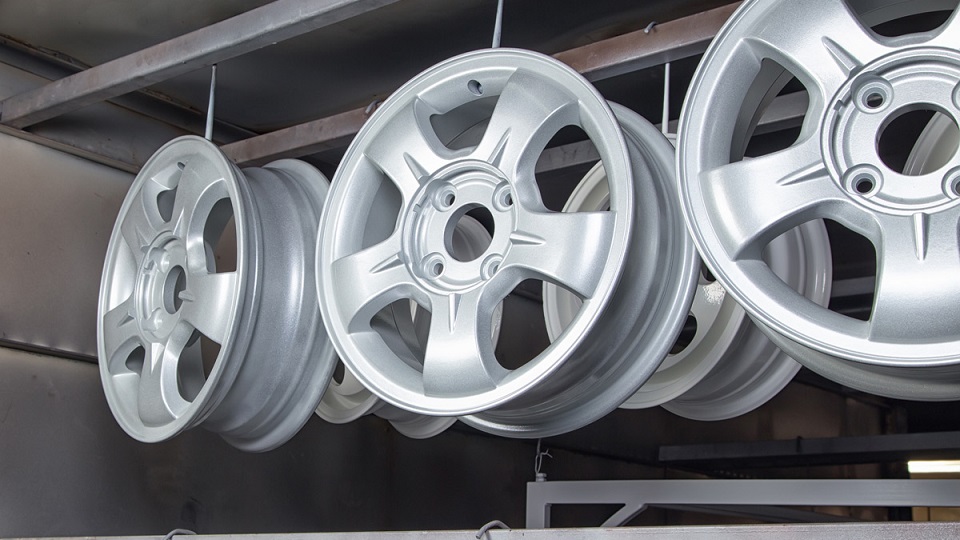
The automotive industry is increasing its use of powder coatings for economic, quality, and environmental reasons
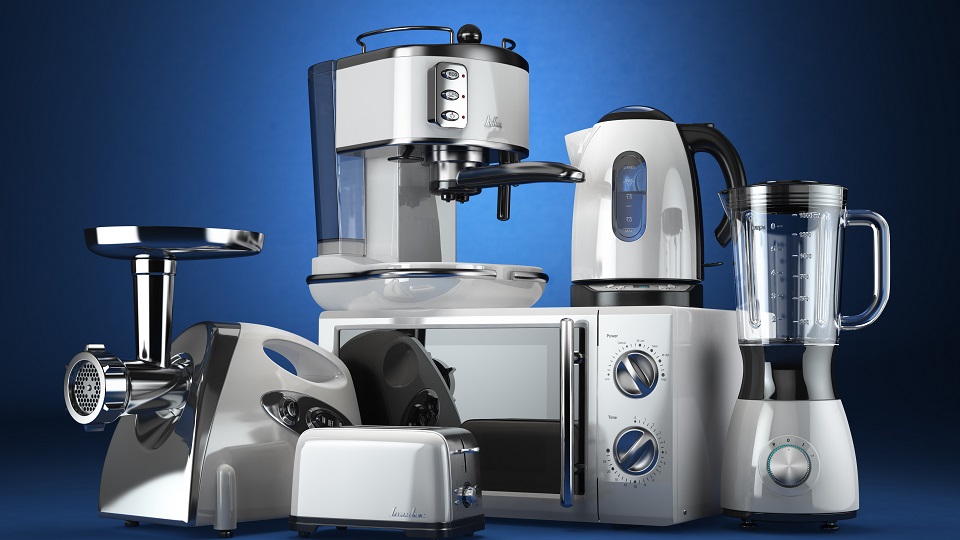
The appliance industry benefits from the use of thermosetting powder coating in applications