

Polyester polyols for water-resistant polyurethane coatings
Last update on Jul 25, 2025
This article was originally published in 2003 and revised in 2025.
Polyurethanes provide an obvious route to very high performing coatings and have long been used in solvent-borne systems. Polyurethanes can be made waterborne and have been used successfully as such or in acrylic-urethane hybrids. However, the hydrolytic sensitivity of the commonly used adipate polyester backbones has often resulted in poor storage stability and film durability.
Find out how to tackle this problem through a range of hydrolytically stable polyester polyols based on dimerized fatty acids.
| We would like to acknowledge Erwin Honcoop and Eric Appelman for providing technical information to develop this guide. |
Chemistry of dimer acids and reaction process
Natural oils and fats have for years provided polyurethane chemists with a variety of building blocks, such as glycerin and castor oil. Less known is the use of a fatty acid derivative, the so-called dimerized fatty acids, for polyurethane chemistry.
These dimerized acids are obtained by the conversion of unsaturated fatty acids (from sources like soybean oil or tall oil) by a combination of pressure, temperature, and catalysis. This process generates a mixture of products, the most important being dimerized fatty acid. Others are trimerized fatty acid and isostearic acid. Figure 1 gives an overview of the dimerization process.
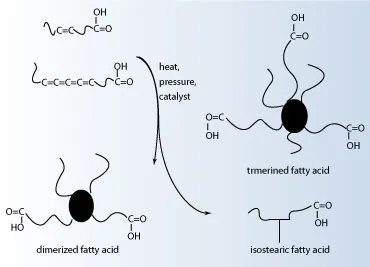
Figure 1: Reactions in oligomerization of fatty acids
Starting from the C18 acids that nature typically provides, the dimer acid is a species with 36 carbon atoms, making it the longest dioic acid available. This hydrocarbon makes dimer acid and polymers in which it is included extremely hydrophobic. The combination of the hydrocarbon character and the non-crystallinity provides flexibility, even at very low temperatures, and lubricity.
Dimerized fatty acids have found application in such areas as polyamide epoxy curatives, polyester coatings, and solvent- and waterborne systems. In these applications, the value of the dimerized fatty acid is related to the following features:
- flexibility and impact strength,
- wetting and flowability, and
- hydrophobicity and hydrolytic resistance
Dimer technology in polyurethanes
The dimer acids provide polyester and epoxy coatings with a range of favorable features, such as flexibility and hydrolytic resistance. Other coating systems could benefit from the introduction of dimer acids as well. Conversion of dimerized fatty acid to the corresponding diol, or by building dimerized fatty acid into hydroxy-terminated polyesters, makes it available for incorporation in polyurethane (see Figure 2).
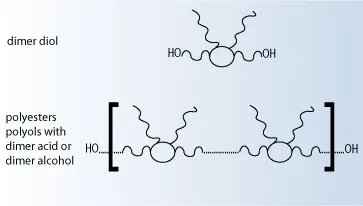
Figure 2: Dimer technology for polyurethanes
When comparing dimerate polyols to adipate polyesters, polycaprolactone polyols, and polyether polyols, it becomes clear that they form a category of their own.
- Compared to the adipates, dimerate polyols have much lower moisture absorption, lower hydrolysis rate and greater flexibility can be expected.
- Compared to polyethers like polyethylene glycol (PEG), polypropylene glycol (PPG), or polytetramethylene glycol (PTMEG), the absence of ether linkages will make dimer-based polyurethanes much more resistant to degradation by radical-type attack, such as heat, oxidation, or ultraviolet radiation.
The combination of stability against both hydrolysis and radical-type attack is unique, and highly relevant for applications including heavy-duty coatings and adhesives, and automotive elastomers. Additionally, it can be expected that dimer technology will bring low-temperature flexibility, flowability, and affinity for low-energy surfaces; no monomer comes closer to a polyolefin than dimer acid.
A range of dimer-based polyester polyols is commercially available and has recently been tested in polyurethane elastomers and dispersions, in order to substantiate the above-mentioned assumptions.
Basic properties of dimerized fatty acid-based polyester polyols
Initially, cured materials were tested by way of the preparation of polyurethane elastomers based on:
- 1-part polyol,
- 2-parts butane diol chain extender, and
- 3-parts pure MDI
Testing the dimerized fatty acid-based polyester polyols in polyurethane dispersion followed this study. Unless mentioned otherwise, the polyols had a molecular weight of 2000 g/mol.
Water uptake and hydrolysis
As a start, the expected hydrolytic stability of the dimer-containing PU elastomers was tested. Figure 3 demonstrates the performance of various polyol technologies after exposure of their polyurethanes to 90°C in water for a week. It is obvious that the polyurethanes based on hexane diol adipate and polycaprolactone have undergone substantial hydrolysis.
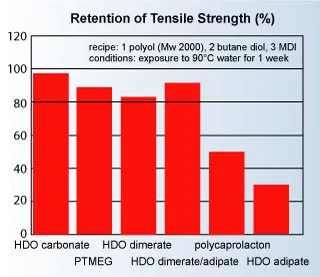
Figure 3: Hydrolysis of dimer-based and other polyurethanes
Hexane diol dimerate and a hexane diol ester of a mixture of dimer and adipic acids hold out very well. In fact, they are similar to PTMEG and polycarbonate diol. The explanation is in figure 4, the very low solubility of water in dimer-based systems very effectively reduces actual hydrolysis.
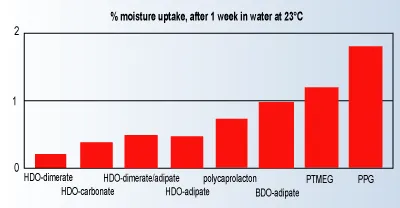
Figure 4: Moisture uptake of dimer-based and other polyurethanes
Mechanical properties
The mechanical properties of dimer-based urethanes on elastomers made by 1-part polyol, 2-parts chain extender (butane diol), and 3-parts MDI show that the dimer technology offers some unique benefits. Figure 5 shows the mechanical properties of various PU elastomers as modulus vs. elongation.
- This graph shows that the modulus at 100% is comparable for all polyester and polyether polyols. The dimerates perform just as well as any other polyol.
- At 300% elongation, the picture is slightly different. For PTMEG and adipate, the modulus at 300% is double that of 100%. This can be explained by crystallization of amorphous polyol chains when oriented by the applied strain. The dimerate soft segment, on the other hand, is unable to crystallize because of the branched dimer structure. As a result, the modulus at 300% is only slightly higher than the modulus at 100%, although the increase depends on the structure of the polyol.
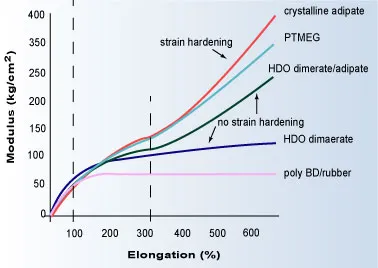
Figure 5: Elongation vs. tensile strength of dimer-based and other polyurethanes
In other words, the dimer-based polyurethane behaves more like a rubber. Any deformation is in principle reversible since no strain hardening takes place. The inability to crystallize when stretched (or the inability to strain harden) is also reflected in a relatively low strength when pushing the material to the limit of destruction. However, dimerate polyols produce a PU with similar elongation to any other technology, showing unimpaired untangling of soft segment.
Adhesion of dimer-based polyurethanes to various substrates
Dimerized fatty acids are expected to have a high affinity for low-energy surfaces, since the long alkane chains show a structure similar to polyethylene. Polyurethane adhesives were prepared from a variety of polyether and polyester diols, and pure MDI in an NCO:OH ratio of 2.5.
These materials were tested as adhesives for two polyethylene substrates and for steel after full cure. It should be realized that these tests were performed to quantify the difference in adhesion of the PU resins to polyethylene for the various polyester and polyether diols, and neither adhesion promoters nor blends of polyester and polyether diols were used to optimize adhesion.
Figure 6 shows the adhesion of dimer-based polyurethanes on untreated polyethylene in comparison with systems based on adipate ester and PTMEG, and Figure 7 shows the adhesion on steel.
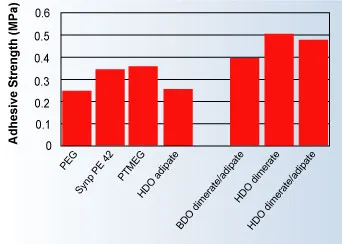
Figure 6: Adhesion of dimerate and other polyurethanes on low-energy substrates
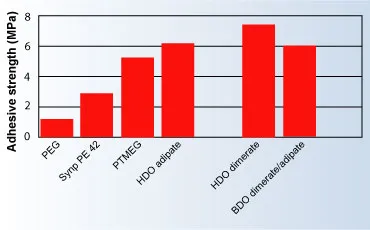
Figure 7: Adhesion of dimerate and other polyurethanes on steel
The graphs show that introduction of dimerized fatty acids into PU adhesives results in a substantial improvement of the adhesion to polyethylene. Surprisingly, the adhesion on polar substrates such as steel is similar to or better than the adhesion of polyurethanes based on other polyols. This could be due to phase separation processes that take place in the adhesive during cure. The segments with most affinity for the substrate will move toward it, thus increasing the bond strength regardless of the polarity of the substrate.
Switching to low solvent or solvent-free PU dispersions
Though the coating industry has benefited from solvent-containing polyurethanes coatings, a change to polyurethanes for low-solvent to solvent-free dispersions is necessary. These polyurethanes are used as single binders or in combination with acrylates or styrene acrylates in various coatings and adhesives applications, including anti-corrosion coatings, coatings for wood, plastic and textiles, printing inks, and adhesives.
Polyurethane dispersions have acquired an importance in these areas of application in spite of their comparatively high raw material price. Following are benefits of polyurethane dispersions.
- Good environmental compatibility, being aqueous (in some instances they contain small quantities of solvent such as N-methylpyrrolidone)
- Can be processed as one-component systems (in some cases chemical crosslinking may be possible or necessary)
- High mechanical resistance, abrasion resistance, flexibility, yellowing resistance (dependent on raw materials), adhesion, and impact resistance
- Absence of external emulsifiers: There are also properties that can be improved, such as hydrolytic stability, ethanol resistance, and UV resistance. Because a large percentage of polyurethanes consist of polyols, isocyanates, and chain extenders, it is to be expected that polyols have a major impact on the above-mentioned list.
Dimerized fatty acids are expected to have hydrolytic stability, mechanical strength, and adhesion. Because dimer fatty acids are hydrophobic, it is challenging to get them into water.
Preparation of polyurethane dispersion
The polyurethane dispersions were prepared making use of the so-called acetone process. The addition reaction between the dimer-based polyester polyols, dimethylolpropionic acid, and isocyanates that take place in the presence of water-dilutable solvents such as acetone or methyl isobutyl ketone.
The formation of the prepolymer takes place in the organic phase, and after the theoretical NCO content has been reached the carboxyl groups are neutralized with a tertiary amine. After further chain extension, the polymer is transferred into water. Once successfully dispersed into water, the low-boiling solvent is removed by gentle distillation, to give a solvent-free polyurethane dispersion with a solid content of approximately 40%.
Polyester Polyols | HD/NPG Adipate acid | HD/NPG Dimer acid/Adipic acid | HD Dimer acid/Adipic acid | BD Dimer acid/Adipic acid | BD Dimer acid/Adipic acid |
Hydrophilic group Isocyanate Extender | Dimethylol propionic Isophorone diisocyanate Butanediol | Butanediol/Trimethylol propane | |||
Chain Extruder Neutralizing | Isophorone diamine Ammonia (25 % solution) | ||||
HD: 1,6-hexanediol BD: 1,4-butanediol | |||||
Table 1: Raw materials for preparation of polyurethane dispersants
For our preparation of the polyurethane dispersions, an experimental dimerized fatty acid-based polyester polyol was used. Table 1 shows the raw materials used to prepare the polyurethane dispersions.
The resulting polyurethane dispersions, having a solids content of 40% and a particle size in the range of 100-200 nm, were freeze-thaw stable for more than one month using a cycle of 11 hours at 5°C followed by 11 hours at 40°C.
Mechanical properties of PUDs
The mechanical properties that were evaluated were: elongation, hardness and adhesion.
Elongation
The elongation of the produced polyurethane dispersions was evaluated. The test samples were put on 500 m wet on glass and were thickened by a rheology modifier (TAFIGEL® PUR 40 from Munzing). Figure 8 shows that the elongation of dimer fatty acid-based polyester polyols with Mw 2000 is in the range of the commercial-based HD adipate-based polyurethane dispersion. The polyester polyols with Mw 1700 yield lower elongation due to less strain hardening.
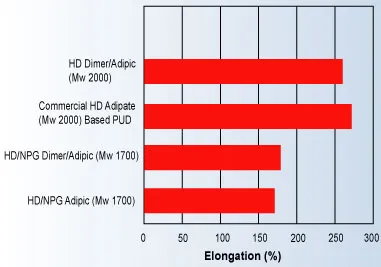
Figure 8: Elongation of free film polyurethane dispersions
Coating hardness of the polyurethane dispersions
The structure of the dimer fatty acid offers flexibility, which normally means a reduction of coating hardness if the coating is not reformulated. For polyurethane coatings based on the dimer fatty acid-based polyols, hardness was measured with Konig and pencil hardness. The Konig results are shown in Figure 9, where the dimer fatty acid-based polyester polyols (Mw 2000) are comparable to the commercial PUD.
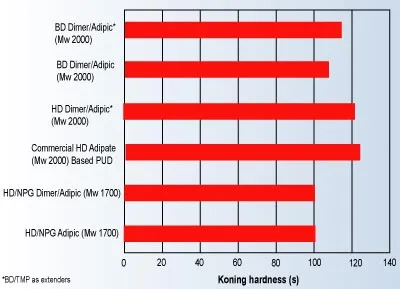
Figure 9: Konig hardness of polyurethane dispersions
The pencil hardness results in Figure 10 show that the dimer fatty acid-based polyester polyols based on HD/NPG with Mw 1700 show an improvement on coating surface hardness when stress is inflicted by scratching. The same phenomenon is noticeable when the HD dimer/adipic-based polyurethane dispersion is compared to the commercial HD adipate-based dispersion.
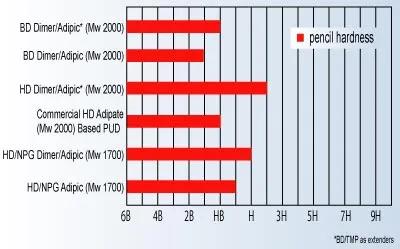
Figure 10: Pencil hardness of polyurethane dispersions
Adhesion to various substrates
Evaluating the cross-cut adhesion of the polyurethane dispersions on a range of different substrates shows that the polyols based on HD/NPG with a Mw of 1700 fail in the adhesion to acrylate foil. The dimer fatty acid-based polyester polyols with Mw 2000 have improved on PVC and ALU-foil over the commercial-based polyurethane dispersion (see Table 2).
PVC | ALU-foil | Steel | Acrylate Sheet | ABS | |
BD Dimer/Adipic (Mw 2000)* | 0 | 0 | 0 | 0 | 0 |
BD Dimer/Adipic (Mw 2000) | 0 | 0 | 0 | 0 | 0 |
HD Dimer/Adpic (Mw 2000) | 0 | 0 | 0 | 0 | 1-2 |
HD Adipic (Mw 2000) | 1-2 | 4 | 0 | 0 | 1-2 |
HD/NPG Dimer/Adipic (Mw 1700) | 0 | 0 | 0 | 5 | 0 |
HD/NPG Adipic (Mw 1700) | 0 | 0 | 0 | 5 | 0 |
| Adhesive: | 0-good | 5-fail | |||
| *BD/TMP as extenders | |||||
Table 2: Adhesion of Polyurethane Dispersions
Dimer fatty acid-based polyester polyols offer good mechanical properties and good adhesion to PVC, aluminum, and steel.
Chemical resistance and water uptake
Table 3 shows that the chemical resistance of the dimer fatty acid-based polyester polyols in the coating application is overall good.
Water | Ethanol (50%) | Ammonia | Acetone | |
BD Dimer/Adipic (Mw 2000)* | 0 | 0-1 | 0 | 5 |
BD Dimer/Adipic (Mw 2000) | 0 | 1-2 | 0 | 5 |
HD Dimer/Adipic (Mw 2000) | 0 | 1 | 0 | 5 |
HD Adipic (Mw 2000) | 5 | 5 | 1 | 5 |
HD/NPG Dimer/Adipic (Mw 1700) | 0 | 1 | 0 | 5 |
HD/NPG Adipic (Mw 1700) | 3 | 2-3 | 1 | 5 |
| Surface damage | 0-no damage | 5-fail | ||
| *BD/TMP as extenders | ||||
Table 3: Chemical resistance of dimer fatty acid-based polyurethane dispersion
The most striking is the water resistance when the HD/NPG adipate is compared with the HD/NPG dimer/adipic-based polyester polyol. The dimer fatty acid-based polyol shows no damage to the surface, while the adipate has severe damage to the surface.
With these results in mind, the water uptake of polyurethane films was tested. Figure 11 shows that the hydrophobic character of the dimer fatty acid has a positive impact on the water uptake. The adipate based polyurethane films take up to 9% of water vs. only 2-3% for dimer fatty acid-based polyols. The dimer fatty acid-based polyols stay below 10% water uptake when the same test preformed at a higher temperature.
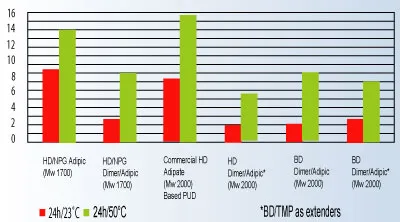
Figure 11: Water Uptake of Dimer Fatty Acid-Based Polyurethanes
Heat, oxygen, and ultraviolet radiation attack
In comparison with the used polyether-type polyols, dimer fatty acid-based polyesters offer lower sensitivity to heat, oxygen and UV radiation, all of which attack ether bonds. The performance of dimer fatty acid-based polyurethanes was compared with an adipate polyester type and PTMEG diol in a Weather-O-meter experiment (see Figure 12).
The polyether formulation breaks down quickly because of UV attack. The adipate polyurethane also fails quickly, which we attribute to the affect of periodic rain fall in the Weather-O-meter, causing hydrolysis of the ester bonds. The dimer fatty acid-based polyurethane resists hydrolytic attack as well as degradation by radiation and oxygen.
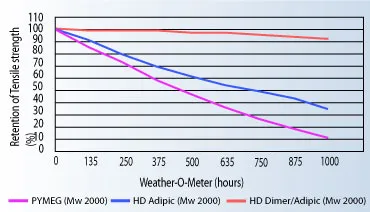
Figure 12: Weatherability of dimer fatty acid-based and other polyurethanes
Conclusion
It has been demonstrated that polyester polyols based on dimerized fatty acids offer unique properties. Especially useful is the combination of hydrolytic stability and resistance against attack by heat, oxygen and UV radiation. The dimer technology produces materials with good mechanical properties and good adhesion on PVC, aluminum and steel. Furthermore, an overall good chemical resistance with a fair to good resistance against ethanol compared against a commercial HD adipate-based polyurethane dispersion is produced.
With respect to water uptake and resistance to hydrolysis, the dimer fatty acid-based polyols exceeded the adipate-based polyols. Adding to that the inability to strain-harden makes the dimer-based polyester polyols extremely suitable for flexible substrates.
- 30th International Waterborne, High-Solids, and Powder Coatings Symposium, February 26-28, 2003, in New Orleans.