

Why replace classical sols with Axcentive's photoinduced sol-gel technology
Last update on Jun 1, 2026
This is a sponsored article by Axcentive.
Since the first silica “gel” was observed in 1845 by M. Ebelmen, the sol-gel method has enabled glassy or ceramic materials for all kind of applications. Over time, however, classical sol-gel techniques revealed practical bottlenecks: multi-step curing over days, copious solvent handling and evaporation, high-temperature post-treatments (up to ~800 °C) for densification, and cracking or substrate damage for thick or heat-sensitive applications.1,2
In the late 20th century, researchers found a better way. They used ultraviolet (UV) light to trigger the same network-forming reactions. This is called photoinduced sol-gel or UV-SG. This paradigm shift, from thermal curing to UV-curing - directly tackled those bottlenecks. Photochemical sol-gel processes can achieve one-step, rapid curing at room temperature without added solvent.
This article explains the switch from Ebelmen's early silica gels to today's UV-activated methods. It focuses on cationic photoacid curing, key industrial problems, and their solutions supported by historical and technical data. Key application areas such as coatings, optics, microelectronics - are also highlighted to emphasize scalability and impact.3,4
Classical sol-gel processing and its limitations
In the traditional sol-gel process, metal alkoxide precursors (e.g., Si(OR)4) react with water. This triggers two key reactions:
- Hydrolysis: –OR + H2O → –OH + ROH
- Condensation: –OH + –OR/–OH → –O– + H2O/ROH
These reactions build a three-dimensional M–O–M network at or near room temperature. The name "sol-gel" describes the transition from a fluid colloidal sol to a semi-rigid gel.
Silica was the first and most studied system. By the mid-20th century, the method expanded to other metals like titanium (Ti), zirconium (Zr), aluminum (Al), and more. Non-silicate alkoxides react much faster than silica. So, they need careful control during processing.1,2
The four stages of classic sol-gel synthesis:
- Hydrolysis and partial condensation: The precursors begin to react with water.
- Gelation: Condensation continues, linking hydrolyzed precursors into a continuous 3D gel network.
- Aging: The wet gel keeps condensing and reorganizing. It often shrinks (syneresis) and expels solvent.
- Thermal curing (optional): Heat removes residual –OH groups and densifies the network. For silica, this means calcination at ~500-800 °C to reach glass-like properties.
Key limitations
Classical sol-gel works well in the lab. But it struggles in industrial and high-throughput settings.
- Speed: Gelation and aging can take hours or days. Thick coatings and crack-free monoliths need slow, controlled drying. This extends cycle times and raises costs.
- Solvents: Traditional sol-gel uses high dilution ratios. This produces large volumes of volatile organic compounds (VOCs). Up to 50-70% of solvents evaporate during drying. This waste increases environmental risk and raises the chance of film cracking.
- Heat: Fully dense, stable ceramics still need high temperatures. Despite many advancements most sol-gel coatings still require curing at 200-600 °C or more. This rules out coating of heat-sensitive substrates like plastics and drives up energy use.

Emergence of organic-inorganic hybrids
Pure inorganic gels have real drawbacks that later innovations would solve. By the 1980s, researchers began exploring hybrid organic-inorganic sol-gel systems. They introduced organically modified silanes, a class of precursors known as ORMOSILs (organically modified silicates). The idea was to bond organic polymers into the gel network. This reduced brittleness and shrinkage.
ORMOSILs contain stable Si–C bonds. This means an organic group attaches directly to the silicon network. Common examples include:
- GPTMS (glycidyloxypropyltrimethoxysilane)
- MAPTMS (methacryloxypropyltrimethoxysilane)
Both carry polymerizable epoxy or acrylate moieties in addition to hydrolyzable also contain hydrolyzable –Si(OR)3 groups.1,3
Why hybrids work
By including non-hydrolyzable organic groups in the framework, one can create a co-network of inorganic and organic components which in essence are nanocomposites at the molecular scale. This offers several benefits:
Reduced shrinkage and cracking occur because organic segments such as –CH₂–CH₂– units, aromatic bridges, or polymer chains act as internal scaffolds or spring like linkers that relieve stress during drying. Hybrid systems therefore tolerate greater film thickness than fully inorganic gels, enabling crack free sol–gel coatings above 3 µm that would otherwise crack during curing.
Improved mechanical properties arise from combining ceramic hardness with polymer toughness. Covalently linking organic chains into the silica network produces dense films with higher scratch resistance and improved flexibility.
Functionalization is enabled by introducing a wide range of organic groups such as alkyl, vinyl, glycidyl, or silicone moieties via organosilanes. This allows tuning of surface properties like hydrophobicity, refractive index, and adhesion, and can also enable subsequent polymerization when reactive groups such as epoxy, isocyanates or acrylate are present.
Lower processing temperatures are achievable because useful properties can be obtained without high temperature calcination. Although the inorganic network may remain partially condensed with residual –OH or organic groups, the organic phase provides sufficient film integrity, allowing curing from 90 till 150 °C or in case of two component systems at room temperature. UV or EB cure come also in to play using precursors with acrylic moieties.
Notably, up through the early 2000s most hybrid sol-gel coatings still relied on a two-step cure: first a conventional sol-gel hydrolysis/condensation (often catalyzed by ambient moisture and/or a thermal acid catalyst) to form an oligomeric “organopolysiloxane,” and subsequently a thermal or UV polymerization of the pendent organic groups to crosslink the organic phase. This sequential approach improved control (each network formed in turn) but added complexity.
Transition to photoinduced sol-gel technology
In the mid-1990s, photopolymerization technology merged with sol-gel chemistry. This opened a new chapter. Light could now trigger network formation instantly - no long hydrolysis steps, no thermal curing periods.
Modes driving sol-gel reactions
There are two main ways light drives sol-gel reactions.3
Photo-polymerization of hybrid precursors
Some sol-gel precursors already contain a polymerizable organic group. MAPTMS is a key example. UV exposure triggers radical polymerization of that organic group. This reinforces and interconnects the overall network.
In simpler systems, the organic polymerization strengthens a gel matrix that already formed. The two steps happen in sequence. In more advanced systems, two photoinitiators work at once. One drives organic polymer formation. The other drives inorganic network development. Both happen in a single UV step.
Photoinduced polycondensation via photolatent acid catalysis
This mode uses a photoacid generator (PAG). UV light activates the PAG. It then releases a strong Brønsted acid - for example, hexafluorophosphoric acid from an iodonium salt.
This acid drives sol-gel chemistry. It protonates alkoxides and water. This accelerates hydrolysis and condensation, converting Si–OR bonds into Si–O–Si bonds. The result mirrors classical acid-catalyzed sol-gel chemistry. But it happens in a single UV flash.
No added water or solvent is needed. Ambient humidity provides enough moisture. Small volatile by-products escape quickly. A dry gel film forms within seconds.
In hybrid systems based on epoxy-functional precursors like GPTMS, the same PAG performs twice:
- It drives cationic ring-opening polymerization of the epoxy group (organic network)
- It catalyzes Si–O–Si condensation (inorganic network)
Both networks develop at the same time. One PAG controls both. This is a truly concurrent process.
This dual role sets GPTMS-type systems apart from MAPTMS-type systems. In MAPTMS systems, the organic and inorganic reactions use separate, chemically independent initiators. In GPTMS systems, a single PAG handles both.5,6
Both modes of action can simultaneously occur with UV-sol-gel hybrid systems and lead to hard UV systems with hardnesses up 4H or 5H.7

Types of photoinitiators
Cationic onium salt photoinitiators
Cationic onium salts were central to early photo-sol–gel work. Chemist J. Crivello first described them in the late 1970s. Under UV light, these compounds release a strong Brønsted superacid (H+X-).
Two common types are:
- Diaryliodonium salts - for example, diphenyliodonium hexafluorophosphate, which releases H+PF6-
- Triarylsulfonium salts - another widely used cationic photoinitiator family
These strong acids do two things at once. They initiate ring-opening polymerization of epoxides or vinyl ethers. They also catalyze hydrolysis and condensation of alkoxysilanes, building the Si–O–Si network.
Multiple studies in the 1990s confirmed that onium PAGs drive siloxane network formation under UV. A key milestone came in 1995. Crivello et al. demonstrated photoacid curing of a trialkoxysilane with no added solvent.5,6
Radical photoinitiators
Radical photoinitiators work differently. Common examples include α-cleavage types such as:
- Irgacure® 651
- Darocur® 1173 (2-hydroxy-2-methyl-1-phenyl-propan-1-one)
These target the organic phase. They polymerize acrylate and methacrylate groups in hybrid systems.
Radical initiators do not build the Si–O–Si network directly. Radicals also perform poorly in oxygen-rich inorganic environments.
Dual-cure: Combining both systems
Combining a radical photoinitiator with a cationic PAG solves this limitation. Each initiator handles one network:
- The radical initiator crosslinks the acrylic organic matrix
- The cationic PAG builds the inorganic silica network
Both reactions happen in a single UV exposure. This strategy was applied to MAPTMS-based hybrids. One example used Darocur® 1173 (radical) paired with an iodonium salt (cationic PAG). Together, they cured both the methacrylate and siloxane phases simultaneously.3
One-step UV sol-gel: Use cases
UV‐sol-gel (UV‐SG) technology has enabled fast-curing high-performance coatings in diverse applications.

Hardcoats for polymers and glass
One of the most important uses is protective hardcoats on polymers such as polycarbonate (PC) and PMMA, as well as on glass.
These hybrid silica-organic films deliver:
- High hardness: Typically 4-6H pencil hardness on plastics
- High transparency: Over 96% visible light transmission, with initial haze below 1%
- Strong scratch resistance: After standard Taber abrasion tests (500-1000 cycles, CS-10 wheel, 500 g load), haze increase is only 1-5%. Uncoated polycarbonate shows ~30% haze increase under the same conditions.
- Strong adhesion: Cross-hatch tape tests show ~100% paint retention on both glass and polymers7
All of this is achieved at ambient temperature - no high-heat curing required. Combining UV monomers with sol-gel nanoparticles in newer formulations has pushed performance even further.
UV sol-gel hardcoats work best on flat or low-curvature surfaces. Uniform UV irradiance is easy to achieve across flat substrates and shows no shadowing issues. Key application areas include:
- Architectural glazing: skylights, noise barriers, and façade panels
- Mass transit windows: trains and buses
- Agricultural greenhouse panels
- Flat electronics covers and display overlays
These coatings are applied at the sheet level, before thermoforming or fabrication. This suits high-throughput roll and flow coating production lines.
Antifog coatings
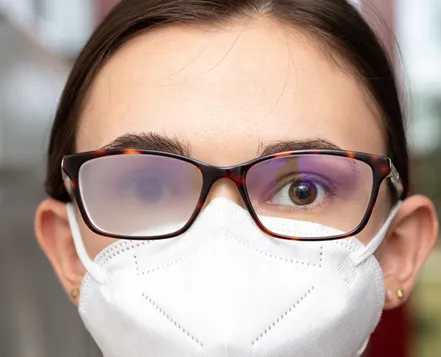
UV-curable sol-gel antifog coatings serve industries where fogging affects visibility or safety. They work by creating ultra-hydrophilic surfaces. Water contact angles reach 0-10°. Condensation spreads invisibly across the surface instead of forming droplets.
Key performance results include:
- Clarity maintained for over 180 seconds in simulated fog conditions (EN166 standard)
- Near 100% transparency and negligible haze retained after environmental exposure and repeated cleaning
- Durability sustained through many condensation and drying cycles
This performance comes from combining inorganic nano-oxides with crosslinked polymer domains.
Antifog UV-SG coatings appear across several sectors:
- Eyewear: The largest segment, combining antifog and scratch resistance in one coating
- Personal protective equipment (PPE): Face shields, visors, and respirator lenses for industrial and medical use
- Cold-chain and food packaging: Transparent PC and PET panels in refrigerated displays
- Automotive interiors: Rear-view mirrors, instrument cluster covers, and heads-up display combiners where cabin humidity causes recurring condensation
- Sports and leisure optics: Ski goggles, diving masks, and helmet visors, where UV-cured coatings handle complex curved shapes at moderate production volumes

How UV sol-gel solves the drawbacks of classical systems
The shift from thermal to photoinduced sol-gel brought real, measurable improvements. Each major limitation of classical sol-gel now has a direct solution.
Speed: from days to seconds
Classical sol-gel required batch processing. A typical workflow included 24 hours of room-temperature hydrolysis, 1 hour of solvent evaporation, and a 150 °C bake.
UV-SG replaces all of that. A 15 µm hybrid film cures fully with just a few passes under a UV lamp in less than 1 second of exposure per pass. The entire process runs in-line, within seconds or minutes.
Faster curing brings more than speed. It also reduces work-in-progress inventory and cuts the floor space needed for curing ovens.5
Energy: lower temperatures, lower costs
Classical sol-gel needed high-temperature furnaces. UV curing does not. A UV lamp or LED array uses far less energy than an industrial oven.
Room-temperature processing also removes thermal expansion mismatch. Coatings are ready to use immediately after curing. This expands the range of compatible substrates. Polymer films, circuit boards, and biomedical implants can all be coated. The entire process stays below ~50 °C, even accounting for heat from the lamp.6,3
Solvents: near zero waste
Classical sol-gel used high volumes of solvent. Dip-coating lines evaporated liters of solvent per batch. This produced large amounts of volatile organic compound (VOC) emissions and extended processing times.
UV-SG formulations can be made as 100% solids. They use neat organosilane monomers plus a photoinitiator - no bulk solvent is required. Ambient moisture drives the reaction. There is nothing to evaporate and no drain or bake step needed.
The result is a hard, cured film with near-zero solvent waste. This is a major environmental and practical advantage.3,4
Manufacturing flexibility: continuous processing
UV curing fits directly into continuous manufacturing lines. It is compatible with:
- Roll-to-roll coating: High-speed, large-area processing
- Inkjet deposition: Precise, on-demand application
- Spray deposition: Followed by in-line UV curing
This brings sol-gel into production environments once dominated by UV-curable organic coatings such as graphic arts and rapid prototyping. The difference is that UV-SG coatings also deliver ceramic-level hardness and durability. Inorganic performance now comes with the speed and flexibility of a polymer coating line.
Conclusion
The evolution of sol-gel technology from Ebelmen’s 19th-century silica gels to today’s photo-curable hybrid UV sol-gel showcases how combining chemistry with photophysics can overcome practical barriers. The shift from thermal to photoinduced processing addressed the key industrial pain points:
- It virtually eliminated long curing cycles
- Cut out solvent waste, lowered energy input, and
- Broadened the material set to include sensitive substrates
In doing so, it transformed sol-gel from a specialty lab technique into a versatile manufacturing process for high-performance coatings and optical components.
The continued convergence of photonics and chemistry in this field promises even more imaginative applications in the years ahead, truly fulfilling the early sol-gel pioneers’ goal of “glass at room temperature,” now achieved at the speed of light.

DISCLAIMER: All images used in this article are copyright of Axcentive.
- Boudiba, H., et al. (n.d.). Sol-gel process: An outstanding technology for coatings. Materia Nova.
- Guo, J., Kim, G. B., Shan, D., Kim, J., Hu, J., Wang, W., & Liang, H. (2016). Click chemistry improved wet adhesion strength of mussel-inspired citrate-based antimicrobial bioadhesives. Materials Horizons, 3(5), 458–466. Royal Society of Chemistry.
- RadTech International North America. (2010). Proceedings paper 1434. RadTech.
- Liu, Y., Meng, H., Konst, S., Sarmiento, R., Rajachar, R., & Lee, B. P. (2015). Injectable dopamine-modified poly(ethylene glycol) nanocomposite hydrogel with enhanced adhesive property and bioactivity. New Journal of Chemistry, 39(7), 5917–5927. Royal Society of Chemistry.
- Wang, D., Haick, H., & Marks, R. S. (2009). Biomimetic adhesive materials containing dopamine-based polymers. New Journal of Chemistry, 33(9), 1795–1802. Royal Society of Chemistry.
- Sangermano M, Roppolo I, Chiappone A. (2018). New Horizons in Cationic Photopolymerization. Polymers (Basel);10(2):136.
- Axcentive. (n.d.). Internal data.