

Ingevity's Capa® technology: The future of high-performance, low-VOC coatings
Last update on Feb 24, 2025
An Interview with Chuck Jones, Market Segment Manager, Coatings at Ingevity & President, Eastern Coatings Federation
In an era where coating performance and sustainability are intertwined, Ingevity stands at the forefront of innovation with its Capa® technology.
Capa® polyols add value to the end properties of one-component (1K) stoving enamels and two-component (2K) waterborne and solvent-borne polyurethane coatings. This makes them longer-lasting and more sustainable.
The Capa® polyols offer several performance benefits, including:
- improved weather, abrasion, and chemical resistance
- enhanced flexibility and toughness
- excellent finish and appearance
From automotive refinishing to marine and protective coatings, Ingevity's Capa® range can help reduce volatile organic compounds (VOCs). They help achieve coating formulations that offer unmatched durability.
We interviewed Chuck Jones, Market Segment Manager, Coatings at Ingevity & President, Eastern Coatings Federation. He gives us insights on the current and future market trends and the challenges customers face in the coatings industry. Also, you will learn how Ingevity’s Capa® technology is driving the next generation of high-performance, eco-friendly coatings.
#1. What is Ingevity's positioning in the world of coatings?
Ingevity is the world leader in caprolactone technology and innovation, with a 50-year history of enhancing performance in a wide variety of coatings applications. We develop, manufacture, and bring to market products that purify, protect, and enhance the world around us. Ingevity has a global presence and conducts business in about 75 countries.
The Capa® portfolio is a family of innovation-driven products that enable high-performing coatings. When Capa® caprolactone polyol technology is introduced to a system, coatings can be more flexible, more durable, and more resistant to the elements. The benefits from Capa® can be realized both as a raw material in a coating formulation and as a building block for a polyurethane dispersion or radical-cure oligomer.
#2. How is Ingevity unique and why is this relevant?
With the world’s largest caprolactone plant, Ingevity provides unique manufacturing capabilities that include technical services. Our Innovation Center in Warrington, U.K., has a dedicated coatings lab with state-of-the-art equipment and testing facilities, along with a dedicated, growing technical staff for coatings applications.
Ingevity has the expertise to help customers create premium coating formulations for the most demanding indoor and outdoor applications. From automotive OEM and refinish to marine and protective, coatings formulated with Capa® are longer-lasting and built to perform.
Capa® polyols are compatible with other polyol technologies, including acrylic and polyether. When used in combination with other polymers, even in relatively small amounts, the performance of a coating can be dramatically improved without sacrificing appearance.

#3. What are the most critical challenges customers are facing nowadays, and how your innovative solutions are helping them?
The coatings industry historically has prioritized performance and cost. A transition is underway where sustainability is now a prioritized value proposition. The introduction of bio-based or environmentally friendly materials often negatively impacts performance.
This year we are launching two Capa® polyols that will benefit both the performance of coatings and their impact on the environment. These new products, Capa® PROTX 3112 and Capa® PROTX 3224 are both three-functional polyols that are 100% solids.
By introducing these aliphatic polyols into a formulation, the same performance benefits as conventional caprolactone chemistry can be achieved, along with the ability to lower volatile organic compound (VOC) levels by using them as reactive diluents. Furthermore, the new grades are partially bio-based and label-free.

#4. What are the current and future market trends/shifts and how Ingevity is leading them?
Lower or zero VOC levels are both a current and future coatings market trend, and Capa® technology can lead the way toward level reduction. Outside of sustainability, performance remains the most important driver of market trends for coatings. Specifically, resistance to chemicals is becoming more important due to the increased use of cleaning agents in a post-COVID world (like using disinfectant wipes on vehicle dashboards, which was not common five years ago!).
Ingevity is leading the way with Capa® PROTX 1001 and Capa® PROTX 2002 grades, which were designed to help polyurethane dispersions achieve resistance to stains and chemicals, like ethanol. Ingevity is also leading the drive for coatings that have a longer service life by providing polymers that are resistant to ultraviolet radiation and are more resistant to hydrolysis than their polyester adipate counterparts.
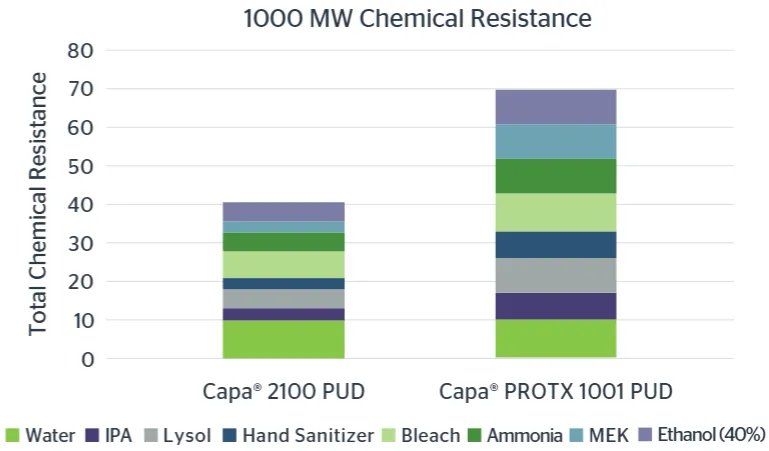
Capa® PROTX Grades Help Polyurethane Dispersions Achieve Resistance to Chemicals
#5. How does Capa® technology help the reduction of VOC levels?
Reduction of VOC levels, along with hazardous components, is a trend across the chemical industry and is especially important for coatings. Our liquid-grade Capa® polyols typically have lower viscosities when compared to acrylic and polyester adipate polyols. The low viscosity allows a formulator to reduce the amount of solvent to adjust the application viscosity. They also provide the additional benefits of resistance to common enemies of a coating, which include:
- chemicals,
- light,
- scratches, and
- impacts
Ingevity supplies Capa® polyols with hydroxyl functionalities that range from 2 to 4, providing a useful toolbox for enhancing formulations.
 Ingevity — View supplier offerings here

DISCLAIMER: All images and graphs used in this article are copyright of Ingevity.