

Increasing adhesion of UV coatings on wood
Last update on Aug 26, 2025
This article was originally published in 2003 and revised in 2025.
Coatings on wooden substrates for furniture, flooring and interior are a main application for radiation curing lacquers. Increased adhesion is an important target for development of UV coatings on wood. Superior adhesion leads to better whitening behavior (via coin test) and abrasion resistance.
Guidelines to improve adhesion on wood include:
- Swelling of wooden fibers with waterborne UV primers to increase the substrate's surface area and its interaction with the coating.
- Better wetting of oily surfaces e.g., teak, mahogany, or rosewood by using coatings with low surface tension.
- Chemical crosslinking of coating and substrate.
Let us help you decode three ways to increase the adhesion of UV coatings on wood surfaces.
| We would like to acknowledge Dr. Jan Weikard and Dr. Wolfgang Fischer for providing assistance with this article. |
Adhesion challenges of UV-curable coatings on wood substrates
From a theoretical point of view, adhesion is the result of the action of surface forces and the wetting and of the coating's curing process at the substrate coating interface.1
- The porous nature of wood is a main difference in comparison to other substrates such as metal and plastics.
- The liquid coating material is partly absorbed into the wood by capillary forces. This presents an additional challenge for UV curing coatings as the absorbed material will only be cured if there is sufficient UV energy.
- Uncured material especially low-molecular-weight reactive diluents can cause loss of adhesion and sweating of the cured coating.
- The surface of wood is seldom homogeneous. Varying surface tension (e.g., caused by oily components from the wood) and phenolic components with inhibiting effects on UV cure have a negative influence on the adhesion of coatings.
- Additional problems may arise from the very fast UV curing reaction during which a high amount of internal stress is built up in the coating.
Solution 1: Increase substrate's surface area with waterborne UV primers
The right choice of waterborne UV curing primers solves many of the above-mentioned adhesion problems. Water, together with the dispersed or dissolved polymers, is rapidly absorbed by the wood pores and capillaries.
Fibers are swollen and lifted up, which increases the substrates surface area. Waterborne UV curing coatings are available as water-reducible/water-containing resins, emulsions or dispersions2 of different chemical nature. The best overall properties are achieved with polyurethane systems.
Polyurethane production: Traditional and modern developments
Polyurethane dispersions are generally produced by the polyaddition of diisocyanates with bivalent compounds that react with isocyanates. Emulsifying groups such as polyether or ammonium carboxylate (internal emulsifiers) are also incorporated into the polyurethane structure. The key factor in UV curing PUR dispersions is how the acrylic double bonds enter the polymer.
Previously, the only dispersions known were those in which hydroxy-functional acrylate monomers such as 2-hydroxyethyl acrylate were used as the UV curing component. As these acrylate monomers are monofunctional components, which stop the formation of the polyurethane polymer, it is very difficult to produce high molecular weights with an adequate density of double bonds.
Recent developments no longer use monomeric acrylates as the double bond components but rather oligomeric or polymeric compounds such as polyester acrylates and epoxy acrylates, which have their own hydroxy functionality.
Customization and design flexibility
The combination of different components allows the specific design of UV curing polyurethane dispersions. The properties of the polymers can be customized by:
- Varying the saturated and unsaturated polymer building blocks
- Choosing different diisocyanates
- Using monomeric diols/diamines or mono/polyfunctional building blocks
- Varying the process technology
Examples of such properties are physical drying, UV reactivity, hardness and elasticity, glass transition temperature (Tg), and other solids-related properties of the paint film.
Also, urethane acrylates that can be formulated with about 10% water for roller coating application are well-suited for application on wood (see Figure 1). Here, the amount of water that has to be forced out of the coating during drying is minimized.
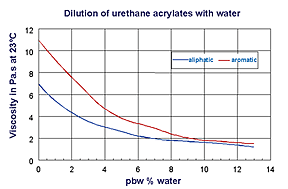
Figure 1: Water-reducible urethane acrylates
Table 1 summarizes the advantages of PUR dispersions, PUR emulsions, and water-reducible urethane acrylates.
| Advantages | ||
| UV curing PU dispersions | UV curing PU emulsions | Water-reducible urethane acrylates |
|
|
|
Table 1: Advantages of different waterborne UV curing polyurethane systems
Solution 2: Better wetting of oily surfaces using low surface tension coatings
If the use of waterborne material is not possible for a given coating process, resins with a reduced shrinkage during polymerization and improved wetting are needed.
Table 2 compares a standard polyester acrylate with an unsaturated polyester in DPGDA. With the latter, good adhesion is achieved, especially on oily wood types like mahogany, teak, or rosewood. The lower double-bond density, however, means a reduced UV reactivity.
| Property | Unsaturated polyester in DPGDA | vs. Polyester acrylate |
| Reactivity | Moderate | Good |
| Sandability | Good | Good |
| Adhesion | Good | Moderate |
| Wetting | Good | Moderate |
Table 2: Unsaturated polyesters in acrylate diluents are a cost-effective as primers on wood
Wood contains many phenolic compounds, which have similar chemical structures compared to the substances that are commonly used to stabilize acrylate resins. In a model experiment, commercial grade hexanediol diacrylate (HDDA) was used to extract shredded teak wood (3 pbw. HDDA on 1 pbw. teak). Analysis of the extract by means of GC-MS revealed substantial amounts of the expected phenolic type species.
Varying amounts of teak HDDA extract were further used to formulate coatings based on the above-mentioned unsaturated polyester in DPGDA. The formulations were tested for UV reactivity in relation to the amount of teak HDDA extract added. Reduced reactivity in comparison to a formulation with standard HDDA was found only with high amounts of teak HDDA extract.
This simple experiment shows that there is an inhibiting effect of the wood extractables. But under conditions closer to an actual coating process, it can be estimated that this inhibiting effect is low.
Solution 3: Chemical crosslinking of coating and substrate
Chemical crosslinking between coating and wooden substrate can be achieved with "dual-cure" formulations. Dual-cure formulations are taken here to mean those that crosslink not only by radical photopolymerization but also by an additional mechanism, namely the reaction of isocyanates with highly polar groups. The polar groups may be a constituent of one of the components in the formulation or may form through the effect of atmospheric moisture on the isocyanates. Alternatively, they may be bound in the substrate (see Figure 2).
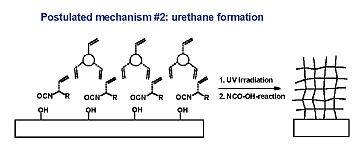
Figure 2: Dual-cure adhesion promotion
The use of urethane acrylates bearing free-isocyanate groups results in significantly improved adhesion of the coating on wood. We conducted a model experiment to find out how exactly the chemical crosslinking takes place considering three probable mechanisms.
- Moisture from the wood leads to the formation of urea groups at the coating substrate interface.
- Aliphatic hydroxy groups of the cellulose fibers react with the isocyanates to yield aliphatic urethane groups.
- Phenolic hydroxy groups, e.g., from lignin form aromatic urethanes.
An aliphatic hexamethylene diisocyante isocyanurate polymer was applied on wood and, as a control, on glass. Both coated substrates were stored under dry nitrogen atmosphere to exclude any influence from atmospheric moisture.
Infrared spectra were recorded using a probe head that was moved along the z-axis through the coating layer. After one week, the control on glass showed no change in the IR spectra. The coating on wood, however, after a couple of hours showed a new peak as a shoulder at 1687 cm-1. This occurred in those spectra that were recorded close (< 2 Km) to the coating wood interface.
The peak was evaluated as typical for an aromatic urethane by comparison with reference spectra from the literature. Aliphatic urethanes and ureas could not be detected in this experiment. Therefore, the most probable mechanism for the crosslinking of isocyanate functional urethane acrylates with wood is formation of additional urethane bonds with lignin type components of wood.
For dual-cure applications, the range of isocyanate-functional urethane acrylates for outdoor use is supplemented by a new range of low-viscosity products for indoor use. An application example is a parquet flooring coating process. The use of a dual-cure adhesion promoter leads to significant improvement in adhesion. The drawback of the primer formulation is the reduced pot life.
There are, however, two advantages of using isocyanate modified urethane acrylates instead of just adding polyisocyanates to an acrylate resin formulation.
- Since the unmodified polyisocyanate is unreactive under UV irradiation, it will lower the UV reactivity of the formulation.
- Second, some of the polyisocyanate will not yet have reacted when the topcoat is applied. The polyisocyanate, therefore, can be extracted and induces a pot life on the topcoat roller coater that is applying a one-component system.
Both problems can be avoided by using isocyanate functional urethane acrylates that link the isocyanate functions to the acrylate network.
Conclusion
Improving adhesion of UV curing coatings on wood can be achieved by different approaches.
- Using waterborne UV primers results in significantly enhanced adhesion.
- If water as solvent is not wanted, similar improvements are possible with dual-cure adhesion promoters. Here, isocyanate functional urethane acrylates are the resins of choice.
- If the pot life of dual-cure systems is not acceptable, 100% resins with optimized adhesion properties but lower UV reactivity are available.
- Cited after H.Pecina, O. Paprzycki, "Lack auf Holz", Vincentz Verlag, Hannover, 1995.
- In physics, the term emulsion usually describes insoluble liquid oligomers and polymers dispersed in water. The (umbrella) term dispersion allows no conclusion as to the state of aggregation of the disperse phase. In the coatings industry, both terms are often used to describe the state of a film after evaporation of the water. Emulsions yield tacky and dispersions tack-free films.