

How to select the right catalyst for your coatings?
Last update on Apr 13, 2026
Catalysts play a decisive role in how paints and coatings cure, perform, and endure. Yet, their function is often oversimplified. Catalysts do not merely “accelerate” crosslinking; in some systems, they intentionally slow it down. Understanding catalysts as tools that modify the energy required for a reaction is the key to making informed formulation decisions.
This guide explores the fundamental role of catalysts in coatings and how they work in amino-crosslinked and urethane systems. Also, learn the practical tips to test and select the right catalyst for your formulation, faster, smarter, and with confidence.
What are catalysts?
A catalyst can be defined as a substance that initiates a chemical reaction, making it able to proceed at a modified rate. Unlike other reagents, the catalyst is not consumed by this reaction. So, it may participate in multiple chemical reactions.
In coating formulations, this catalytic effect plays a critical role in controlling cure kinetics and film formation.
Mechanism of catalytic action in coatings
Nowadays, in many coatings, crosslinking reactions do not occur without the use of a catalyst. Even if it happens, the kinetic is so low that the film-forming reaction takes a long time. Due to its presence, the catalyzed reaction will have a lower rate-limiting free energy of activation than the corresponding non-catalyzed reaction. Thus, resulting in a higher reaction rate under the same conditions.
Using a catalyst can help in accelerating the crosslinking reaction or reducing the curing temperature. For example, the reaction between A and B requires a certain amount of energy. However, using a catalyst will reduce the amount of energy required.
As the catalyzed reaction requires less energy, to obtain the same crosslinking rate as the non-catalyzed reaction, it is possible to reduce the curing time or curing temperature.
| Reaction: | A + B → AB (No catalyst) | A + B → AB (With catalyst) |
| Energy amount: | Energy required to proceed with the reaction | Lower than the reaction without a catalyst |
Many coating systems, such as high solids, specific waterborne, urethane, amino systems, and other 2-component systems require high-reactivity, low-viscosity resins and crosslinkers to achieve perfect curing. This is especially needed in the fields of industrial coatings, automotive, and coil.
Catalysts can help to convert these systems into chemically resistant and high-performance coatings at reduced cure temperatures. They also help meet eco-friendly demands. Polyurethanes, acrylics, alkyds, epoxies, and polyesters with reactive functional groups, such as hydroxyl, carbamate, or amide, can be reacted with various crosslinkers. The selection of the proper catalyst will enhance the crosslinking reaction.
Catalyst can be used either in waterborne, solventborne, or even powder coatings, as long as their delivery forms fit your paint system characteristics.
Performance benefits of catalysts in coating formulations
Reducing the drying time and decreasing the curing temperature are possible ways to optimize productivity and costs. Enhancing the crosslinking or polymerization of the resins may strengthen the dry film and offer better quality coatings.
All formulators want to save time, energy, and money while enhancing the quality of their coating. Some of these goals can be achieved by using a catalyst. But playing a crucial role in the polymerization, the catalyst will not only affect the reaction rate, but it will also influence many other properties, such as:
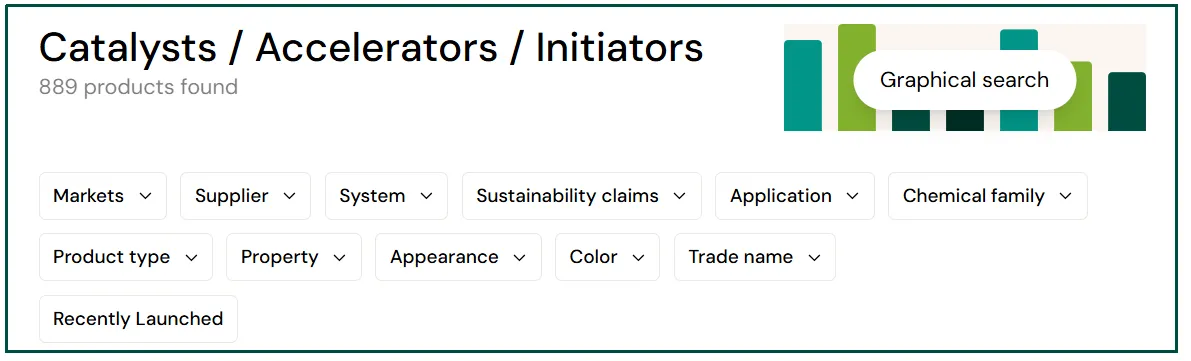
Our catalyst Master Catalog simplifies material selection with advanced filters by chemistry, system, application, sustainability claims, and performance properties. Compare grades, access technical datasheets, and request samples directly from suppliers, all in one place.
Moving on to the next section will help you take a closer look at how catalyst selection differs between major curing chemistries, specifically, amino crosslinked and urethane systems.
Catalysts used in coating systems
Catalysts play a critical role in coatings by controlling crosslinking speed, cure temperature, and final film properties. The type of catalyst selected depends on the curing chemistry.
- Acid catalysts dominate amino crosslinked systems
- Metal-based or amine catalysts are used in urethane systems
Catalysts for amino crosslinked coating systems
Amino crosslinked coatings are based on melamine, urea, benzoguanamine, or glycoluril-formaldehyde resins. They require acidic conditions to promote the reaction between hydroxyl-functional binders and amino crosslinkers. As a result, acid catalysts are recommended for these systems.
The factors that influence the reaction process are as follows:
- Functionality of the amino crosslinker and hydroxyl binder
- Dosage and type of the acid catalyst
- Temperature and curing time
- Moisture (that deactivates the catalyst)
The catalyst type strongly depends on the amino crosslinking resin. The coatings market offers a broad range of acid catalysts. These are mainly based on sulfonic acids and their derivatives. Their relative strength is linked with their equivalent weight.
Various types of catalysts for amino systems are listed in the table below.
Catalyst for amino systems | Equivalent weight (g/mol) | Relative strength |
Para-toluene sulfonic acid (p-TSA) | 172 | High  Low |
Di-nonyl naphtalene di sulfonic acid (DNNDSA) | 270 | |
Do-decyl benzene sulfonic acid (DDBSA) | 326 | |
Di-nonyl naphtalene mono sulfonic acid (DNNSA) | 460 | |
Phosphate acid | Various | |
Carboxylic acid | Various |
Types of catalysts used for amino systems
Catalyst selection by amino resin
Several factors influence the choice of acid-based catalysts. These include:
- Type of formulation (1K/2K for blocked or non-blocked catalyst)
- Type of amino crosslinker (relative strength of the catalyst)
- Functionalities of binder and crosslinker (strength and dosage)
Let's find out which catalyst types are used for specific amino resins.
➤ Strong acids: Resins like fully alkylated monomeric melamine, urea formaldehyde, benzoguanamine, glycoluril require strong sulfonic acids (pKa < 1). Examples of strong sulfonic acid catalysts include p-TSA, DNNDSA, DDBSA, DNNS, and alkylated sulfonic acids.
➤ Weak acids: Resins like high-imino melamine formaldehyde, or polymeric butylated melamine prefer weaker acids (pKa > 1). Examples of weak acid catalysts include phosphates, carboxylic acids, or amine-blocked sulfonic acids to avoid over-catalysis.
Blocked acid catalysts
The crosslinking reaction proceeds under acidic conditions. Block acid catalysts are used to:
- Enable 1-component formulations
- Delay crosslinking in 2-component systems
Under specific conditions (usually temperature-specific), the amine will separate from the acid, and the reaction will start. The market offers many amine-blocked acid catalysts. While amine-blocked acids are effective, the released amine can cause side effects such as odor, yellowing, or film defects.
The boiling point of the blocking amine should also be taken into consideration, as it can lead to film defects (wrinkling, pinholes, and pendulum hardness reduction). Using covalent-blocked acid catalysts may have fewer negative side effects than the amine-blocked type. However, they require more energy to unblock. It means either a higher curing temperature or a longer curing time is required.
Catalysts used in urethane systems
Under ambient conditions, the reaction between the hydroxyl groups of urethane and isocyanates is relatively slow. Therefore, catalysts are used to improve the reaction rate, especially with aliphatic isocyanates. Aromatic isocyanates, being more reactive, may require less or sometimes no catalyst at all. To achieve this required reaction rate, metallic or amine catalysts may be used.
Metallic catalysts are widely used in urethane coatings. However, amine-based catalysts are less recommended due to the risk of color drift (yellowing) and moisture sensitivity. DBTL is well-known for its toxicity, but many alternatives exist. New developments are focused on tin-free catalysts. Most catalyst types can be used in either waterborne or solventborne systems, depending on their commercial form. Catalyst selection can be done by checking the decrease of free isocyanate (NCO groups) over time.
Properties of metal-based catalyst
The table below explains all the catalysts that are used for urethane systems, along with their advantages and disadvantages.
Catalyst for urethane | Advantages | Disadvantages |
| Di-butyl tin laurate (DBTL) | Very well-known performances | Poor toxicological profile; Reprotoxic/mutagenic |
| Di-octyl tin laurate (DOTL) | Similar performances as DBTL | Requires higher dosage. May be also classified in the near future |
| Di-butyl tin oxide (DBTO) | Similar performances as DBTL | Poor toxicological profile; Reprotoxic/mutagenic |
| Bismuth-based | Better toxicological profile and versatile | Requires higher dosage |
| Zirconium-based | Less gassing/foaming; Good pot life | Selective catalyst, less versatility |
| Metal complex | May be good tin alternative, effective in waterborne | Need many trials to find the optimal product |
| Amine-based | Better toxicological profile | May induce color drift and water sensitivity |
Types of metal-based catalysts
Looking for catalysts with diverse chemistries for your next formulation? With 800+ commercial catalysts listed in our Master Catalog, you will find everything you need in one place. Easily select the right grades for your application and access samples and downloadable technical datasheets with just a click.
 |  |  |