

Sol-gel Technology: A Promising Replacement for Chromium Conversion Coatings
Last update on Jun 14, 2024
This is a sponsored article by Axcentive.
Conversion coatings have long been used for corrosion protection on metal substrates. However, the quest for eco-friendly products has led to the search for alternatives.
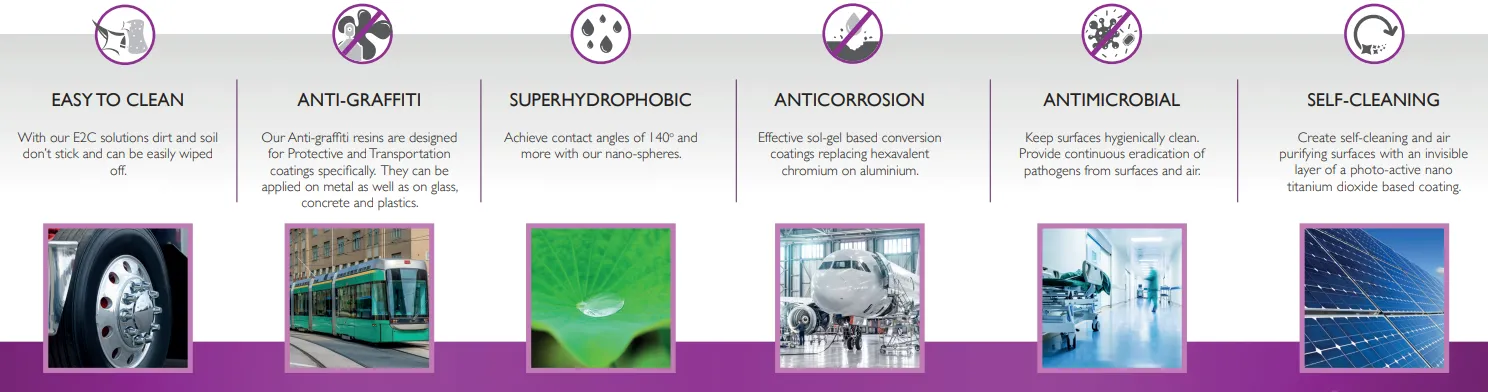
Axcentive's sol-gel technology is a promising replacement for chromium-based conversion coatings. With the EXOCOAT™ technology, Axcentive aims to formulate coatings with functionalities like:
- easy-to-clean,
- superhydrophobic,
- antimicrobial,
- anticorrosive, and
- self-cleaning
Sol-gel coatings showcase versatile applications. This ranges from corrosion protection in aerospace and automotive to anti-reflective solutions for optical devices.
In this article, we will explore the application of sol-gel coatings on aluminum substrates. Also, evaluate how these coatings are better than traditional ones using specialized techniques.
How sol-gel technology is applied in coatings?
- Corrosion protection: Sol-gel coatings are applied to metal substrates, to provide corrosion resistance. They have gained interest as a primary and effective alternative to chromium-based conversion coatings as used in aerospace, automotive, and coil coating applications.
- Anti-reflective coatings: Sol-gel coatings can be engineered to reduce surface reflections, making them ideal for applications such as optical lenses, solar panels, and display screens. Sol-gel technology can minimize light reflection and improve optical performance.
- Functional coatings: Sol-gel technology enables the incorporation of functional additives or nanoparticles into coatings to impart specific properties, such as UV protection, antimicrobial activity, flame retardance, or scratch resistance. These functional coatings find applications in various industries, including automotive, aerospace, electronics, and healthcare.
- Barrier effect: Surface functionalization with hydrophobic or oleophobic molecules during the sol-gel process helps create coatings that resist wetting, staining, or other external effects; thus, making them suitable for applications requiring self-cleaning. Sol-gel coatings can enhance the abrasion resistance of surfaces, protecting them from wear and damage by improving mechanical durability.
- Temperature and chemical resistance: Sol-gel coatings can withstand high temperatures and harsh chemical environments, making them suitable for applications requiring thermal or chemical resistance.
Benefits of Sol-gel Technology in Coatings
Why sol-gel technology has been considered a promising alternative to chromium conversion coatings?
Conversion coatings are the chemical treatments applied to metal surfaces to enhance their properties or prepare them for subsequent processes such as painting or bonding. These coatings typically involve the formation of a thin, protective layer on the metal surface through a chemical reaction between the metal and the conversion coating.
Sol-gel technology involves the synthesis of materials through the conversion of precursor molecules into a networked structure, typically in the form of a gel. This technology has gained significant attention and application in the field of conversion coatings due to its versatility, ease of application, and ability to tailor properties to meet specific requirements.
Reasons for choosing sol-gel technology as a promising alternative to chromium conversion coatings include:
- Environmental friendliness
- Versatility and controlled application process
- Improved performance
Characterizing silicon-based chromium (VI) replacement coatings on an Al substrate
In the realm of corrosion protection coatings for metal substrates, silicon-based conversion coatings are gaining traction as REACH-compliant technology to replace carcinogenic chromium (VI). These coatings, evolving from silane monolayers to sol-gel and preceramic polymers, effectively convert the metal interface and form a protective barrier.
Sol-gel chemistry, involving the hydrolysis and condensation of metal alkoxides, produces a uniform and durable coating highly resistant to corrosion. Furthermore, sol-gel coatings can incorporate various functional groups, improving adhesion and flexibility. The effectiveness of these coatings is typically assessed through salt spray testing, though this method has limitations in distinguishing between barrier and adhesion properties.
To address this challenge, Time-of-Flight Secondary Ion Mass Spectrometry (ToF-SIMS) is proposed as a tool to study interface bonding and coating characteristics in depth. The article aims to evaluate three silicon-based conversion coatings on aluminum substrates using both ToF-SIMS and salt spray tests, proposing an innovative approach to correlate results and understand the mechanism of anti-corrosion performance.
Assessing Corrosion Resistance: Tests and Results
Experimental setup for performing the tests
Material requirement and preparation
Metal coupons were cut from aluminum (Al2024, ref. ARX) sheets with a thickness of 0.8 mm purchased from Q-Panel. Three liquid experimental products (PCT146, PCT161, and PCT167) based on silicon-based preceramic precursors were applied to the aluminum substrates. These formulations differed mainly in organic content, with:
- PCT161 being completely inorganic,
- PCT146 containing partly organic components, and
- PCT167 is based on an organic epoxy-based matrix containing inorganic sol-gel-based particles
Steps involved in substrate preparation
- STEP 1: Aluminum (Al) coupons were prepared by cleaning with acetone
- STEP 2: They were dipped in NaOH aqueous solution (60g/l) at 60°C for 10 seconds
- STEP 3: They were rinsed with water
- STEP 4: They were dipped in HNO3 aqueous solution (20%) for 30 seconds at room temperature
- STEP 5: They were again rinsed with water and dried with dry compressed air
Application of silicon-based conversion coating
- The silicon-based conversion coatings were applied onto the aluminum using a bar coater with a wet thickness of 10 µm.
- After deposition, the metal coupons were cured at room temperature for one week.
- Three coated aluminum coupons were synthesized for each of the three formulations to ensure reproducibility. One coupon from each set was reserved for ToF-SIMS measurements.
Salt spray test: Measurements and conditions
The coated aluminum coupons were subjected to a neutral salt spray test as per ISO 7253 standard for 300 hours. The test conditions included:
- NaCl concentration of 5% (± 1%)
- Temperature of 35°C (± 2)
- Demineralized water usage
- pH range between 6.5 - 7.2
Intermediate measurements were taken during the test duration to monitor corrosion evolution.
ToF-SIMS: Measurements and analysis
ToF-SIMS measurements were conducted using a ToF-SIMS V instrument from ION TOF GmbH in both depth profile and surface analytical modes. Depth profiles were generated using alternating cycles of Bi3+ analysis and Ar-GCIB sputtering. Composition measurements of each coating were performed by acquiring longer intermediate surface spectra at various depths within each coating during the depth profile.
Analyzing salt spray test results
Salt spray tests, also known as salt fog tests or salt corrosion tests, are commonly used in industry to assess the corrosion resistance of materials and coatings. During the test, the samples are subjected to continuous or intermittent exposure to the salt spray, and their corrosion behavior is monitored over time. The extent of corrosion, such as the formation of rust, pitting, or other degradation, is evaluated visually or through quantitative measurements.
Results obtained from salt spray tests of PCT146
After 24 hours, minor corrosion and pitting (5-10%) appear along the direction of the laminate on PCT146. By 168 hours, corrosion and pitting had escalated to 30-70%. Additionally, cracks and corrosion are noticeable in areas where the coating is thickest. Over the entire 300-hour duration, corrosion becomes widespread across the whole coupon surface.

Figure 1: Images of 1 PCT146-coated Aluminum Coupon After Salt Spray Test Measurements for a Duration of 24h, 168h, and 300h
Results obtained from salt spray tests of PCT161
After 24 hours, a white haze emerged across the entirety of PCT161's surface, accompanied by minor pitting corrosion (approximately 1%). Additionally, minor defects were noted on the surface. By 168 hours, the white haze and pitting increased to approximately 10-20%, respectively, with some defects still visible. Throughout the total 300-hour duration, the white haze and pitting phenomena reached a maximum range of 30%, with occasional defects present.

Figure 2: Images of 1 PCT161-coated Aluminum Coupon After Salt Spray Test Measurements for a Duration of 24h, 168h, and 300h
Results obtained from salt spray tests of PCT167
After 24 hours, PCT167 exhibits pitting corrosion affecting 10-20% of the surface area. This corrosion escalates to 40% and 60% after 168 and 300 hours, respectively.

Figure 3: Images of 1 PCT167-coated Aluminum Coupon After Salt Spray Test Measurements for a Duration of 24h, 168h, and 300h
Summarizing the final results of salt spray tests
Figures 1 to 3 illustrate:
- PCT161 demonstrates the highest corrosion resistance
- PCT146 displays extensive corrosion across its entire surface
- PCT167 demonstrates intermediate corrosion resistance compared to both PCT146 and PCT161
ToF-SIMS: Precision in material composition analysis
ToF-SIMS (Time-of-Flight Secondary Ion Mass Spectrometry) is a surface analysis technique used to determine the composition and structure of materials. It works by bombarding a sample's surface with a beam of primary ions, which dislodges secondary ions. These secondary ions are then measured based on their mass-to-charge ratio (m/z), providing information about the elemental and molecular composition of the sample.
ToF-SIMS can achieve high sensitivity and spatial resolution, making it valuable for analyzing thin films, coatings, and surfaces in various fields such as materials science, biology, and semiconductor technology.
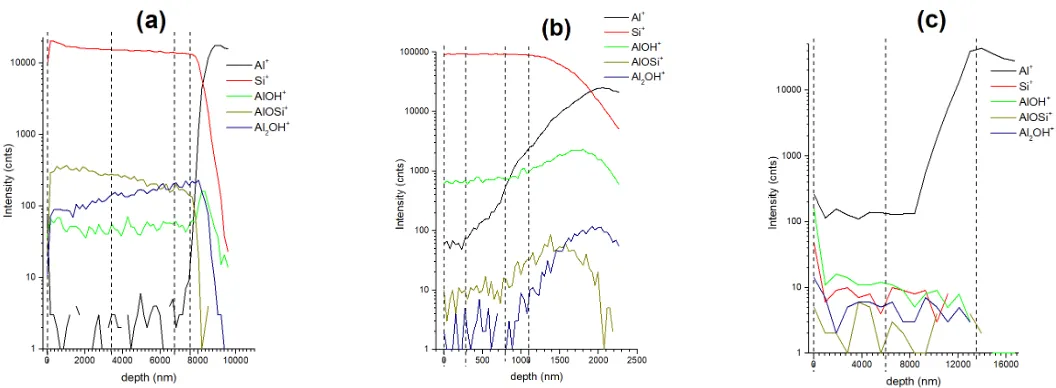
Figure 4: ToF-SIMS Depth Profile (Positive ion Mode) Obtained from the 3 Samples PCT146, PCT161, and PCT167
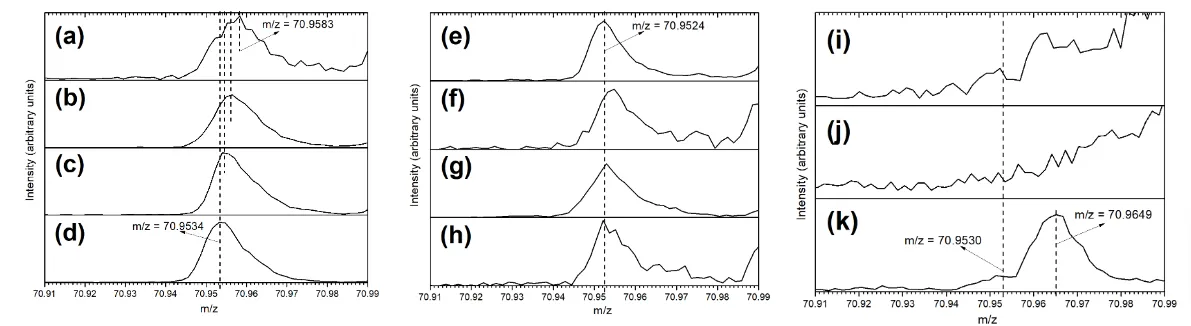
Figure 5: ToF-SIMS Spectra (Positive Ions, m/z between 70.91 and 70.99) Recorded for PCT146 at (a) The Surface and at the Bottom of the Sputter Crater While having Paused the Profile and at Depths of (b) 3.4 µm, (c) 6.8 µm and (d) 7.6 µm (= Coating/ Al Substrate Interface)

Figure 6: ToF-SIMS Spectra (Positive Ions, m/z between 115.00 and 115.10) Recorded for PCT146 at (a) The Surface and at the Bottom of the Sputter Crater While having Paused the Profile at Depths of (b) 3.4 µm, (c) 6.8 µm and (d) 7.6 µm (= Coating/ Al Substrate Interface)

Figure 7: ToF-SIMS Depth Profile (Positive Ion Mode) Obtained from the 3 Samples PCT146, PCT161, and PCT167. The following ions drawn are Al+, Si+, and Si2O2+
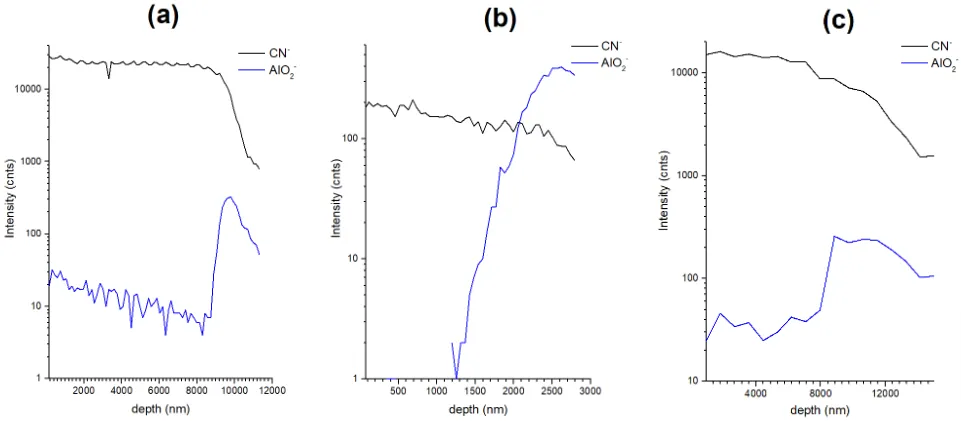
Figure 8: ToF-SIMS Depth Profile (Negative Ion Mode) Obtained from the 3 Samples PCT146, PCT161, and PCT167. The following ions are CN- and AlO2-
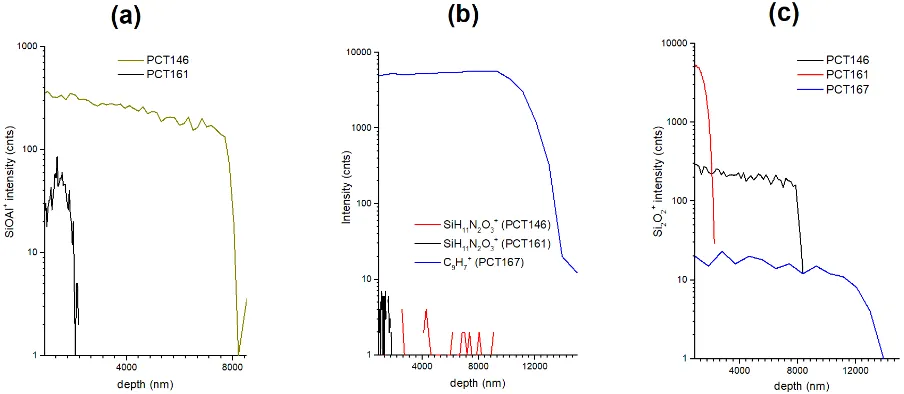
Figure 9: ToF-SIMS depth profile (positive ion mode) where (a) AlOSi+ is drawn for PCT146 and PCT161; (b) SiH11N2O3+ is drawn for PCT146 and PCT161 and C9H7+ for PCT167 and (c) Si2O2+ is drawn for PCT146, PCT161, and PCT167
Results of corrosion evaluation: ToF-SIMS vs. salt spray testing
This study examined the corrosion resistance of three different silicon-based coatings on aluminum 2024 through salt spray testing and ToF-SIMS analysis. The findings revealed a correlation between the salt spray results and the molecular composition analyzed by ToF-SIMS.
- Specifically, coatings with strong AlOSi+ and Si2O2+ peaks, like PCT161, exhibited the highest corrosion resistance. PCT146, with lower intensity peaks, performed worse in salt spray tests.
- PCT167, though lacking in AlOSi+ and Si2O2+, showed the presence of an organic fragment (C9H7+), potentially enhancing its properties. Additionally, the thickness of PCT167, at 16.5 µm, likely contributed to its anti-corrosion properties. Detection of interface bonding was crucial for corrosion resistance, especially its specific location within the layered structure.
Overall, PCT161 emerged as the most promising coating. This study highlights the potential of ToF-SIMS as a cost-effective alternative to traditional salt spray tests for evaluating corrosion resistance.
Conclusion
Correlating ToF-SIMS data with salt spray test results indicates that PCT161 demonstrates superior corrosion resistance compared to PCT146 and PCT167. PCT161 and PCT167 both exhibit characteristics of conversion coatings, while PCT167 displays the highest thickness.
The key factors influencing corrosion resistance include interface bonding and cross-linking degree, with thickness playing a secondary role. Despite variations in thickness, PCT161's enhanced resistance suggests interface bonding and cross-linking are critical determinants of corrosion protection.
| Product Name → / Properties ↓ | EXOCOAT™ 143 | EXOCOAT™ 161 | EXOCOAT™ AC | EXOCOAT™ 151 | EXOCOAT™ SH | EXOCOAT™ CV |
| Description | High-performance coating resin to create durable easy to clean finishes or anti-graffiti coatings | Multipurpose high-performance coating resin, preceramic that will cure to a ceramic layer | Sol-gel-based anticorrosive conversion coating 60% in ethanol | Sol-gel based self-cleaning coating | Sol-gel based self-cleaning coating & superhydrophobic | Sol-gel based hydrophobic glass coating |
| Active content | ≥ 60% | ≥ 20% | 45-55% | Ready to use | 100%, dilute 1:10 in water before use | Ready to use |
| Layer thickness | 0.5 to 2 µm | 10 to 15 µm | <1mu | |||
| Regulatory standards | Complies with the EC Regulation 1907/2006 (REACH) and is registered in CAS, EINECS, TSCA, AICS, CEPA, MIT inventories | Complies with the EC Regulation 1907/2006 (REACH) | Complies with the EC Regulation 1907/2006 (REACH) and TSCA, AICS, ENCS, KECL inventories | Complies with the EC Regulation 1907/2006 (REACH) and is registered in CAS, EINECS, TSCA, AICS, CEPA, MIT inventories | ||
| Characteristics | Hydrophobic, oleophobic, durable, heat resistant | Excellent barrier properties, high durability, extreme hardness (9H), scratch and oxidation resistant | Fits well with epoxy primer and PU topcoat systems | Photocatalytic and superhydrophilic, self- cleaning | Superhydrophobic self-cleaning with lotus effect on walls | Hydrophobic and transparent |
| Benefits and uses | Anti-graffiti coatings, durable marine topcoats, automotive topcoats, and easy to clean protective coatings | Conversion coating, replacing Cr(VI), epoxy primer and PU topcoat, and higher durability and hardness | Conventional low-pressure and high-pressure airless and airmix spraying, salt spray and weathering resistance, and good overloadability with epoxies | Invisible layer, self-cleaning, and highly active against moderate soiling | Super- hydrophobic water barrier | Wiperless driving for car windshields and automotive glass |
| Commercial grades | EXOCOAT™ 143 | EXOCOAT™ 161 | EXOCOAT™ AC | EXOCOAT™ 151 | EXOCOAT™ SH | EXOCOAT™ CV |