

Acrylic resins: How to select the right grade for coatings?
Last update on Apr 27, 2026
Acrylic resins are synthetic polymers used in the coatings industry. They serve as binders, forming the backbone for acrylic coating and paint formulations. They provide an excellent balance of hardness, flexibility, and durability. This makes acrylic paints and coatings suitable for architectural paints, industrial coatings, automotive, and decorative finishes.
There are myriad options of acrylic resin paints and coatings available in the market today. They are based on various chemistries, molecular weights, and functional modifications. Hence, selecting the right acrylic resin material for your specific application can be challenging.
In this guide, let's decode how acrylic resins stand out as a powerful choice for formulators. We will also discuss the key factors to consider when selecting the right acrylic resins to help you make informed decisions for specific applications.
What is an acrylic resin?
Chemical structure
An acrylic resin is a polymeric material containing acrylic monomers. These polymers are derived from acrylic acid, methacrylic acid, or their esters. They can be functionalized by introducing different chemical groups (R groups). Other acrylate monomers can also be incorporated into the polymer chains. They help in achieving different properties or lower costs. The molecular structure of acrylics can be linear, branched, or crosslinked.

Functional properties of acrylic resin materials
Several resin parameters influence viscosity and dispersion. They ultimately determine the flexibility and hardness of the final acrylic coating/film. The key properties of acrylic resin material in the coatings industry include:
- Available in solution, dispersion, or solid form
- Good photochemical and chemical resistance
- Glass transition temperature (Tg )
- Average molecular weight and molecular weight distribution
- Excellent transparency and color retention
- Superior resistance to UV radiation and environmental degradation
- Good adhesion to various substrates
- Excellent resistance to yellowing, chalking, and cracking over time
- Soluble in both water-based and solvent-based systems
Factors influencing acrylic resin selection
Selecting the right acrylic resin material requires balancing multiple material properties. These directly impact coating performance, processing, and end-use behavior. The following factors highlight the key parameters formulators consider when choosing an appropriate acrylic resin system.
Glass transition temperature (Tg)
The glass transition temperature (Tg) is the temperature at which a polymeric material will go from a glassy solid state to a liquid state. The Tg of an acrylic resin is defined by the resin formulation. This parameter has a key role in the hardness/flexibility of the final acrylic resin paint film.
The following rules can help in selecting acrylic resins formulation with a suitable Tg:
- Presence of monomers: Methacrylate monomers have a higher Tg than acrylate ones. Select from 2000+ acrylate/methacrylate monomers available in our Master Catalog.
- Type of crosslinking agents: Melamine or isocyanate
- Degree of crosslinking: Number of crosslinks between 2 polymer chains
- Nature of R groups: Reactive or non-reactive
It should be noted that the higher the Tg of the acrylic resins, the harder (less flexible) the film obtained.
Viscosity
The viscosity of an acrylic resin material depends on the solid content. However, the average molecular weight and molecular weight distribution of the polymers will also have an impact. Usually, the following rules apply:
- For the same solid content, the higher the average molecular weight of the polymer, the higher the viscosity.
- When the average molecular weight is the same, the narrower the molecular weight distribution, the lower the viscosity.
It is important to notice that the average molecular weight does not influence the viscosity of latex emulsions. In this specific case, viscosity depends on the particle size and size distribution.
Hydroxyl value number
The hydroxyl value is an indicator of the reactivity of the acrylic resins functionalized with hydroxyl functions (i.e., the number of OH groups available). It is usually expressed as the KOH mass in mg equivalent to the amount of acetic acid reacting during the acetylation of 1g of resin. The higher the hydroxyl value, the higher the reactivity (and thus the crosslinking possibilities).
Acid value
The acid is an indicator of the number of carboxyl groups present in the copolymer. It is usually expressed as the amount of KOH needed to neutralize 1g of resin (See DIN 53402 or ISO 2114). The number of carboxyl groups has an impact on the adhesion properties of the resin and the solubility in water. The higher the acid value, the higher the number of carboxyl groups.
Minimum film-forming temperature
The minimum film-forming temperature (MFT) is the minimum temperature at which the acrylic latex will form a cracked material rather than a continuous film.
- For acrylic latexes designed for architectural applications (wall paints), the MFFT is typically below 5°C.
- For latexes designed for industrial applications, where oven curing is used, the MFFT can be higher.
pH (for water-based or dispersion)
Water-based acrylic resins are neutralized with acid or basic buffers to improve resin stability. During the formulation of the coating, the pH may evolve, and the dispersion can become unstable and coagulate:
- If the initial pH is acidic, a risk of coagulation of the particles is possible.
- If the pH is basic, the dispersion can usually tolerate a higher pH but not a lower one.
Now that we’ve covered the fundamentals of acrylic resins and the key criteria for selecting the right commercial grades, let’s take a closer look at the various types of acrylic resins available and their applications.
Types of acrylic resins
Classification based on chemical composition
Depending on their composition, we can divide acrylic resins into 2 different categories. We will explore each of these categories in detail in the section below.
Pure acrylic resins
Pure acrylic resins contain only acrylic monomers. On each monomer, different functionalizations (R groups) are possible. The most common ones include:
- Simple hydrogen atoms lead to the presence of carboxyl groups in the polymer.
- Non-reactive groups, for instance, alkyl chains contain only carbon and hydrogen. These may prevent reactions with other compounds. Thus, improving the resin's chemical resistance.
- Reactive groups contain hydroxy functions, which could react with isocyanates or melamines. Some contain glycidyl functions (epoxy group) that will react with amines and carboxylic acids. These groups allow bonding between polymer chains to form a stronger polymeric material.
They influence resin properties, applications, and final properties of the acrylic coating/film obtained. H-functionalizations and the presence of carboxyl groups can improve the adhesion on a substrate. A large number of carboxyl groups will also help to solubilize the resin in water. To get a resin with specific properties or to reduce its cost, different monomers can be incorporated into the acrylic polymer.
Complex acrylic resins
Styrene is the most used, and the resulting resins are known as styrene-acrylic. Styrene monomers are significantly less expensive than acrylic ones. They are known to increase water resistance and alkali resistance, while also improving hardness. However, styrene-acrylic resins are often subject to yellowing and chalking. They have severe issues that reduce their potential applications.
Sub-types of complex acrylic resins
Complex acrylic resin materials can be further tailored by incorporating different co-monomers and functionalities. This enables a wide range of performance profiles to meet specific coating requirements. These sub-types offer formulators flexibility in balancing cost, durability, reactivity, and end-use performance across diverse applications.
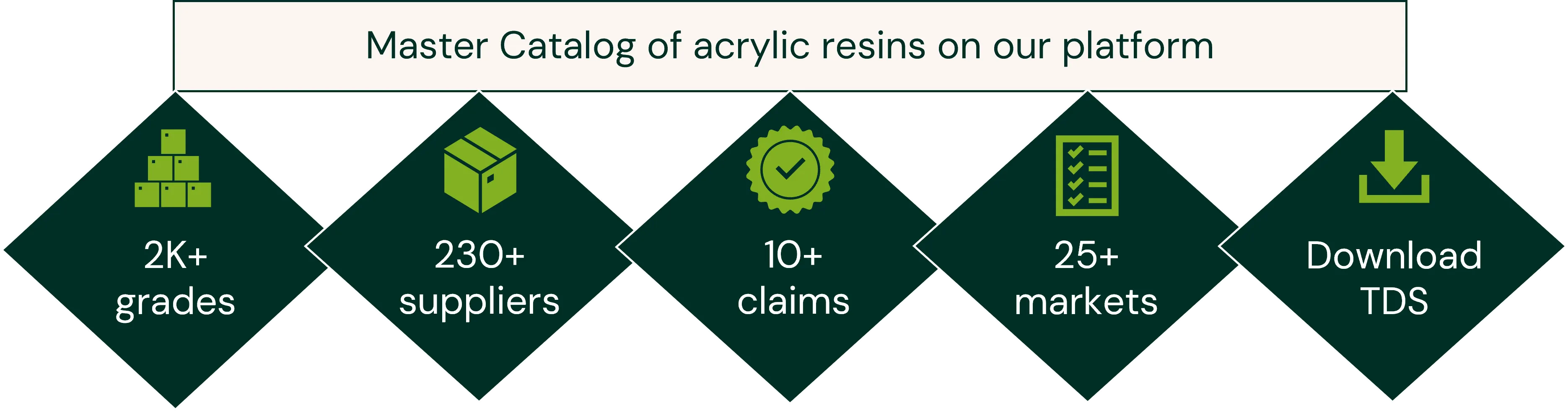
Select from a range of 7000+ acrylic polymers and copolymers available in our Master Catalog. Finding the right grade is now quicker than before with our new filters and streamlined product discovery experience. Request samples and download technical datasheets with a click.
 |  |  |
 |  |  |
 |  |  |
TIP: Click on the "Chemical family" facet on our platform and select the desired type of acrylic resin based on chemistry for your acrylic paints and coatings formulation.
Classification based on form and curing mechanism
Acrylic resins are available in 3 different forms: thermoplastic, crosslinking, and latexes. Each form has a unique set of features, functionalization, and uses, which set them apart. Let's explore each category in detail.
Thermoplastic acrylic resins
The polymers composing the resin do not contain any reactive group. Thus, the polymer chains are not crosslinked. To improve the interaction between the different polymer chains, high molecular weight polymers are used.
Thermoplastic resins normally soften and can be reshaped with an increase in temperature. This property makes these resins the ideal candidates for some industrial processes, such as:
- injection molding,
- compression molding, or
- extrusion
Given below are the physical forms, functionalization, properties, and applications of thermoplastic resins.
| Thermoplastic acrylics | |
| Physical form | Available as small beads, flakes, high solid content, viscous solution, or dispersion |
| Functionalization | No reactive groups on acrylic monomers |
| Properties | Water resistance, yellowing resistance, gloss retention, fast drying, alkali resistance, good adhesion |
| Applications | Inks, exterior applications that require metal protection, and adhesives |
Crosslinking resins
Crosslinking resins can be cured to promote chemical interactions between different polymer chains. Curing can lead to more complex polymeric structures and stronger materials. It can occur in different conditions that depend mainly on the active group present in the polymers.
In the presence of reactive groups, acrylic resins can be crosslinked. These groups allow the interaction between two different polymer chains. This can occur at a certain temperature or under UV light. A catalyst may also be added to promote and accelerate the chemical reaction.
We can distinguish between two types of crosslinking systems.
Externally crosslinked resins
They require a curing agent, a chemical that will react with the polymers. In this case, the R group is commonly a hydroxyl-functionalized chain. It allows the reaction with melamine or isocyanate curing agents. This kind of formulation (resin + curing agent) can be provided where they are already mixed as:
The 2K are used in particular when heating in an oven is not possible. In 1K, isocyanate curing agents can be 'blocked', or made unreactive at room temperature. The curing of the resin will occur only at higher temperatures in an oven (stoving coatings).
Carboxyl groups are also present on the polymer chains of crosslinking resins or as free acrylic acids. They can act as catalysts for the curing reaction and improve coating adhesion. Moreover, other curing agents like epoxies can react with the carboxyl groups. These crosslinking acrylic resins can be provided in the solvent phase, but if the number of carboxyl groups in polymers is high enough, they can be soluble in water. In this case, they are commonly identified as water-thinnable.
In water-based systems, a cosolvent can also be present to improve resin compatibility. Finally, emulsions of thermoset acrylic resins are also available. Emulsions usually allow:
- higher solid content at the same viscosity compared to water-thinnable ones, and
- alkali resistance is usually better as they require fewer carboxyl groups
Self-crosslinking resins
Acrylic resins can be available as self-crosslinking versions (rather solvent-based or water-based). Some R groups in the copolymer structure are blocked amide (alkoxymethyl acrylamides) groups. For example, N, N-bis-butoxy-methylamide. During the curing process, they react with the hydroxyl groups available on the copolymers, leading to a crosslinked network. The curing takes place usually in an oven at elevated temperatures.
Compared to resins crosslinked with curing agents, self-crosslinked resins have:
- increased hardness
- gloss, and
- chemical resistance
Given below are the physical forms, functionalization, properties, and applications of crosslinking acrylic resins.
| Crosslinking resins | |
| Physical form | Available as solution in solvent, water thinnable, and water dispersion |
| Functionalization | Reactive groups on acrylic monomers (hydroxyl, carboxyl) Presence of curing agents (epoxy, melamine, isocyanate) Self-crosslinked with functionalized specific groups (alkoxymethyl acrylamides) |
| Properties | Excellent mechanical resistance, good durability with time, weatherability, chemical resistance, flexibility, gloss retention, increased hardness |
| Applications | Industrial (automotive, OEM, can coatings), stoving coatings, appliances and white goods |
Acrylic latexes
In solvent-based acrylic resins, the resin is solubilized in a solvent or a solvent blend. While water-based resins are formulated in water. A very specific class of water-based resins is latexes. Latexes are emulsions of acrylic resins that become water-resistant once the water evaporates.
Acrylic latexes are emulsions of acrylic polymeric particles in water. There exist acrylic emulsions that can be crosslinked with curing agents. Coalescence is the main mechanism used to obtain a paint film or coating from latex.
After application, the latex is left to dry, and the water evaporates. The polymeric particles get in contact with each other, interact, and coalesce to form a continuous film. To obtain coalescence and a good film, the Tg of the polymer needs to be below the film-forming temperature. This allows the deformation of the particles and diffusion of polymer molecules. The minimum film-forming temperature (MFFT) is thus an important parameter to consider when selecting an acrylic emulsion.
Given below are the physical forms, functionalization, properties, and applications of acrylic latexes.
| Acrylic latexes | |
| Physical form | Available as water emulsions |
| Functionalization | Coalescence is the main mechanism to obtain a film. However, reactive groups (hydroxyl, glycidyl, carboxyl) can be incorporated in the resin (R groups) to achieve further crosslinking. |
| Properties | Yellowing resistance, gloss retention, alkali resistance, flexibility, improved emulsion stability using pH buffers |
| Applications | Architectural wall paints, masonry, industrial, and automotive coatings |
Unsure about which physical form of acrylic resin would suit your formulation needs? Use the "Appearance" filter on our platform and select the required physical form of acrylic resins from our exhaustive Master catalog. Download technical data with ease and request samples.
 |  |  |
 |  |  |
With the key types and importance of acrylic resins established, let's focus on how these resin technologies are evolving to address environmental impact, regulatory expectations, and sustainability-driven formulation goals.