


How to formulate adhesives that are easy to apply?
Last update on Jun 16, 2025
The effectiveness of an adhesive extends beyond its bonding strength. Ease of application plays a critical role in user experience and overall product adoption. By considering factors like viscosity, flow properties, and application methods, manufacturers can develop adhesives that are not only strong and reliable but also user-friendly and efficient to apply.
Pre-requisites
There are a few pre-requisites for effective adhesive use:
Suitable application techniques
For different circumstances, one of the following techniques can be used:
Spray
Brush
Roll coat
Nozzle
Screen print
Why is the application technique critical?
The chosen application technique plays a vital role in ensuring good initial contact between the adhesive and the substrates.
The application technique needs to be tailored to allow the adhesive to cure effectively.
Techniques like proper alignment of the substrates and maintaining pressure during curing help prevent misalignment or movement that could weaken the bond.
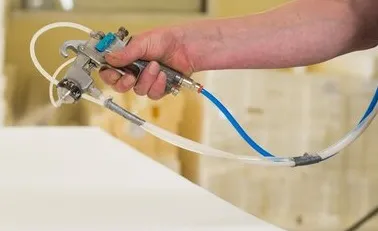
Spray application method (Source: Follmann1)
Rheology of the system
Rheological properties like viscosity and thixotropy (shear-thinning behavior) influence how easily the adhesive spreads and flows. Thus, impacting factors like workability, dispensing, and overall user experience. For example, a high-viscosity adhesive might be difficult to spread and require specialized equipment. Whereas, a low-viscosity adhesive might drip or sag if not applied correctly.
Rheology also helps predict how the adhesive will interact with the surfaces being bonded.
Surface wetting
If the adhesive does not wet the surface well, it will likely bead up or form weak, discontinuous patches. This results in a limited contact area and weak intermolecular forces, leading to a poor bond that can easily fail under stress.
Surface preparation techniques like cleaning, degreasing, or applying primers can be necessary to improve the surface energy and promote good wetting.