

Additives & polymers for high temperature structural adhesives
Last update on Apr 28, 2026
Effects of elevated service temperature
For an adhesive bond to be useful, it must not only withstand the mechanical forces that act on it, but it must also resist the elements to which it is exposed during service. One of the most degrading elements for organic adhesives is heat. To synthesize high temperature polymer systems for structural adhesives is a never ending challenge.
Let's take a look at the resins capable of withstanding extreme temperatures along with some important class of additives.
All polymeric materials are degraded to some extent by exposure to elevated temperature. Not only do elevated temperatures lower short-term physical properties, but properties will also likely degrade with prolonged thermal aging. Thus, several important questions need to be asked for an adhesive if high service temperatures are expected.
- What is the maximum temperature that the bond will be exposed to in service?
- What is the average temperature to which the bond will be exposed?
Ideally, one would like to have a definition of the entire temperature - time relationship representing the adhesive's expected service history. This data would include time at various temperatures, number of temperature cycles, and rates of temperature change.
Creep and lack of cohesive strength
Certain polymers have excellent resistance to high temperatures over short durations (e.g., several minutes or hours). The short-term effect of elevated temperature is primarily one of increasing the molecular mobility of the adhesive. Thus, depending on the adhesive, the bond could actually show increased toughness but lower shear strength. Certain polymers with lower glass transition temperatures will show softness and a high degree of creep at elevated temperatures.
However, prolonged exposure to elevated temperatures may cause several reactions to occur in the adhesive. These mechanisms can weaken the bond both cohesively and adhesively. The main reactions that affect the bulk adhesive material are:
- Oxidation
- Pyrolysis
These reactions generally result in brittleness and loss of cohesive strength. Thermal aging can also affect adhesion by causing changes at the interface. These changes include:
- Internal stress on the interface due to shrinkage of the polymer
- Chemical reactions with the substrate, and
- Reduced peel or cleavage strength because of brittleness
If heating brings a non-crosslinked adhesive above its glass transition temperature, the molecules will become so flexible that their cohesive strength will drastically decrease. In this flexible, mobile condition, the adhesive is susceptible to creep and greater chemical or moisture penetration occurs. Generally with a crosslinked adhesive, prolonged heating at an excessively elevated temperature will have the following effects:
- Split polymer molecules (chain scission) causing lower molecular weight, degraded cohesive strength, and low molecular weight byproducts.
- Continued crosslinking resulting in bond embrittlement and shrinkage.
- Evaporation of plasticizer resulting in bond embrittlement.
- Oxidation (if oxygen or a metal oxide interface is present) resulting in lower cohesive strength and weak boundary layers.
Most organic adhesives degrade rapidly at service temperatures greater than 150°C. However, several polymeric materials have been found to withstand up to 250-300°C continuously and even higher temperatures for a short-term basis. To use these materials one must generally pay a premium in adhesive cost and also be able to provide long, high temperature cures, often with pressure. Long-term temperature resistance, greater than 250-300°C, can only be accomplished with inorganic or ceramic-based adhesives.
Understanding how heat impacts adhesive behavior is only the first step. The next question is - what kind of material can actually withstand these conditions? That brings the focus to selecting the right base polymer.
Requirements of the base polymer
The base polymer, of course, is a key ingredient in a high temperature adhesive system. For an adhesive to withstand elevated temperatures it must have a high melting or softening point, and resistance to oxidation.
1. A high softening point or glass transition temperature
Materials with a low melting point, such as many of the thermoplastic adhesives, may prove excellent adhesives at room temperature. However, once the service temperature approaches the glass transition, plastic flow results in deformation of the bond and degradation of cohesive strength.
Thermosetting adhesives, exhibiting no melting point, consist of highly crosslinked networks of macromolecules. Because of this dense crosslinked structure, they show relatively little creep at elevated temperatures and exhibit relatively little loss of mechanical function when exposed to either elevated temperatures or other degrading environments. Many of these materials are suitable for high temperature applications.
2. Resistance to oxidation degradation
When considering thermosets, the critical factor is the rate of strength reduction due to thermal oxidation or pyrolysis. Thermal oxidation can result in chain scission or crosslinking. Crosslinking causes the polymer to increase in molecular weight, leading to brittleness and decreased elongation.
Progressive chain scission of molecules results the following losses within the bulk adhesive:
- Weight
- Strength
- Elongation, and
- Toughness
Figure below, illustrates the effect of oxidation by comparing adhesive joints that are aged in both high temperature air and inert gas (nitrogen) environments. The rate of bond strength degradation in air depends on the temperature, the adhesive, the rate of airflow, and even the type of adherend.
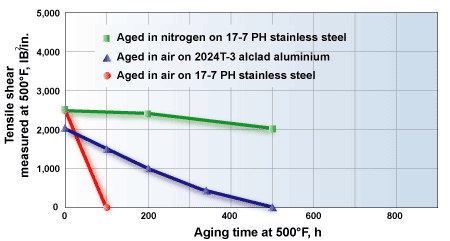
The effect of 260°C aging in air and nitrogen on an epoxy-phenolic adhesive
Some metal adhesive interfaces are chemically capable of accelerating the rate of oxidation. For example, it has been found that nearly all types of structural adhesives exhibit better thermal stability when bonded to aluminum than when bonded to stainless steel or titanium
3. Resistance to thermally induced chain scission
Pyrolysis is simple thermal destruction of the molecular chain of the base polymer in the adhesive or sealant formulation. Pyrolysis causes chain scission and decreased molecular weight of the bulk polymer. This results in both reduced cohesive strength and brittleness. Resistance to pyrolysis is predominantly a function of the intrinsic heat resistance of the polymers used in the adhesive formulation. As a result, many of the polymers that are used as base resins in high temperature adhesives are rigidly crosslinked or are made of a molecular backbone referred to as a "ladder" structure as shown in the figure below.

The ladder structure is made from aromatic or heterocyclic rings in the main polymer structure. The rigidity of the molecular chain decreases the possibility of chain scission by preventing thermally agitated vibration of the chemical bonds. The ladder structure provides high bond dissociating energy and acts as an energy sink to its environment.
Notice in the figure above that to have a complete chain separation (resulting in a decrease in the molecular weight) two bonds must be broken in the ladder polymer. Whereas, only one needs to be broken on a more conventional linear or branched chain structure.
In order to be considered as a promising candidate for high temperature applications, an adhesive must provide all of the usual functions necessary for good adhesion (wettability, low shrinkage on cure, thermal expansion coefficient similar to the substrate, toughness, etc.)
Once the key material requirements are clear, it becomes easier to explore which adhesive chemistries can realistically meet these demands at high temperatures.
Conventional high temperature polymers for structural adhesives
High temperature adhesives are usually characterized by a rigid polymeric structure, high glass transition temperature, and stable chemical groups. The same factors also make these adhesive relatively difficult to process.
Only certain epoxy phenolic, bismaleimide, polyimide, and polybenzimidazole adhesive can withstand long-term service greater than 177°C. However, modified epoxy and even certain cyanoacrylate adhesives have moderately high short-term temperature resistance. Silicone adhesive also have excellent high temperature permanence, but they exhibit low shear strength and may not be applicable for "structural" applications.
Properties of these adhesive systems are compared in the table below.
Property | Modified Epoxy | Epoxy-Phenolic | Cyano-acrylate | Polyimide | Silicone Rubber | Pressure Sensitive Silicone |
| Temperature Range, °C | -55 to 177 | -251 to 260 | -40 to 246 | -251 to 315 | -73 to 232 | -40 to 260 |
Optimum Cure Condition
|
|
|
|
|
|
|
Tensile shear, psi at
|
|
|
|
|
|
|
There are even fewer sealants suitable for long term, high temperature service. The thermal endurance requirement of a highly crosslinked polymer generally is counter to the requirement that a sealant must be flexible. Silicone based elastomers and some very special elevated temperature elastomers are the only products that will provide both thermal endurance and a significant degree of flexibility.
There are many polymers that are not mentioned here because they are used in relatively small amounts or are still considered in the developmental stage. The reader may want to consider a large number of textbooks and research papers on the development of high temperature polymers.
These high temperature resins will provide the main elements in the adhesive formulator's recipe. However, as will be shown in following sections of this paper, there are also additives, fillers, etc. that can further enhance the thermal properties of these adhesives. These additional components will improve thermal resistance by providing oxidation resistance, toughening, and control of bondline stress.
While these polymers form the foundation, their performance can still be influenced by external factors especially oxidation, which plays a critical role in long-term durability at elevated temperatures.
Oxidation resistance
Performance enhancement strategies
- Krieger, R. B., R. E., Politi. (1967). High temperature structural adhesives. In Aspects of Adhesion (vol. 3, ed. D. J. Alner). London University Press.
- Black, J. M., & Bloomquist, R. F. (1956). Metal bonding adhesives for high temperature service. Modern Plastics.
- Wilkinson et al. (1992). Polymer Preprints, 33 (1), p. 425.
- Shimp, D. A., et al. (1988). Co-reaction of epoxide and cyanate resins. 33rd SAMPE Symposium and Exhibition.