WANHUA Isocyanates
Last update on Nov 28, 2025
WANHUA Aliphatic Diisocyanates for adhesives: Ensuring purity with low monomer content
Expertly formulated aliphatic diisocyanates enhance the bonding strength, durability, and chemical resistance of adhesives, ensuring exceptional performance in demanding industrial applications.
ABOUT WANHUA – Advancing Chemistry, Transforming Lives
Wanhua Chemical Group headquartered in Yantai, ShandongChina, stands as a global leader in the production of isocyanates, pivotal components in polyurethane chemistry. The company boasts a comprehensive portfolio encompassing both aromatic and aliphatic isocyanates, catering to diverse applications across coatings, adhesives, elastomers, and foams.
Key Isocyanate Products (monomers and derivatives)
- MDI (Methylene Diphenyl Diisocyanate)
- TDI (Toluene Diisocyanate)
- IPDI (Isophorone Diisocyanate)
- HDI (Hexamethylene Diisocyanate)
Wanhua continues to innovate in the adhesives sector with products that offer excellent weather resistance, color retention, and mechanical properties, suitable for automotive OEM and refinishing coatings, as well as industrial applications. Demonstrating a commitment to sustainability, several of Wanhua's products, including MDI, TDI, and IPDI, have obtained ISCC PLUS certification. This certification underscores the company's dedication to reducing carbon footprints and promoting sustainable practices in the chemical industry.
Wanhua Chemical Group's extensive range of isocyanates, coupled with its focus on innovation and sustainability, solidifies its position as a key player in the global polyurethane industry.
Introduction to Isocyanates:
Isocyanates are reactive compounds widely used in polyurethane systems, where they act as curing agents by reacting with polyols. This reaction forms durable, high-performance films with excellent mechanical strength, chemical resistance, and weatherability. The isocyanate-based products are used for automotive, industrial, tile and grout systems, and are valued for their fast curing, strong adhesion, and gloss retention. However, due to health risks like respiratory sensitization, careful handling is essential. While safer and more sustainable alternatives are emerging, isocyanates remain key for better adhesive features.
Aliphatic Diisocyanates – What are these?
Aliphatic Diisocyanates are highly reactive chemicals used predominantly in the production of polyurethane products. They are crucial components in creating polymers and are particularly valuable in the adhesive industry because they react with various substances, including alcohols (to form urethanes) and water (to form foams), offering tailored properties for specific applications.
Quick Read
- Isocyanates: Compounds with at least one isocyanate group (-NCO), serving as the fundamental building blocks for polyurethane materials.
- Polyisocyanates: Polymers composed of multiple isocyanate groups, offering enhanced cross-linking in polyurethane products through their multiple reactive sites.
Blocked isocyanates:
Blocked isocyanates are a versatile solution in the formulation of heat-activated adhesives. In adhesive systems where controlled reactivity and extended shelf life are critical, blocked isocyanates offer a reliable way to delay curing until the desired thermal activation stage. The isocyanate group is temporarily “blocked” with a protecting agent, preventing premature crosslinking during storage or application. Once heat is applied—typically during the bonding or lamination process—the blocking agent is released, enabling the isocyanate to react with polyols or active hydrogen compounds. This results in strong, durable polyurethane networks with excellent mechanical strength, chemical resistance, and adhesion to a variety of substrates. Blocked isocyanates are especially useful in high-performance industrial adhesives, such as those used in automotive assembly, industrial, tile and grout systems.
WANNATE® Aliphatic Diisocyanates: Tailored Solutions for Diverse Applications
Wanhua Chemical's WANNATE® series utilizes the unique reactivity of isocyanates to engineer adhesives that enhance performance in several critical applications.
Key Properties - WANNATE® GRADES
Bonding & Durability Isocyanates create durable linkages for robust, long-lasting bonds
| Versatility Effective on various substrates, suitable for automotive, construction, and more
| Curing Speed Fast curing, ideal for quick assembly with adjustable rates for tailored applications
| Chemical Resistance Provides resilient bonds against chemicals, oils, and solvents
|
Temperature Resistance Maintains effectiveness across a range of temperatures
| Formaldehyde Free Reduced health risks and increased safety with low VOC formulations
| Flexibility Flexibility post-curing that is essential for dynamic applications
|
WANNATE® Grades – Key Benefits
Better mechanical strength
Better viscosity
Resistance to chemicals
Weathering resistant
Low monomer content
HIGHLIGHTS – Chemical Properties
PRACTICAL APPLICATIONS

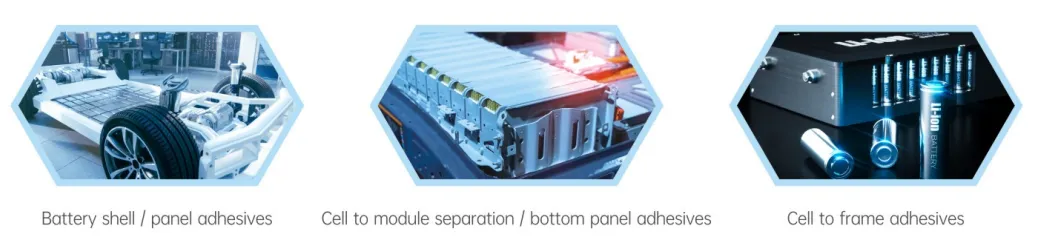
Aliphatic Diisocyanates (ADI) in Batteries
Wanhua Chemical's WANNATE® series, specifically formulated with Aliphatic Diisocyanates (ADI), specifically formulated with Aliphatic Diisocyanates (ADI), provides advanced solutions for battery bonding in electric vehicles and energy storage systems. ADI-based polyurethane (PU) structural adhesives offer unique advantages optimized for high-performance battery applications.

Advantages of Aliphatic Diisocyanates (ADI) in Batteries
Extended Pot Life ADI formulations offer the longest working time among competing chemistries, facilitating complex assembly processes without compromising speed or efficiency | Enhanced Thermal Conductivity The lower viscosity inherent to ADI allows for higher additive loading, which enhances the thermal management of battery packs, crucial for maintaining optimal operating temperatures and efficiency | Customizable Flexibility ADI-based adhesives can be tailored to meet specific flexibility requirements, providing a robust solution that accommodates thermal expansion and mechanical stresses within battery modules |
Advantages of PU Structural Adhesives
Compared to other adhesive technologies, PU structural adhesives synthesized from WANNATE® ADI exhibit superior characteristics essential for battery bonding:
- Superior Adhesion and Cohesion: PU adhesives provide better bonding strength than silicone-based adhesives, ensuring a secure and durable attachment of battery components.
- Improved Weatherability: Offering significant improvements over epoxy adhesives, PU adhesives excel in various environmental conditions, resisting weathering, moisture, and thermal cycling.
- Flexibility and Low Hardness: The inherent flexibility and lower hardness of PU adhesives facilitate easy positioning and adjustment during assembly processes, enhancing handling operations and impact resistance.
- Versatile Mechanical Properties: These adhesives are engineered to meet the diverse demands of battery applications, providing a balance of strength, flexibility, and durability that is critical for the dynamic stresses encountered in mobile and stationary battery systems.

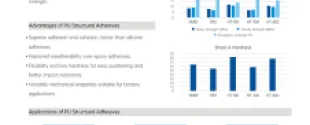
The graphs display the performance characteristics of different WANNATE® Diisocyanates: HMDI, IPDI, HT-100, HT-300and HT-600, showcasing variations in pot life, mechanical properties (shear and tensile strength, elongation at break), and Shore A hardness, highlighting their diverse applications based on durability and flexibility.
Advantages of PU Structural Adhesives
WANNATE SPECIALTY ALIPHATIC DIISOCYANATES FOR POLYASPARTIC GROUT AND SEALER
In grout and sealer applications, adhesives play a critical role in ensuring long-term performance under moisture, mechanical, and chemical stress. These systems require precise formulation to deliver strong adhesion, fast curing, and resistance to water ingress and staining.
Polyaspartic resin technologies, when combined with Wanhua’s aliphatic diisocyanates WANNATE® HT-600 and WANNATE® HT-300, offer excellent mechanical strength, UV durability, and hydrolytic stability, making them ideal for both interior and exterior construction environments.

KEY CHARACTERISTICS
Low VOC Emissions Solvent-free, 100% solids formulation for environmentally responsible applications. | Excellent Weatherability Preserves both appearance and performance over long-term exposure. | Hardness & Flexibility Delivers outstanding scratch and abrasion resistance under stress and impact. |
Strong Adhesion Promotes robust bonding to substrates for enhanced durability. | Adjustable Working Time Easily tailored to meet varying application needs. | Superior Chemical Resistance Shields surfaces from aggressive chemicals and pollutants. |
Mechanical performance comparison - Cured polyaspartic resins
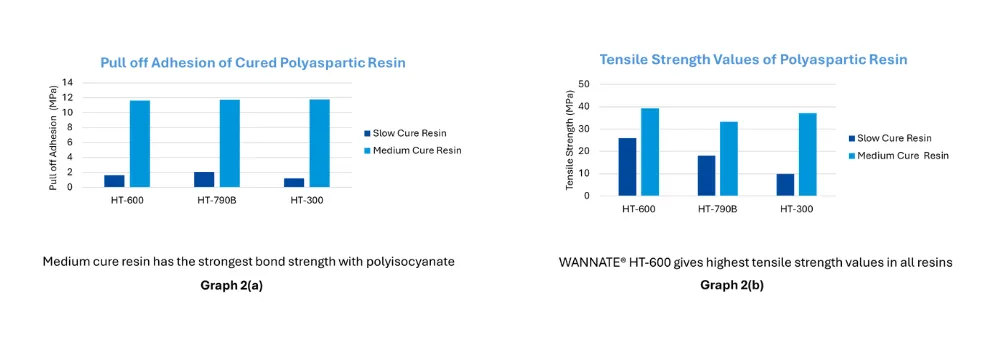
Graph 2(a). Medium cure polyaspartic resins exhibit significantly higher pull-off adhesion with diisocyanates compared to slow cure variants.
Graph 2(b). WANNATE® HT-600 delivers the highest tensile strength across both slow and medium cure polyaspartic resins.

Hydrolytic stability of cured polyaspartic resin
| Mechanical Property | Medium Cure Resin with WANNATE® HT-600 | Medium Cure Resin with WANNATE® HT-300 | ||||
|---|---|---|---|---|---|---|
| Control | Soak | Soak and Dry | Control | Soak | Soak and Dry | |
| Maximum Tensile Strength (MPa) | 41.7 | 39.5 | 41.6 | 39.9 | 35.6 | 39.7 |
| Tensile Modulus (GPa) | 1.837 | 1.782 | 1.744 | 1.589 | 1.389 | 1.605 |
Test conditions: Wanhua internal method
WANNATE® HT-600 demonstrates slightly better retention of tensile strength and modulus after hydrolytic aging compared to WANNATE® HT-300, indicating superior hydrolytic stability.
Wanhua-polyaspartic grout formulations can show very high pull-off adhesion and/or strain performance, indicating excellent formulation tailorability using various grades of Wannate aliphatic diisocyanates.
Formulation Recommendations
| Property | Increase | Decrease |
|---|---|---|
| Set Time/ Working Time | HT-300 | HT-600 |
| Maximum Tensile Strength & Young's Modulus | HT-600 | HT-790B, HT-300 |
| Adhesion | HT-300 | HT-790B, HT-600 |
| Chemical Resistance (Immersion) | HT-300 | HT-600 |
| Hydrolytic Stability | HT-600 | HT-300 |
| Strain Resistance | HT-790B, HT-600 | HT-300 |
The table provides formulation guidance for adjusting key performance properties in polyaspartic systems using different WANNATE® aliphatic polyisocyanate grades.
Products
See All Products
WANNATE® HT-400
- Support available
- Original documents
WANNATE® HT-100
- Sustainable option
- Support available
- Original documents
WANNATE® HMDI
- Support available
- Original documents