
Injection Molding with TPEs,TPVs
Last update on Jul 26, 2006| Kenneth Kear, Ph.D., Kear Technology (Retired: Santoprene elastomer business, ExxonMobil Chemical Co.) |
Introduction
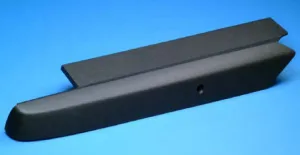
The field of thermoplastic elastomers (TPEs) has been growing rapidly during the last two decades. A number of classes of TPE have been commercialized and have been widely adopted in many applications across most industries. The thermoplastic vulcanizates (TPVs) are the class of TPEs with a cross-linked rubber phase, which has the performance of thermoset rubbers. The TPVs are growing most rapidly of the TPEs and attention to their processing is important to understanding TPEs. The other TPEs generally can be described as block copolymer or a polymer blend. A block copolymer is a TPE where one region is rubber and the other has a rigid nature, and includes styrene block copolymers (SBCs) (e.g. styrene-butadiene-styrene (SBS)), copolyester TPEs (COPEs), thermoplastic urethanes (TPUs), copolyamide TPEs (COPAs) and melt-processible rubber (MPRs). The third division of the classes of TPE are described as rubber / plastic blends. These include thermoplastic olefins (TPOs) where EP rubber and polypropylene are blended and the polyvinyl chloride / nitrile rubber blends (PVC/NBRs). A key process for the manufacture of TPE parts is injection molding. A basic understanding of the process for TPEs is needed to successfully commercialize an application. Here we address the primary injection molding issues for TPEs and show the contrast in the various classes of TPEs. The primary approach has been to use the technology developed for thermoplastics and make the adjustments necessary for adapting it to TPEs. The adjacent figure shows an example of a TPO part manufactured with injection molding.
TPO-truck-compartment-cover |
TPE Molding Overview
The injection molding process has been widely used for thermoplastics. The most widely used version of the process consists of a barrel and screw configuration that melts the polymer and fills the zone of the barrel in front of a reciprocating screw with molten polymer. When the barrel region is full, it is injected forward to force the melted thermoplastic or TPE through a series of channels (called the sprue and runners) through a narrow restriction (called the gate) into a chamber in the mold (called the cavity). The cavity typically has two halves that are kept closed by a hydraulic or electric clamping system. As the cavity fills, the injection pressure from the screw will increase in the cavity. Injection pressures used are up to 140 MPa (20,000 psi) and with the substantial projected area of the cavity of the mold, it is necessary to apply a very large force to keep the mold halves closed. This clamping pressure is generally measured in tons of force and is a key rating for the capability of an injection molding machine along with the surface area size of the clamping platens. Another key factor is the injection volume capacity of the barrel, which is generally measured in kg or oz. of poly-styrene it will inject.
Once the mold is filled, the pressure is maintained while the TPE cools and solidifies. It is necessary to compensate for the volumetric shrinkage of the TPE melt as it cools. Therefore, during this phase it is critical to maintain an injection pressure with the injection screw (called packing pressure). Once solidified the injection pressure is no longer necessary, but the mold still needs to remain closed under clamping force until the part is adequately cooled. It is called the mold closed phase. During this phase, the screw will be filling the barrel again with melted TPE to be used in the next cycle. The solidified TPE must cool to a temperature where it can be removed without being distorted. Once cooled the mold halves are opened by activating the clamping mechanism and the TPE part is removed. Typically, the removal process is automated and an ejection system incorporated into the mold or a robotic picking system will extract the part from the mold. Once the TPE part is removed, the mold closes and another injection cycle is initiated.
Process Methods
The injection molding process is adapted to TPEs rather readily. The various classes of TPEs will generally mold well. Historically the thermoplastic urethanes were the exception due to their high viscosity, but in recent years TPU grades that injection mold well have been commercialized. In order to process TPEs the key process variables have to be set to accommodate the particular properties of any given class of TPE.
The main TPE properties include:
- the melt temperature,
- the melt viscosity, which is temperature and shear rate dependent (the higher the injection rate, the lower the viscosity), and
- the shrinkage rate, which dictates how much oversized the cavity must be to achieve the desired part size.
The processing melt temperature directly correlates with the melting temperature of the TPE polymer. The melt viscosity at the process shear rates used directly correlates with the injection pressure and packing pressure required. The various TPE classes have different viscosity ranges and temperature sensitivity, and these vary from grade to grade. Therefore, the process and mold must be tailored to the specific class of TPE and the grade selected. This is also the case in general for thermoplastics. The chemistry and degree of polymerization dictate the properties found in any given TPE as is also true for thermoplastic polymers. A comparison of the relative molding parameters for the various TPEs is shown in the table below.
Typical TPE Injection Molding Characteristics |
Typical TPE Injection Molding Characteristics |
The TPVs represent a special case since the structure does not consist of a single polymer type. TPVs have a cross-linked rubber phase dispersed in a thermoplastic phase. This morphological structure makes them very shear dependent such that the viscosity is quite low at the high shear rates used during injection molding (1,000 to 100,000 sec-1). Then at very low shear (and when static) the viscosity is quite high giving the TPV melt a relatively high stiffness. The grades of TPVs commercially available also vary widely in their injection moldability. Some are highly tailored to injection molding and wrok extremely well. These molding grade TPVs work better in thin and difficult to mold parts. The general purpose grades generally mold well and can be used many TPV applications without resorting to the more expensive molding grades. But where they are needed, the higher cost is more than offset by the elimination of molding difficulties.
Tooling
The various mold designs and injection molding machines used for thermoplastics work well for TPEs, too. These include:
- Two plate molds with cold runners
- Three plate molds with cold runners
- Externally heated hot runner manifold molds using pin gates, valve gates, etc. (Internally heated hot runners are not preferred but have been used commercially with careful attention)
- Stacked molds
- Insert molds
- Two shot (sequential injection) molds with double barrel machines, and even multiple barrel machines can be used for multiple materials/grades/colors
- Coinjection molding with two parallel barrels (but has limited utility)
- Gas injection (for coring out thick-walled regions of a part)
TPVs are more difficult to use where the tooling approach requires a flow at low shear rates, including particularly in internally heated hot runner manifolds and the coinjection molding processes. Most block copolymer TPEs (SBCs, COPEs, TPUs, MPRs) are available in low viscosity grades that injection mold quite easily. The rubber / plastic blend TPEs also have the general characteristic of being readily moldable.
Applications
TPEs are processed with injection molding in an extensive number of applications. Nearly all industries benefit by using TPE parts that are injections molded. A cross-section of these applications includes:
- Automotive fascia, trim and cladding
- Automotive body plugs, boots, vacuum connectors, air flow seals, electrical connectors, door bumpers and door latch components
- Automotive interior soft touch panels, cup holders, console tray liners, panels
- Medical equipment components, seals, feet, vial stoppers, syringe stoppers, tubing
- Appliance seals, rub strips, rollers, soft-touch knobs, vacuum seals, dryer drum wheels, washer seals and boots, refrigeration compressor mounts
- Architectural seals corner molding, expansion
- Highway markers, expansion joints
- Agricultural and construction equipment shock bumpers, seals, lamp mounts, motor mounts, vibration isolators, hydraulic connector plugs, roll covers
- Electronic / telecommunication equipment feet, impact cladding, soft touch buttons and panels, keypads, caster wheels, roll covers
- Electrical plugs, connectors, insulators, grips, strain reliefs, wire insulation, wire jacketing
- Hose covers and tubing used for a wide variety of fluids
- Tool grips, soft touch handles, seals, impact cladding, strain reliefs
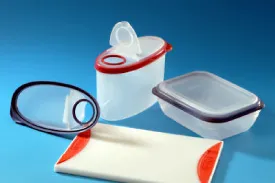
- Consumer goods kitchenware grips and soft touch, container lids, baster bulbs
- Plumbing seals, faucet seals
- Furniture caster wheels, bumper strips
- Sporting goods and toys covers, seals, bladders, treads, grips, pistol grips, bow grips, fishing rods and poles grips
EPDM/PP TPV-kitchenware tray-container lids |
Injection molding is the process of choice for virtually any part with three-dimensional geometry and which requires flexibility, resiliency, rebound, recovery, seal retention, friction, impact absorption, high abrasion resistance, flex fatigue, low temperature impact resistance or easy deformability. All industries have components that may have traditionally been made of thermoset rubber to accomplish these functions that are now likely candidates to be molded from TPEs. Many new components benefit from integrating multiple components into a single part, or multiple shot part, designed by incorporating a TPE to simplify assembly and to reduce total assembled system costs.
Conclusion
A wide variety of TPEs are available that can be injection molded and provide the range of properties to meet the needs of a vast number applications. The TPEs generally injection mold well and can be incorporated readily into part designs. The injection molding process and tool design for TPEs is quite similar to that for thermoplastics in general. TPEs could be materials of choice in most applications requiring flexibility, friction, sealing or impact absorption, and they should be seriously considered in others where part consolidation is beneficial and some of these functions are required in the system.
TPE, Injection Molding, TPV, SBS, SBC, TPO, COPE, COPA, TPU, Melt, Shrinkage, Molds, Tooling, Applications, Process conditions.